My phone began buzzing sporadically the night of April 29 with several texts sharing the news that Chicago Cubs’ Craig Counsell had toasted his 900th career managerial victory in San Diego with Chicago’s infamous spirit, Jeppson’s Malört.
How about that? Malört, the pungent drink once confined to the most infamous dives, had now surfaced at a Major League Baseball game. Sure, it was at a Cubs game, where the staff might already be familiar with its bouquet, but is this yet another sign that Malört has jumped the shark? Now, I’ll pick my words carefully as a White Sox fan who will be accused of being bitter, even though I’ve sampled plenty of Malört over the years. Malört was an underdog, and despite the Lovable Loser propaganda manufactured from the Friendly Confines, nothing spells underdog like the Sox, an underdog team in its own hometown. Malört was once the drink for those dark horses, but the tides have changed.
As an aside, I breathe a sigh of relief that no one at Ravenous will question the use of the word “infamous.” A long lineage of editors, no one who’s actually from Chicago, have poked and probed as to whether “infamous” was the proper word for Malört. “Don’t you mean famous?” they would question.
If there was ever a more accurate word describing Jeppson’s Malört than “infamous,” no one has invented it yet. There was a time few would admit they would enjoy the beverage. Judgments were harsh. Establishments with cocktail menus or those that employed mixologists would not carry the liquor. My friend, Keith, a grizzled former Chicago police officer, would tell me about times he spent at a bar in Chicago’s Ukrainian Village, helping out one of the barkeeps in the neighborhood in the 1970s. Malört was not popular, and cases would accumulate. He and the barkeep would challenge each other to Pong, one of the first arcade video games. The loser would have to chug a shot. That helped deplete the supply, making it easier to carry boxes down to the basement for storage.
Half a century later, and Malört is nearly everywhere. CH Distillery is the Chicago company that owns the Jeppson’s Malört brand, and I met CH founder Tremaine Atkinson in 2016 at the James Beard Awards in Chicago. We sipped glasses of red wine that night, not knowing we shared a love for this divisive yellowish elixir. CH purchased Jeppson’s two years later, and we’ve kept in touch through the years. When a friend with celiac disease visited Chicago a few years ago, and we were at a bar, Atkinson quickly texted me back and assured me that Malört was gluten-free and safe for my friend’s consumption.
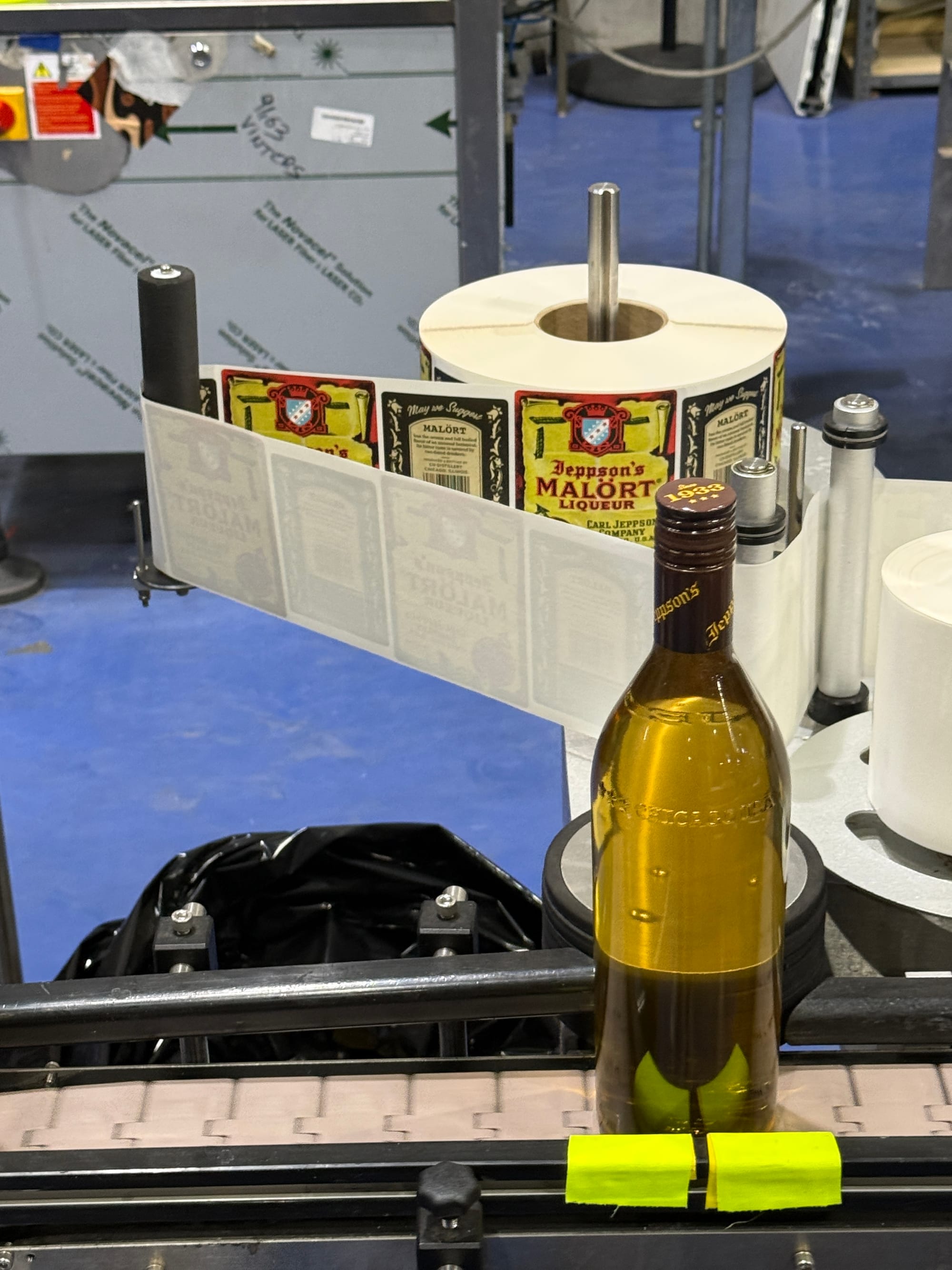
I caught up with Atkinson last month and took a tour of the distillery, seeing where the magic was manufactured. We recalled our first meeting. Chefs around the country converge in Chicago every June for the Beards, and they consume their share of Malört. It’s a “when in Rome” moment. I smuggled a few bottles into the Beard Awards in 2019 (this was an Ocean’s Eleven-like operation). I managed to introduce the liquor to chefs Esther Choi and Rodney Scott and kept in touch with both. They don’t teach the Malört trick in journalism school.
However impactful Malört is in forging friendships, the bottle can be destructive. Atkinson’s memory is foggy as he describes a scene from 2018. He was serving drinks at the Beards gala in partnership with Nielsen-Massey, the makers of vanilla extracts and pastes. Like at a wedding reception, the bars close during the awards presentations (Atkinson notes the show can sometimes drag). That’s when the controversy began.
“All these chef dudes start coming over because they see the Malört sign,” Atkinson says. “‘Can I have a shot of Malört?’ Yeah of course!”
Breaking the rules had consequences, and even though he made friends within the chef community that night, Atkinson recalls that Beard officials were unhappy he was serving alcohol to the audience, and they told him in no uncertain terms. Atkinson admits that he barked back, angry that the Beard Foundation’s heavy New York contingent did not appreciate what Malört is to Chicago. Atkinson says CH Distillery and Malört have not been asked to return since then. “It was fun to be there,” Atkinson says. “I wish we hadn't gotten banned, because we should be there.”
Beard Foundation representatives tried to piece together what happened eight years ago, but noted the organization had gone through significant turnover. A representative confirms to Ravenous that CH Distillery worked with one of their sponsors at the gala (“We believe in 2018,” they say). The representative also says that the sponsor participated in the Beard’s Taste America series in 2021. This sparks hope: “Therefore, we have no internal record of declining to invite either party back and are open to working with CH Distillery as a sponsor in the future,” the Beard spokesperson adds.
“It was fun to be there,” Atkinson says. “I wish we hadn't gotten banned, because we should be there.”
America’s thirst for alcohol has changed in recent years. Private equity and celebrities have put a stranglehold on the industry. CH also makes vodka and bourbon, but has focused much of its effort on Malört as companies like Tito’s and Diageo dominate. That focus catalyzed Malört’s resurgence. A pivot point may have been when Chicago’s Violet Hour, the highly influential haute cocktail bar that closed in 2025, started stocking its bar with bottles after it opened in 2007. A copycat liquor, from Chicago’s Letherbee Distillers, debuted in 2013 and eventually changed its name from Malört to Besk, after criticism. Dives from Pilsen to Bucktown poured shot after shot to hipsters while the sounds of bands like the Strokes and the Killers played on their non-Internet-enabled jukeboxes. This coincided with the hipster obsession with the blue-collar life — from trucker hats to PBR. A popular bar special, the Chicago Handshake — a shot of Malört and an Old Style tallboy — began emerging. When Atkinson bought the brand in 2018, he tried to market the drink differently, even buying advertising inside Wrigley Field that appeared on the outfield video screens. It’s become a lucrative business with T-shirts, ice cream, and flavored Malört — from candy cane to a cicada infusion.
Meanwhile, other nearby markets, like Milwaukee, began seeing bottles at their favorite bars. That makeover has continued as the New York Times ran a story in 2024 with a Chicago-washed headline, declaring Malört had more of a regional adoration and dubbing it an “Unexpected Midwest Princess.” The Malört website will now even ship bottles to select states, giving customers genuine bootlegger energy straight from the city that continued to clandestinely produce booze during Prohibition. Some Chicagoans, including those in Chicago’s Black communities, fume that Malört wasn’t a thing for them growing up, but the drink didn’t suddenly sprout up. The ‘20s and ‘30s were when Malört first emerged, mostly in bars around West Town. The geography explains Malört’s lack of popularity in many of Chicago’s Black communities nestled on the South and West sides. Perhaps they’re lucky that they’ve escaped Malört’s taste and marketing.
Wherever two-fisted drinkers may find themselves, a trip to the distillery proves joyful. Our delightfully geeky conversations centered around topics like wormwood, the same active ingredient in absinthe. It’s what gives Malört its charm, forming the spirit’s base. In fact, Malört is Swedish for “wormwood.” Atkinson says CH is one of the largest buyers of wormwood in the world, and that they’ve scrambled in recent years in searching for a reliable supplier. They’ve tried vendors in Ukraine, Kosovo, Bulgaria, and even in the States. A Swiss supplier stopped working with CH after the Food and Drug Administration sent them a letter saying that American inspectors would need to visit the facility if they wanted to continue their import business, Atkinson says. But don’t fret, CH has found a German company that will hydroponically grow all the wormwood they require. The different wormwood can yield different levels of floral and herbal notes, leading to a different taste. Atkinson explains that distillers can still strive for consistency through different extraction times.
Perhaps the relationship with the Beards can be reconciled, but Malört doesn’t need the validation. Beyond the factory, the business of Malört is a well-oiled machine; a fake billboard even appeared in The Bear. And even if the Cubs are toasting with the spirit, the operation often feels like it's run by former White Sox owner Bill Veeck Jr., the man who famously claimed to have planted the ivy at Wrigley Field, and made setting off fireworks after home runs common with the invention of the exploding scoreboard. Veeck never met a gimmick he didn’t like. Malört fans certainly don’t fear the next publicity stunt around the corner. At this point, Malört may just bring out an actual shark.