One thing Chicago shares with Savannah is a reverence for Casimir Pulaski, the Polish-born Revolutionary War hero who died in 1779 in a battle along the Savannah River. The city has memorialized Pulaski at a few locations. Meanwhile, Chicago, the home to one of the world’s largest Polish communities, observes the first Monday in March as Pulaski Day, keeping schools and city offices closed.
The closest I’d ever been to Savannah, Georgia, was in 2000 in college, where I covered the South Carolina Republican presidential primary. By special arrangement, a few of us found a place aboard Sen. John McCain’s tour bus, which his supporters called the “Straight Talk Express.” I never got to visit Savannah’s restaurants until two weeks ago.
In today’s newsletter: A hot and humid family trip to Savannah turns into a tasty reunion.
Plus, Caper drops its long-awaited piece on the state of our former employer, and protestors converge on a Michelin-starred restaurant in Chicago over foie gras. But this isn't garden-variety animal-rights activism: Restaurant ownership says they’re being targeted due to anti-Semitism.
Despite these high temps over the last week, Chicago is in the middle of prime patio season. Chef Andrew Brochu explained the outdoor dining season in Savannah as the opposite of Chicago’s. In the Midwest, June through September bring sunshine and help folks forget about the harsh winters. In the South, it feels like a swamp with mosquitoes and oppressive heat forcing folks indoors into the shelter of air conditioning.
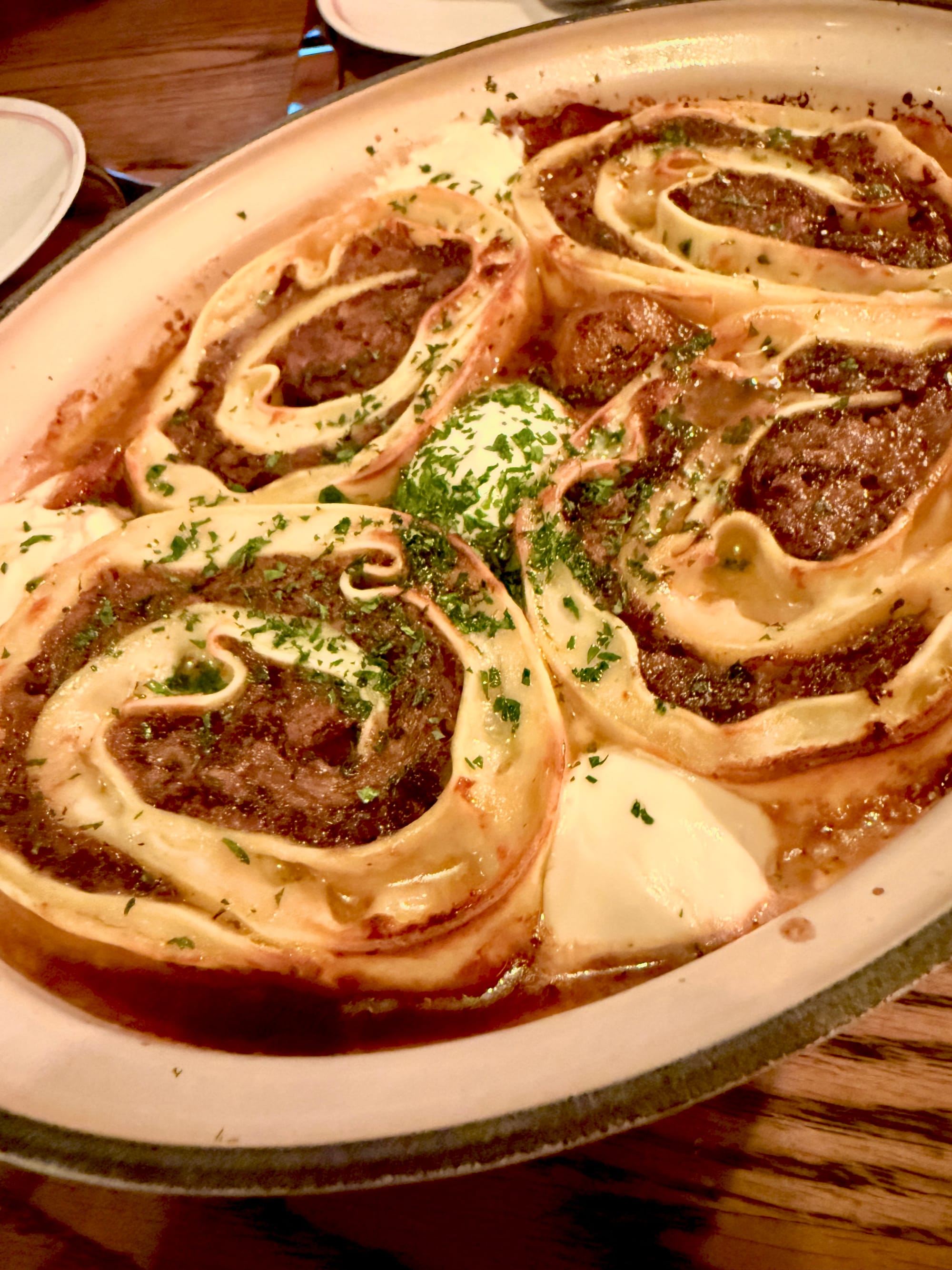
My Savannah trip included nachos made with pulled pork and a Cheerwine barbecue sauce at The Olde Pink House, the most delicious bread and natural wines from the ultra-chic Late Air, and a jalapeño waffle from the friendly Goose Feathers Cafe. Then there was a French onion smash burger from a train car turned restaurant called Strange Bird, mac and cheese from Beard-winning powerhouse The Grey, and a decadent beef bourguignon lasagna from newly opened Lester’s. Fried-green tomatoes were a must, and we tried them at fab Southern favorite B. Matthew’s Eatery. We were in Georgia, so we had to have peach ice cream from Leopold's, which has been around since 1919. We capped it all off with the fluffiest lemon pancakes from brunch haven Sunday Sunday.
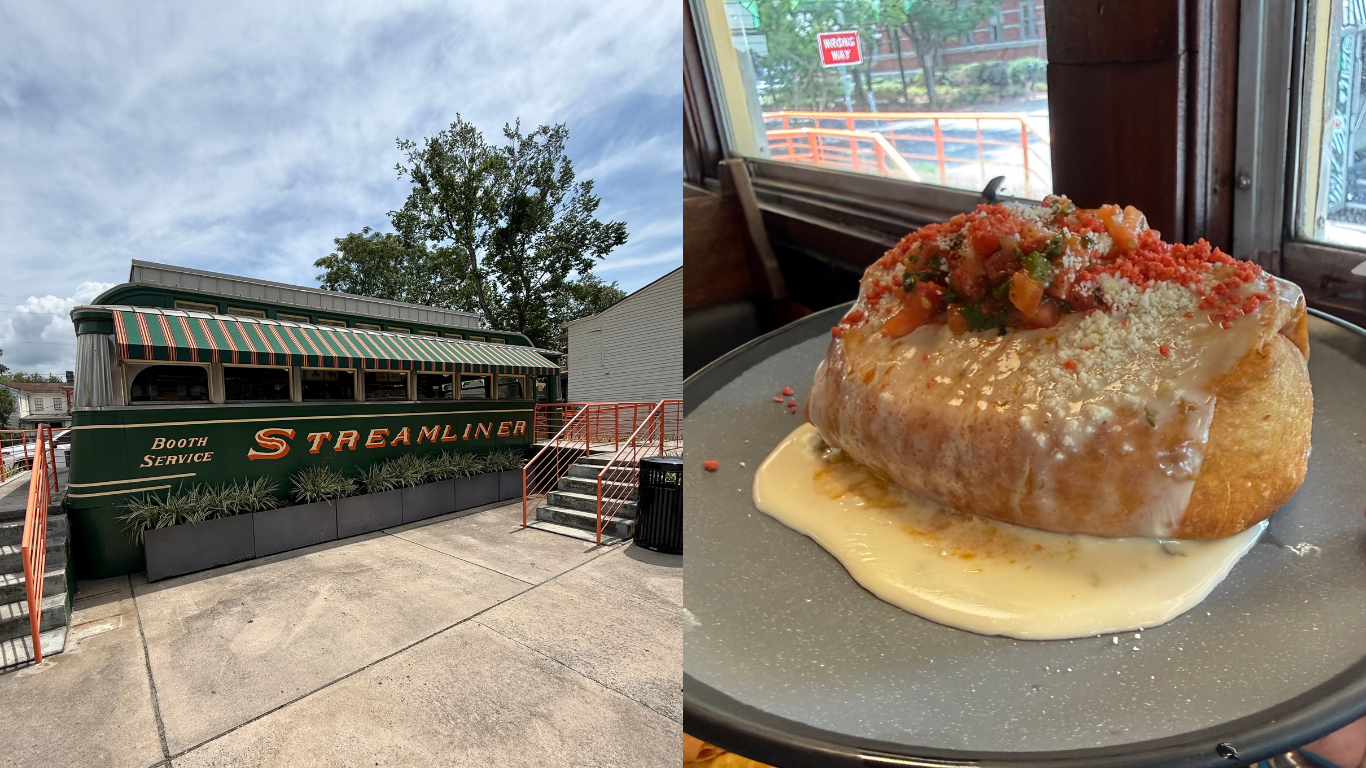
Chef Andrew Brochu is familiar with Chicago and Savannah, having spent his high school years in Atlanta before moving to Chicago, where he helped open Roister in 2016 for Grant Achatz’s Alinea Group. He signed a lease to open his own restaurant in 2019 in Chicago, before the pandemic struck. But COVID snarled his plans to open a West Town restaurant. In the meantime, Brochu scrambled and started to sling burgers and fried chicken sandwiches from a pop-up called Friend of the Devil. It operated from the Wicker Park location of beloved fast-food chain Devil Dawgs.
Instead of opening a Chicago restaurant, Brochu and his wife moved to Savannah, where Sophie was raised. In 2022, the couple opened Brochu’s Family Tradition inside a large space with a patio in the city’s Starland District. Both Brochus grew up in the South, but it took a while for locals to warm up to their restaurant. That apprehension has since evaporated, and securing weekend reservations is challenging, with diners bellying up to the bar and lning up for a table in the dining room. Most enjoy the restaurant’s signature item, an entree Chicagoans should be familiar with: Brochu’s “world famous” chicken.
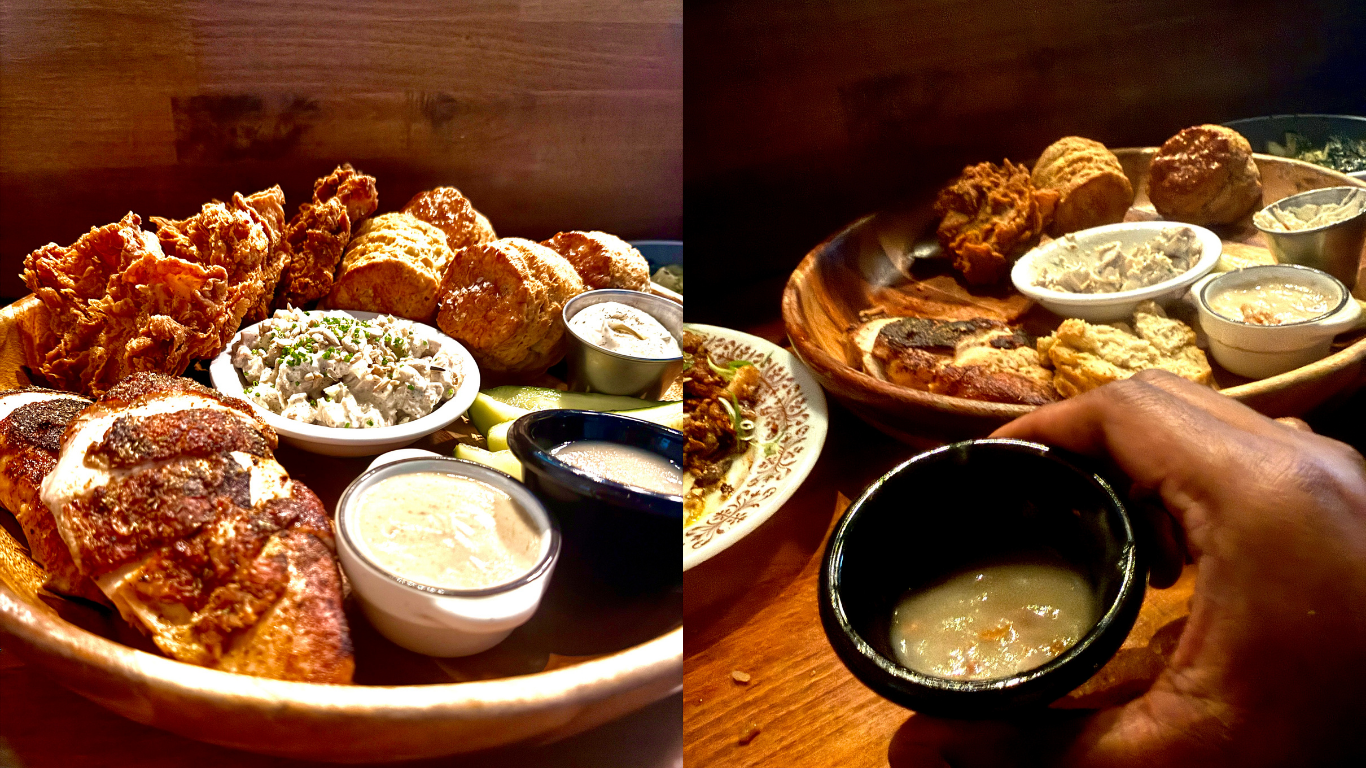
This is a facsimile of the chicken popularized at Roister. The kitchen preps poultry in three ways: fried, grilled, and in chicken salad. It’s served with biscuits, gravy, honey butter, and pickles. But I was most excited to say hello to an old friend, Brochu’s sunchoke hot sauce. The sauce comes in an opaque beige with a flavor profile akin to a mellow Frank’s Hot Sauce. We failed to fill a ramekin with the sauce and bring this wonderful condiment back to its ancestral homeland.
Another couple, executive chef Dave Baker and pastry chef Georgia Vinzant Baker, followed the Brochus from Chicago to Savannah. Dave Baker worked with Brochu at Roister and at Friend of the Devil. Georgia Vinzant Baker worked at Aya Pastry; Brochu’s bread program uses the now-shuttered Chicago bakery’s sourdough starter. Despite Aya Pastry’s spectacular demise, it’s nice that the bakery’s legacy continues in some way.
I ate dinner on Roister’s debut night in April 2016; this was Alinea Group’s most casual restaurant. Management, famously, asked customers for submissions to its playlist before opening, wanting a raucous dining experience with loud music. After dinner, I recall a conversation with Alinea co-founder Nick Kokonas. Kokonas was super enthusiastic about the potato wedges (labeled Yukon Fries on the menu). But he was also proud to tout the supplier of Roister’s chicken. Green Circle Chickens are fed scraps from fancy restaurants, including Per Se and Gramercy Tavern. Kokonas pointed at one of Roister’s neighbors, the Chicago location of Gus’s Fried Chicken, and noted that Roister’s wasn’t using the same supplier as the Memphis-based chain.
Looking around Brochu’s Savannah restaurant, you’ll see high ceilings and plenty of space. One of the bathrooms is lined with adorable wallpaper featuring an armada of fried chicken pieces and biscuits with slender human legs sticking out, all wearing a pair of blue high heels. The bar counter is wide enough to accommodate a full meal, not just a few small plates. It’s difficult to imagine a restaurant this large succeeding in Chicago due to the higher cost of living and high rents. However, it’s about perspective. I spoke with some local food writers, including one who took issue with food costs at Brochu’s. Brochu’s does not use the same Michelin-bred chicken supplier (though, with the tire guide recently agreeing to partner with food distributor Sysco, I’m not sure what to expect anymore).
I really wish restaurant reviews, whether found on social media or in print, would factor in costs and value, so I’ll do a little napkin math. Brochu’s chicken platter costs $63, and it’s a fun and filling meal full of accouterments that can feed two or three. A decade ago, when it opened, Roister charged $55 for its chicken platter. The rate of inflation has increased by nearly 40% during that timeframe, meaning the 2026 inflation-adjusted cost of the Roister’s chicken would be $22 more, or $77. Regardless, it beats paying $40 for only a half rotisserie chicken in New York.
Don't be a chicken, support independent food media by leaving us a tip.
🐦⬛ Bird Droppings
- Let’s get this out of the way. On Wednesday afternoon, our friends at Caper published a story that interested the five of us at Ravenous. We had been aware “How Eater Lost Its Bite” had been in the works for a few months. Caper’s staff asked us if we’d like to be quoted, and after much discussion, we declined. While we don’t want to be accused of sour grapes, we also want to carve our identities.
We’ve been honest with you about how we want to run a food culture publication, and the story Caper — shared on the platform Beehiiv — speaks for itself. At least that’s our current train of thought. As luck would have it, it’s my turn in the rotation to write the newsletter, and out of all five of us, I spent the most time at Eater, more than a decade. Perhaps there’s a time in the future where we can share our stories. I’d like to say hello to Vox Media or PMX’s legal team, or whatever party is charged with looking over our work. But more importantly, minutes after Caper’s publication, my phone started blowing up with texts from former colleagues. These are journalists who earned my trust after spending years collaborating. We laughed in our text threads. We all shared a hollowed-out feeling after finishing the story. In so many ways, it felt the same during that last summer at Eater.
The silver lining, at least for Wednesday, was that we were reunited, at least virtually. It reminded me of back in April when I listened to an episode of The Ringer, an NBA podcast. Co-host Howard Beck, an alum of The New York Times, reminisced about working for the Gray Lady’s sports department and how he still felt a real sense of belonging even 13 years after his departure from the paper. Key members of the paper’s staff keep alums informed so they can gather for retirements, milestone birthdays, and even funerals. That sense of community doesn’t assemble without perseverance or care. Or without being surrounded by special people. And that’s what we’re trying to do with Ravenous. Yes, there are folks who remain trying to fight the good fight, but that’s the past for us. I’m both focused and in awe of the folks in my life who are prospering on their own terms. - America is allegedly celebrating its 250th birthday this weekend — perhaps you’re celebrating with a flag cake. There are many feelings about a certain party held in D.C. Part of any culture, America’s included, is the food. The Washington Post visited the Great American State Fair and reviewed the food stalls, finding hot dogs, fried fare, food on a stick, pad Thai — even something disguised as Chicago-style pizza. There were no tacos or falafel. Because what is “American food?” Certainly nothing with roots from a shithole country. America’s immigrant groups have helped forge a culinary identity, but restaurants have struggled to define the genre. And if industry professionals aren’t finding success, politicians certainly don’t have a prayer. The New York Times took the time to provide a timeline of American food innovation. Bon Appétit uses the occasion to dive into the myriad histories of barbecue. At least the brands can agree that this is the time to try to cash in. Names like Portillo’s, Ring Pop, and McDonald’s have revealed special birthday items. Ain’t that the real America?
- Chicago is no stranger to controversy over foie gras, as in 2006, the city banned foie gras. Anthony Bourdain would mock the ordinance, and Doug Sohn of Hot Doug’s was fined $250 per day for challenging the ban before the city repealed the ordinance in 2008. Now, 18 years later, the topic still burns. Portland, Oregon, has approved its own ban, and since winter, Galit, a Michelin-starred restaurant in Chicago, has been the target of repeated protests from a group seeking the removal of foie gras from its menu. The Chicago Reader spoke with protesters about their motivations — they’ve held rallies outside the restaurant more than 20 times since November. Galit’s ownership, which includes Jewish American and Palestinian American owners, serves a menu inspired from all over the Middle Eastern diaspora. Restaurant ownership has argued that the protests are anti-Semitic in nature, pointing out that several Chicago restaurants serve foie gras, yet they’re the only ones targeted by protesters. Protesters from the Animal Rights Collective of Chicago told the Reader that’s not the case and that they focus on Galit due to the restaurant’s mention of core values on its website. Galit, which is located near DePaul University’s main campus, has been cautious in its messaging since the Israel-Hamas War started on October 7, 2023.
- In more frivolous news, we love hot dogs at Ravenous. Jaya wrote about them last week. But here’s more encased meat news: One of the co-owners of Chicago’s infamous Wieners Circle (you know, the hot dog stand where workers will berate loser customers) is running for mayor. Attorney Matt Brewer joins a crowded field challenging incumbent Brandon Johnson.
Raven Nickname of the Week
Want to have your nickname featured here? You have to become a Regular. And if you want to know the raven's real name, become a Big Spender today.
This week's nickname comes to you from Linda, who feels the raven in her soul and knows how important it is to spill the lore.
"Peaches [which is also] is my nickname. Story of my nickname: it is also my Burning Man name and Black Rock Ranger handle on the radio. Way back in time, like 1994, my practice assistant (I am a lawyer) commented that while my opposing counsel thought I was a bitch, she thought I was a peach. I even got a stamp of a peach to put on documents that I approved. Fast forward to 2004 at Burning Man, and I was being pressed after training to choose a radio handle/name and I thought back and said Peaches, and I grew into it as a co-identity."