

May 29, 2026, 12:57 p.m. ET: This piece was originally published as a newsletter on Sunday, May 24. It has been updated throughout with additional comments from Attaboy co-owner Sam Ross, and union member Hannah Chouinard.
This was originally going to be a very different email.
In April, workers at the New York location of Attaboy, a bar World’s 50 Best described as a “mecca for speakeasy fans,” announced they were forming an independent union, Attaboy Local 134. “We love this bar, and we want it to be the best it can be — for us, and for you all,” the union wrote on Instagram about its mission. A month after the announcement, labor supporters won their right to establish a union with the National Labor Relations Board, thanks to a 13-8 vote.
While the bar’s owners, Sam Ross and Michael McIlroy, told the New York Times they would bargain in good faith, the two sides have yet to set an initial bargaining date. Ross also ominously said, when asked about the business, “we cannot predict the future.” Attaboy Local 134 is organizing at a time when restaurants and bars have faced brutal union busting and even retaliatory closures, like at Brooklyn pizzeria Barboncino and at unionized Starbucks locations. Historically, restaurants and bars met difficulty in unionizing. They tend to be smaller workplaces with high turnover (often by management design), making it hard to keep a group together long enough to fight for better conditions.
I initially spoke to union member and longtime food service worker Hannah Chouinard on May 15, about Attaboy Local 134’s goals as they prepared to bargain, and the belief that both workers and management shared a commitment to Attaboy’s success. But on the night of Friday, May 22, Chouinard texted me that things had escalated. Instead of bargaining in good faith, Attaboy management had fired Chris Hughes, a long tenured worker and outspoken union organizer, in what the union alleges is retaliation for his union involvement. They also allegedly announced new, punitive policies. Now, the union is seeking remedy through the NLRB.
Today’s newsletter features: Exclusive conversations with Chouinard and bartender Samaiyah Patrick about management’s union busting efforts, forming Attaboy Local 134, and reports about them have gotten wrong so far.
Plus, new stories this week on Ravenous about Malört’s tricky relationship with the James Beard Awards gala, and a dispatch on soft serve from around the country — is it a recession indicator?

From the moment Attaboy workers announced their intent to form a union in April, there were signs that Attaboy management wanted to quell union activity. “We started receiving all these weird ‘fact sheets’ about the union from the employers,” Hannah Chouinard, an Attaboy union member, says. “It’s normal ‘union avoidance’ stuff,” like claiming the union is a third party that comes between employees and management, or that unions don’t make sense for a particular industry. “Some of them aren't even ridiculous things; they just say things that are normal and reasonable, but in such a way as to make them sound really nefarious,” she says. “Like, ‘If you have a union you might have to pay dues.’ Well, yeah.”
Luckily, Attaboy Local 134 was in touch with others who had been in a similar position. They spoke to workers at Death & Co., who launched a union drive in 2023, though the union lost the NLRB election. Chouinard notes that Attaboy retained the same lawyers Death & Co.’s management had, and the same language in their union-busting materials. Which was also less effective. While Death & Co. unionized with Workers United, an SEIU affiliate that notably represents Starbucks workers, Attaboy Local 134 is an independent union, meaning there is no larger union body workers become associated with. Chouinard says they chose this route because they believe larger unions have a hard time addressing the nuances of food service work at small, independent bars and restaurants. But it also means “[management] can’t point to some UAW rep and say those guys are just trying to steal your money,” Chouinard says of the union avoidance tactics. “The people who are talking about it are all employees equally, and something that benefits one of us is going to benefit everybody.”
Often, the transient nature of food service work is an impediment to labor organizing. But the experience that bartenders are expected to have at Attaboy means there is less turnover than at other bars. “There are people who have been there for eight, 10, 13 years. That has been mostly a blessing because people feel pretty attached to their workplace in this case,” says Chouinard. However, she says sometimes it’s been a challenge to convince workers change is indeed possible. She speaks of a prevalent mentality in the service industry that if you don’t like where you work, you should just find another job. But “the things that we want to change about this are ubiquitous across the industry. There is no escaping not getting PTO, not getting health insurance that is affordable, and not having air conditioning in the kitchen.”
You’ll notice that Chouinard does not mention higher wages. She says something that other media outlets have misrepresented about Attaboy Local 134 is that their fight is primarily about pay. “Many of us feel well compensated,” she adds, and while they are asking for higher wages for back of house workers, most of their asks are around restructuring management and decision making processes, workplace safety, and making sure no one has to work sick. “A lot of the things that we're asking for don't actually cost the company anything, and the things that could conceivably cost money are not going to put them out of business,” says Chouinard. And the one thing that could potentially be an expense, more affordable health insurance than the company already provides, is something union members have actively been researching for ways to make it cheaper both for them and for management. “Making this easy for [ownership] is one of our priorities, and I don’t think a lot of people understand that,” Chouinard says. Including, it seems, management.
Samaiyah Patrick, who has been working at Attaboy for a year and a half, notes that management wasn’t thrilled about the union election on May 5. “One of the owners stormed out during the count of the vote,” she says, adding management wasn’t “prepared for the possibility of losing.” But since then, she says both the union and management have been taking a break, with the union working on demands and strategy, waiting for management to set a bargaining date.
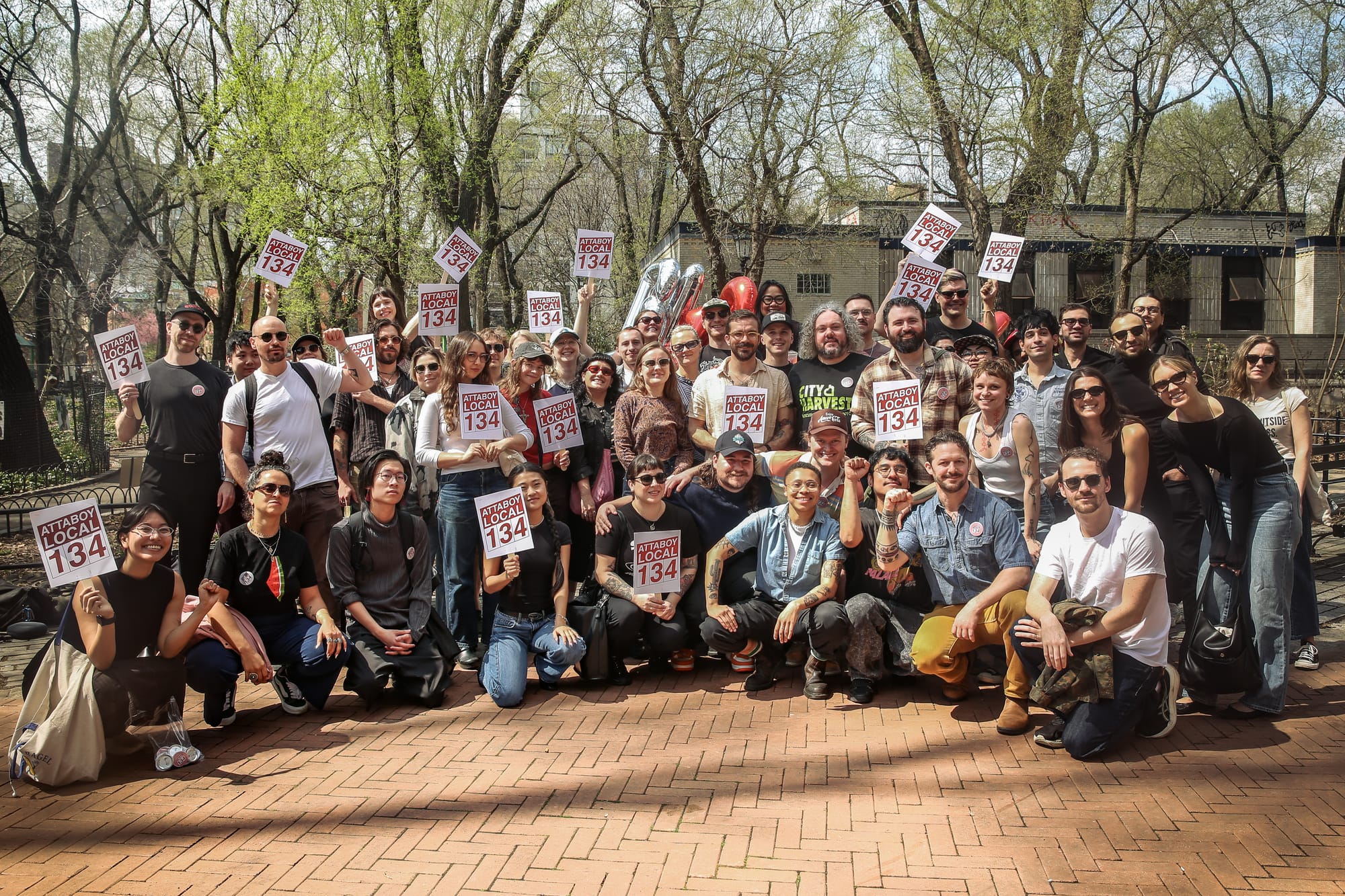
This week, the tone quickly changed. Instead of a bargaining date, Attaboy Local 134 says it received word on May 18, via a message in work Slack from the General Manager, that Attaboy was making some changes to both the working conditions, and the staff, at Attaboy. Both of which the union says violates the National Labor Relations Act.
On that day, workers say they were informed of a new policy revoking staff drinking privileges. Attaboy Local 134 says management argues this is to comply with New York State law, but so far has not been able to cite any specific law when asked. In most workplaces, drinking on the job is understandably frowned upon, but if you’ve ever done a shot with a bartender at the end of the night, you know that at bars this is different. “It's always been that if you can do your job, it doesn't matter,” Patrick says of the occasional shot with customers or other staffers at the end of a shift.
While researching New York’s Alcoholic Beverage Control laws, I came across employment lawyers Borelli & Associates, who say that while there is no specific law barring bartenders from consuming alcohol on the job, bartenders could face legal ramifications if their own intoxication leads them to overserve customers, or contribute to a disorderly environment. “If you serve someone and they get hurt, you and the bar might be liable, which is 100% true, but it doesn't say anything about whether or not the bartender is drunk,” says Patrick. And while it might be a fine enough policy to have, according to the NLRB, bargaining in good faith requires that management not “make changes in wages, hours, working conditions, or other mandatory subjects of bargaining before negotiating with the union to agreement or overall impasse.” Patrick and the rest of the union see this change as a violation of labor law.
Workers say management also changed the way workers conduct R&D. Until now, it was the company culture that when things were slow, bartenders would experiment with new drinks, both for the bar and to add to Attaboy’s Bartender’s Choice app. However, workers were told this week that any drink development now had to happen outside of work hours. Though they will be paid for the work, Patrick says this is another unilateral change to work processes that constitutes an unfair labor practice.
But the biggest shock was the firing of bartender Chris Hughes. Per the union, Hughes had worked at Attaboy for eight years, and “was never disciplined prior to union announcement.” Hughes has been a prominent union organizer, regularly speaking to the press about the issues Attaboy workers face. Attaboy Local 134 claims he was fired in retaliation for his union involvement.
Management’s justification for Hughes’ firing to the union was twofold: stealing, and allowing someone else to make drinks for customers unsupervised. Hughes allegedly took club soda, specifically cans of Canada Dry, from the bar, something Patrick and Chouinard say has long been considered a job perk — they have freely partaken in the bar’s club soda in front of management with no issue. Management also claims Hughes received a warning for allowing a host and a barback to make drinks for customers, which Patrick says is standard training for drink service, and that one staff member in question “literally has [created] drinks approved for service.” For the union, this all reads as retaliatory, with management suddenly penalizing long-accepted behavior without bargaining changes or properly communicating expectations with staff.
For Attaboy, these actions have always been against the rules. When reached on May 28, Attaboy co-owner Sam Ross says Hughes did have written and verbal warnings before the union was formed, and that the firing was justified. He says customers had sent back the drinks made by unsupervised staff, threatening the bar’s reputation. Ross also maintains Hughes’ behavior counts as theft. “You can drink club soda on shift, absolutely. No policy change has been made regarding that. You absolutely cannot load up your bag with multiple beverages to take home with you at the end of your shift,” he wrote in an email to Ravenous. He also shared surveillance video from the bar. The footage, which Ravenous reviewed, shows a man with a tote bag walk behind the bar, open a top-loading fridge, and take out four cans — though it’s unclear what kind of beverages they are — and putting them into the bag.
Chouinard says she has also seen the tape, and reiterates that the issue is not how many cans were taken (Canada Dry club soda retails for about $1.33 a 12-ounce can), but that behavior that wasn’t an issue before seems, to the union, to be punishable now. “Unless the owners of Attaboy fired him for reasons that were not cited in his termination letter, their justifications are unfounded,” she says. “Union members are not interested in getting into a public argument about this… we know what happened, and so do they.”
In response, Attaboy Local 134 is filing two unfair labor practice charges with the NLRB, and demanding Hughes’ immediate reinstatement. Not only does the board prohibit changing working conditions during bargaining, it also states that unionized workers “can't be fired, disciplined, demoted, or penalized in any way” for engaging in union activity.
The union is now escalating things on its own. It staged a rally over Memorial Day weekend outside the bar on the evening of Saturday, May 23, to call for Hughes’ reinstatement and for an end to union busting practices, and to continue to raise awareness of the union. “I don't think most patrons necessarily know what's going on. They just hear Attaboy is on the list of best cocktail bars,” says Patrick. The hope is the more public support they have, the more likely management will be to speak to the union directly, instead of engaging in these union busting tactics.
The day after the rally, on Sunday, May 24, Ross says Attaboy ownership sent a Slack message to workers, saying that management has been unsure of which workers speak on behalf of the union, and that “the best way to eliminate any uncertainty is to begin the bargaining process.” Management suggested dates in early June.
A workers go through the bargaining process, Chouinard wants customers to realize the issues workers face affect their experience: “I believe that service will be better if people are not scared or unhappy.” Service is better if workers aren’t forced to work sick, if they can take breaks, and if they feel empowered to make decisions based on their expertise. Until Hughes’ firing, Chouniard said morale had been high. Now, seeing management more intent on punitive action than good-faith bargaining, the union’s tactics must change. But the goal is the same. “Who wants to get the government involved in matters that involve less than 30 people, you know?” says Patrick. “It’s not ideal, but we’ve tried every other avenue. This is the best way for all of us to get what we deserve.”
As of Friday, May 29, a bargaining date has yet to be scheduled.
Like what you're reading? Sign up for a paid subscription to support our reporting!
New Stories This Week
 Ashok Selvam
 Frances Dumlao
🐦⬛ Bird Droppings
- Mahira Rivers interviewed me for her amazing newsletter, Sweet City. We talk about the state of food media, and a really good babka I had.
- ICYMI, Ashok was on WBEZ talking about how the COVID-19 pandemic is still shaping how we eat out.
- We’re definitely seeing more restaurants start up Mahjong nights, so loved this piece in Coyote about the different versions of the game, and whether the Asian diaspora and other fans of the game can find common ground.
- Schlitz beer is no more, and I really don’t know what New Orleans’ Snake and Jake’s Christmas Club Lounge is going to do without it.
Raven Nickname Of The Week
Want to give our raven a silly little name? You have to become a Regular. Do you want to know the raven's real name? Only Big Spenders have access to that truth.
This week’s nickname was submitted by Michelle, a Regular with a cinematic suggestion.
“Because it seems like y'inz want your work to capture the rambunctious joy, detailed expertise, and enthusiastic nonsense behind our food culture, my name for the Raven comes from a movie that captured its own food moment in the same spirit. I'm calling the bird Tampopo for long, and Poe for short (you can shorten a nickname, right?).”
You absolutely can, Michelle.


