I had never really considered Skirt Steak before. The restaurant, which serves a prix fixe of salad, bottomless fries, and the titular cut of steak, sits at the corner of 29th Street and 6th Avenue in Manhattan, right on the walk from the subway to where I take dance classes. I had passed it dozens of times, ambiently noticing a half-full dining room. Then suddenly, a line. Where the week before there was nothing, now dozens of people stretched halfway down the block, nearly blocking the entrance to another restaurant.
In 2022, Ryan Sutton referred to Skirt Steak as a “TikTok Steakhouse,” serving a $28 menu to around 500 diners a day, after a TikTok review had gone viral (it’s $48 now, an astounding 71% jump in just four years). That, combined with the restaurant’s no-reservation policy, meant there was a consistent wait. At least, for a while. About a month after the line appeared, the queue vanished just as suddenly. You could walk in right now and get the same meal diners spent hours waiting for just a few years ago.
Despite witnessing the Cronut phenomenon firsthand, I have never wrapped my head around this behavior. Perhaps it’s a privilege of living in a big city like New York — there is never just one place to get a good pastry or steak dinner, and I’ve maintained that there is no slice of pizza so exponentially better than one a few blocks away that it warrants an hour wait. I will not succumb to the big dumb line.
The ebbs and flows of these crowds often have unpredictable and negative consequences for the restaurants behind them, whether that’s running out of food and risking pissing off new customers, or annoying neighbors when crowds get too big to manage. And objectively it is just kind of miserable to stand around for 45 minutes waiting for froyo. The specter of the Soviet bread line is a singular driver of reactionary right-wing politics, the idea of waiting for food somehow seen as antithetical to American freedom. Yet so many people are willing to spend their time this way, even if waiting a few weeks might mean no line, or even if there are comparable options nearby and readily available. We can’t wait to wait.
"Now anything can have a freaking line."
It should be noted that lines existed before social media, lest anyone wants to rest this squarely on the shoulders of vertical video. In 1989, The New Yorker profiled Al Yeganeh of Manhattan’s Soup Kitchen International, noting his soups “are so popular that a wait of half an hour at the lunchtime peak is not uncommon,” and the strict rules he put in place to manage service. Yeganeh would go on to be fictionalized and immortalized as the “Soup Nazi” on Seinfeld. Shake Shack opened as a hot dog cart in 2001, six years before the release of the iPhone. The In-N-Out drive-thru line has nothing to do with TikTok.
“People would wait around for Magnolia Bakery, Lucali, Katz’s Deli, these big names that, you know, my aunt Marcia in Illinois knows have a line,” says Luke Fortney, a food writer whose series with The New York Times, “Luke Hates Lines,” shows New Yorkers where to get great food without a wait. [Disclosure: Fortney is a former colleague.] He recalls the first line he ever waited on, at Brooklyn’s Lucali, over eight years ago, where he realized one of his waiting buddies was a Taskrabbit hired to save the spot. Sometimes these places had lines because they served something novel, like the Cronut. Or they were seen as having the best version of something readily available elsewhere, like Magnolia Bakery at a time when the city was littered with Crumbs. Or they were just so small that a line couldn’t help but form. But the lines tended to be constant once they appeared, and only at a few places.
What social media did was spread the attention around even more, creating a boom and bust of food trends and popularity that could hit almost anyone at any time. “Now anything can have a freaking line,” says Fortney. There are lines for bagels when better bagels can be had down the street, for pastries that look good on social media but taste mid, and for great restaurants that were great a week before and will still be the week after.
While the complaints about lines tend to center the customer experience, they are also frustrating for the chefs and workers behind them. When building Del Sur Bakery, a Filipino Midwestern pastry shop with treats like a turon Danish and an adobo brownie in Chicago, owner and baker Justin Lerias emphasized that he wanted it to be a neighborhood spot. “I made it very clear from the get-go before we even opened that I did not want a line,” he says. Well, the best-laid plans etc., because Del Sur has had a line since it opened in March 2025.
While you’d think attention and constant customers would be a boon, the problem is the line economy often exists in direct opposition to the idea of hospitality. When there is a line, the priority becomes making the line shorter, which can correlate to faster, less-personal service. Lerias says he wanted his baristas and servers to prioritize intentionality in their work, not efficiency. “Especially when handling pastries that are culturally significant to me, we really establish a dialogue to educate our customers. I think seeing a line out the door down the block makes it harder to achieve that,” he says. Del Sur has attempted to mitigate the line experience by handing out water and sometimes snacks. The bakery temporarily closed in June to expand into the space next door to increase seating and production. Lerias hopes that will reduce lines when they reopen.
There are still places where the lines show up and never leave. But if you want food from a popular place, the reality is you don’t actually have to wait if you don’t want to. Lucas Gordon, an engineer, recalls living in Manhattan’s West Village and the constant gamble to go to his favorite breakfast spot, Breakfast by Salt’s Cure. “It was just impossible to make a plan with a friend to say hey, do you wanna go to Salt’s Cure because no one wants to go stand in line for an hour,” he says. “I'm too hungry to wait an hour for brunch.” In college, he built a website to monitor the lines at the bars near campus, so earlier this year he revamped that idea to make Damnlines, a website that pays tenants to install IP cameras outside their homes to monitor popular lines in New York (RIP Shake Shack Cam you would have loved Damnlines).
Though Damnlines has an admittedly small sample size, Gordon says he’s observed that even the most popular places’ lines aren’t constant. He notes that L’Industrie Pizza is tough on the weekends, but at 5 p.m. on a weekday you barely have to wait, and that at Bánh An Em, a New York Times Critics Pick, there’s only a 15-minute wait around 8:30, rather than a 45-minute wait two hours before. Some of this of course is about when people want or have the time to eat. But at Salt Hank’s, “there's a line an hour long at 11 a.m. and I never understood this because if you just wait till 2 p.m. there's no line and it's still lunchtime,” says Gordon.
This suggests, on some level, that beating the line isn’t the point. We want to wait in line.
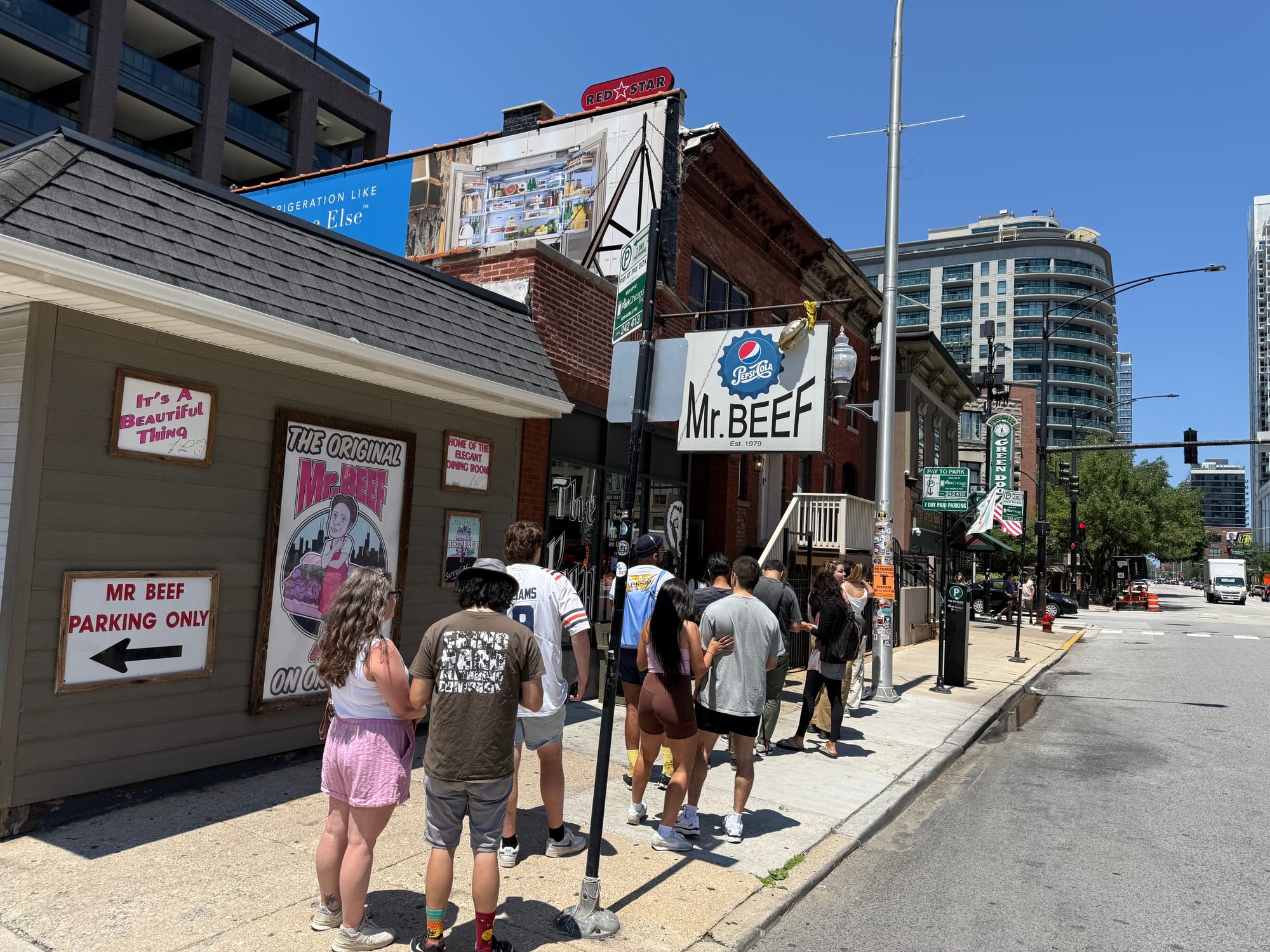
There is one question everyone who has waited in a long food line has at some point asked themselves: Was it worth it? “Almost immediately it becomes a question of is this as good as I heard? Is it worth the time I waited?” says Fortney. It’s not like this question isn’t present at every meal — the more expensive the dinner or harder to get the reservation, the more one might think about whether the juice was worth the squeeze. But at a restaurant, there is ambiance and service and often cocktails to distract you from the pure monetary transaction. Lines usually arise around cheaper pleasures than a full dinner, but a line has no atmosphere, only the feeling of the clock ticking by, leaving just you and a $12 croissant, and the nagging feeling that your time might have been wasted.
“It's almost never going to be worth it, but nobody cares,” says Dr. David Bosch, a professor at New York University in the psychology department, who studies cognition and decisionmaking. He explains that every decision, from choosing to get out of bed in the morning to figuring out where you want to go to lunch, is driven by different motivations and goals. Some of these goals are explicit to us, like wanting to sate hunger, or to eat without spending a lot of money. But others are more abstract, long term, and sometimes subconscious. He gives the example of meeting up with a friend from out of town and needing to choose a restaurant. You might want to meet explicit goals like finding a place in a convenient location. But “one high-level goal could be just enjoying my friend's company, and finding a place where they won't kick us out because we're going to sit and talk. Or it might be to impress my friend,” says Bosch, and choosing a place that seems extravagant or cool. These have nothing to do with base issues of convenience or cost.
Fortney says he sees lines, especially those that rise and fall according to TikTok’s whims, as part of a greater trend of social media encouraging FOMO, and ruining everyone’s patience. “You see something on your phone, on these apps, and you want it now,” he says, even if you’d have the same experience, or an even better one, once the hype died down. It’s as simple as wanting to be like your friends, or at least like the people you’ve formed a parasocial relationship with online. He compares it to the boom in tourism to Japan, which has led to detrimental effects for both the country and tourists. “It would surely be more enjoyable to go in five years, but for some reason no one can wait.”
But there are some understandable psychological goals behind the lines. One is risk aversion, a growing concern when dining out has become prohibitively expensive. Gordon notes that especially for tourists, with a fixed number of meals in any city, a line denotes not necessarily quality, but at least consensus, the logic of “50,000 Elvis Fans Can’t Be Wrong.” The concha on the other side of the line may not be the best you’ve ever had, but it’ll almost certainly never be bad. A line seems like a fine price to pay for the guarantee.
When I said it was objectively miserable to stand in line for froyo, maybe I was wrong. Maybe it’s not that obvious that lines are frustrating. Fortney admits that a younger relative of his, when visiting New York, listed off multiple places with long lines that he wanted to visit, and wasn’t phased at all when warned of the wait. And when asked about the ubiquitous line at Austin, Texas’s Franklin Barbecue back in 2017, Aaron Franklin said it was a scene unto itself. “They want to hang out, make friends, and eat barbecue. And it filters out cranky people. Which actually helps us out,” he said. “You’re not gonna sit in line and then be annoyed at us by the time you get to the counter. It’s a really long time to wait, but the people who do wait really do have a good time.” The people who are there don’t just want the food at the end. They’re there for the experience of the line.
In The New York Times, Amy X. Wang ironically opines that lines are the last bastion of the ever-threatened “third space,” a place to gather with only the anticipation, and not the reality, of spending money. “Now that the town square is bygone, why not let a well-appointed chain frozen-yogurt store swoop in with some substitute feeling of community and belonging?” she writes. But Bosch unironically agrees, especially when it comes to those who spent their formative high school and college years experiencing the worst of COVID lockdowns. “If you were an adult when the pandemic hit, you just wanted things to go back to normal,” he says. But “normal” for that micro-generation was lonely, isolated, and precarious. “You want something different, and what is different from the pandemic years? In-person, real-life experience.” Two hours for barbecue is two hours to chat with your friends, or maybe meet a stranger with a shared willingness to stand in future lines with you. And while a meal at a restaurant is also a real-life experience, it also tends to be way more expensive than the pastry at the end of the wait.
Immediately I think to argue with this framing. A better experience could be had getting a pizza from a less-popular place and picnicking in a nearby park, or going on a walk, or cooking together. I feel the smugness take over me when Wang writes that instead of being a site of great social interactions, the line for froyo at Myka was mostly people looking at their phones. See? I want to shout, This isn’t about coming together in real life, it’s just blatant consumerism. WAKE UP, SHEEPLE.
But I admit, a line can be a social experience. Last year, a friend (a millennial even!) asked to celebrate his birthday with a pizza food crawl, and we waited for hours at multiple of the city’s hottest slice spots. Friends filtered in and out, we swapped bites of each other's slices, and overall a full day was had together for not much money. I’m still not sure if that’s the primary reason there are so many, but it does make the time fly. Maybe it’s a matter of perspective, of choosing the line rather than succumbing to it, of wanting something more than just the ability to post about what you got at the end. In the immortal words of Damnlines, “Time you enjoy wasting is not wasted time. But time spent in a line you could have skipped? That's just dumb.”
Tips go to keeping Ravenous up and running so we can bring you more great food and culture writing!