

On September 17, a group of food industry professionals presented the public with a menu. But this one wasn’t for small plates. The Seat The Table coalition, made up of hundreds of restaurant and worker associations, individual chefs and restaurant owners, and organizations like the James Beard Foundation and the Independent Restaurant Coalition, was joined by lawmakers to announce the Menu of Solutions.
The Menu of Solutions is a collection of immigration proposals that are already before Congress, including the Dream Act of 2025, the Farm Workforce Modernization Act, and S. 4814, which would extend temporary protected status for immigrants from Haiti. Seat The Table hopes this policy “menu” will create security and safety for immigrants across America by making it easier for immigrants to secure long-term work permits. The organization argues that this infrastructure would also bring down food prices, because it’s no secret that America’s food systems are heavily reliant on immigrant labor, whether that’s farm workers picking fruit, chefs working the line, or drivers delivering food.
“Continued inaction will deepen workforce shortages, put further pressure on food prices and destabilize families and communities across the country,” Seat The Table said in a press release. But there are already solutions present in this group of legislation. By reminding lawmakers of the plethora of legislative options that are already on the table, and encouraging them to back at least one, Seat The Table hopes to create a multi-pronged attack to reverse the effects the government’s immigration crackdown is having on communities, and on the economy.
The ongoing threat of ICE raids, deportations, and third-country removals looms over the food industry. Many immigrant and Brown restaurant workers are afraid to go to work when ICE patrols their city, and others have been forced to self-deport because they can’t afford a legal fight. Just this week, ICE shot a DoorDash driver in Austin, Texas. “They sent him to (an ICE facility) with a bullet in his back without pain medication, and he slept overnight in a processing center without a bed,” his lawyer tells CNN. ICE presence has had a drastic impact on small businesses, with Latino business owners specifically feeling financial stress in the past year of Trump’s national immigration crackdown.
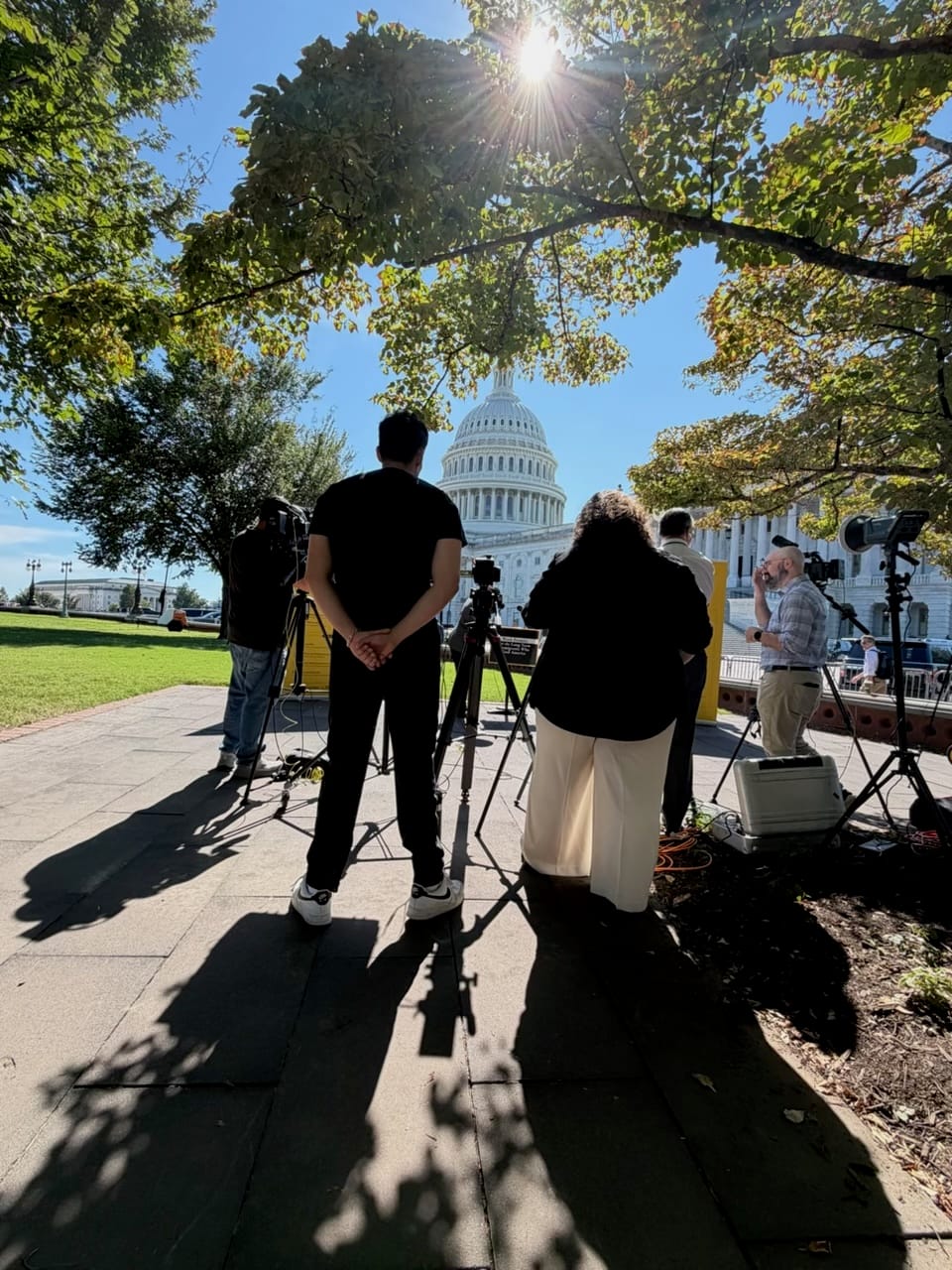
Carlos Raba, chef and partner of Baltimore’s Clavel, was among those in front of the Capitol building on September 17, encouraging lawmakers to choose a piece of legislation from the Menu of Solutions to get behind. “Without [immigrants], our restaurants and hospitality businesses simply could not operate the way they do today. If we lose these people, the impact on our communities and our economy will be enormous,” he said. As an immigrant himself, whose family sought asylum when he was a child, he understands the impact of creating clear, protected pathways to legal residence.
We spoke to Raba about why this legislation is so important, and why the high cost of food might force change.
This interview has been condensed for length and clarity.
Jaya Saxena: Tell me about your background and how you came to open Clavel. Did you always want to be a chef?
Carlos Raba: Well no, I didn't know I was going to be a chef until I quit my job and I came to open the restaurant with my business partner. I came to the United States in 1999 as a political refugee. My mom was a journalist and reporter in Sinaloa, Mexico for many years, and it got scary and ugly. So she took my brother and myself to the United States with the help of Amnesty International. We received asylum in 2002.
I grew up in Silver Spring, Maryland. I went to Montgomery College, and I worked at Whole Foods for almost a decade. And then I worked at Giant. So, I was in the food industry for many years working with immigrants. I come from a food background. My family in Mexico owned restaurants, so food is injected into my DNA.
What led you to open your own restaurant?
I was working in Giant and negotiating union contracts, and I was looking for an outlet. One of my cousins had a restaurant in New York. And then Lane [Harlan], my business partner, traveled to Mexico and fell in love with mezcal. She was like, your food is amazing, you can cook, can we open a taco place with a mezcal bar? I had a six-month-old, and my wife and I thought ok, let’s rent the house and move to Baltimore and open a restaurant. And now it’s been 11 years.
How did you first get involved with the Menu of Solutions?
I've been involved through the James Beard Foundation, because I feel a responsibility to use my platform to help people. I grew up seeing my family help people in Mexico, and I’ve been in the DMV community for 26 years. Of 170,000 Temporary Protected Status [TPS] holders in the United States, 40,000 of those are in the DMV. When I talk to people in the Senate, I say this is not a TPS issue, this is a community issue. We have to hold our Congress accountable for putting a solution to these important problems. When you look at the Menu of Solutions, the first thing it says is to keep food affordable. What’s more important than that?
Much of the argument is about how crucial immigrants are to our food systems. What is the reality of that work?
People have to see that every position in a kitchen is a craft. That's why you have stations. Being a dishwasher is one of the most important jobs in a restaurant, and it’s a craft. The pressure those people receive. You have to be able to work at a fast pace. It's not just physical work, but it's mental. With TPS, these are people that have been in the community for decades. They are people contributing to the economy, they pay taxes, they are business owners, cooks and workers. And they have American kids.
What specific effects of this draconian immigration enforcement are you seeing in the restaurant and food service community?
In the last 6 months, the price of lettuce has gone up 23%. The same with tomatoes and strawberries. We’re seeing shortages on farms, because of TPS revocations, so lettuce is rotting in the fields and prices go up. On the menu, you have the Farm Workforce Modernization Act, which provides a local permit for those that work the farm. So you have the proper permits for those people that are here to work the land, and we have the proper labor to keep food costs down.
A lot of the argument is about affordability, or the effects that ICE and mass deportation will have on non-immigrants. Is it frustrating to have to frame this in terms of the price of lettuce and tomatoes, rather than talking about how this is ruining people’s lives?
Yeah, it’s frustrating. But you have to adjust to the way other people see it, because people have not been exposed to what I've been exposed to. Some people don't even know what this legislation is, or what Congress is doing or voting on. People have to be educated about how these things are connected.
What do you think is the benefit of presenting this as a “menu of solutions,” and asking lawmakers to pick one and support it, rather than all of you getting behind one piece of legislation that you want to get passed?
I think it makes it about location, and a coalition of different businesses getting affected. Just in Maryland, the hospitality industry is $26.5 billion in economic output. It supports more than 242,000 jobs and it delivers $8.6 billion in labor income. That's a lot for a community. Having the menu is telling people, this is going to affect your community, pick up the phone, call your representatives, make sure that people in office are passing the important bills that we need.
Why do you think there is such resistance to this legislation, which presumably allows people to immigrate the “right way”?
It’s ignorance, because this is happening to people who are coming the “right way.” I have an employee, she was the head of the night line, she was running my tickets, she worked with me for seven years. I dedicated seven years to training her, to make sure that she was a good leader.
She had everything, her asylum, her papers, everything was lawful. And every two years, she would go to court and renew her work permit. The last time that she went, the judge canceled her asylum, and ICE was there to pick her up. She called me crying, she didn’t know what to do. Her kids were at home. And this is a lady who has been here seven years, she has two kids that were born in the United States, she had to self-deport herself because she was scared of being in the system. She took her American children with her.
You’re talking about trauma to American citizens and to whole communities. People need to know this is happening in every single city. And these people are doing it the right, and they're getting kicked out.
Is there one piece of legislation on the menu that you think would be particularly important?
For me, it would be TPS for El Salvador. When I came to the United States, there was a guy waiting for me and my brother outside the Reagan Airport, and he was a TPS holder from El Salvador, volunteering for Amnesty International. That was the first person to help me in the United States. Now he's a citizen, but he came under TPS, and he was helping other immigrants. But they’re all important. All of them are speaking to the same issue.
Ravenous is supported by our readers, not investors or VC money. Any donations go directly to our operating costs, and to bringing you more great food and culture writing.


