

It is when Melissa King starts talking about modeling Levi’s jeans in a global campaign that I began to wonder: What is a chef? In the past generation, the definition has changed from someone who makes their living in a kitchen to something more expansive. You can chalk that up to food television and the rise of the “celebrity” chef, and social media that allows people to build their own cooking content and blast it to millions of viewers. A chef is now someone who builds a life on culinary creativity, wherever that leads them.
Melissa King exemplifies this kind of modern chef. After attending the CIA and working in Michelin-starred kitchens, she earned national fame on the 12th season of Top Chef (where she just happened to come out to her entire extended family on national television). She won Top Chef: All Stars LA a few years later, making her a bona fide culinary celebrity. From there, she seems to have done anything and everything she wanted —she was a brand ambassador for Whole Foods, designed a menu for the Met Gala, appeared on Sesame Street, and became a lesbian icon. Last year she published her first cookbook, Cook Like a King.
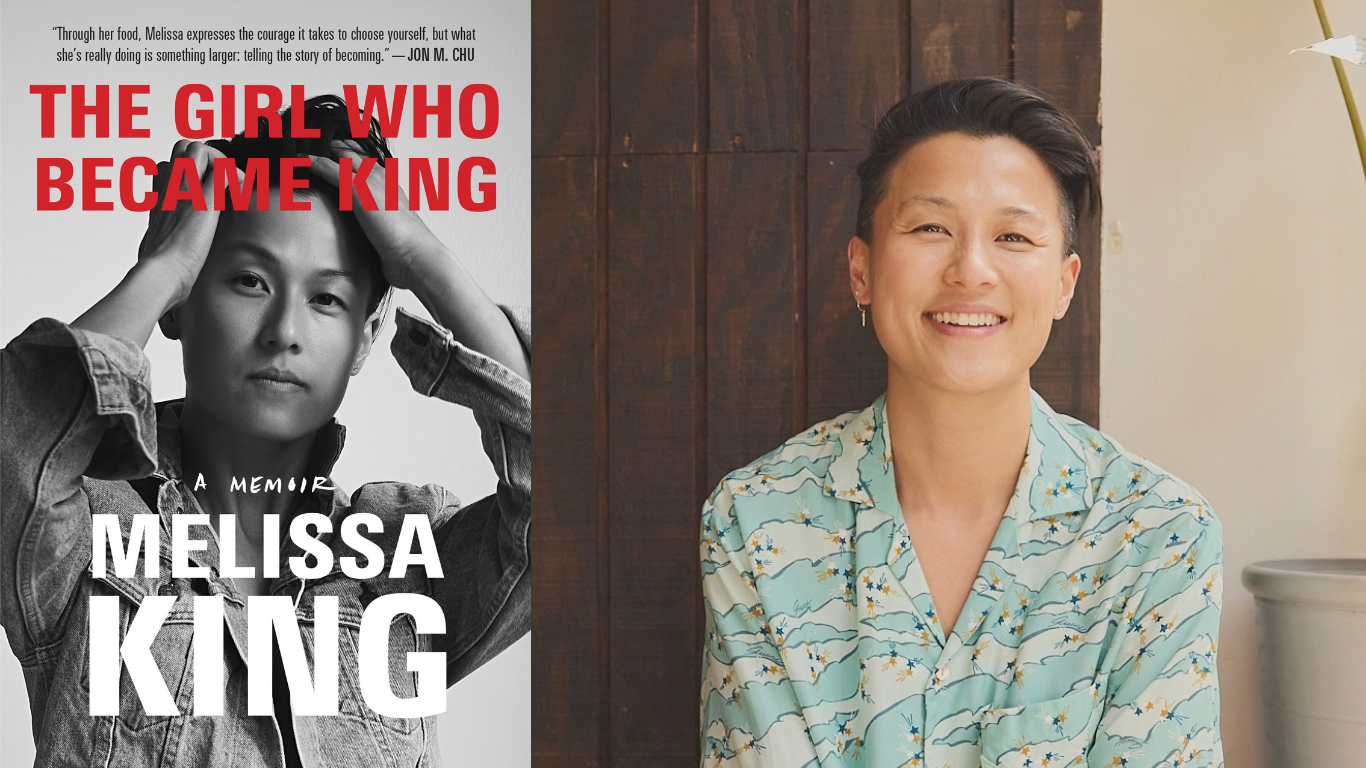
And now she’s followed it up with a memoir, The Girl Who Became King. King says it took her about five years to write the book, which her agent suggested after seeing the writing in her cookbook. So, like with all the wild and varied opportunities presented to her, she said yes.
The result is a piercing and honest narrative that explores how food is inextricable from everything, good and bad, in her life. She recalls what she ate meeting her judgmental, overbearing grandparents in Hong Kong, and how their treatment of her father cast a shadow over her own relationship with him. She lovingly describes the Korean fried chicken and boba eaten with a high school friend, one who made her feel alive and confused, which will make every queer woman cringe in recognition. She describes the toxic kitchens where she learned to love Italian cooking, and the Mahjong parties where, from an early age, she stood in the kitchen making sea bass with Sichuan chiles with her auntie.
You walk away from the book not just understanding King, but understanding what it looks like to build inspiration and creativity out of even the toughest parts of life. Because even after your girlfriend dumps you and you get bedbugs, you have to eat. We spoke to King about why it was important for her to write this memoir herself, fighting to include difficult stories about her family, and how cooking remains her creative outlet. Plus, she reveals the one ingredient she hates to cook with.
Jaya Saxena: You thank some folks in the acknowledgements of your book, who you say helped convince you that you could write it. When did you first start thinking of yourself as a writer, and that this was something you wanted?
Melissa King: Like never, I just never thought I would write a book. I never journaled as a kid. I never had a diary. I was much stronger in math and science. I am dyslexic. I just always had difficulty when it came to reading and writing, and so this was truly the biggest challenge of my career.
I was pitching a cookbook, and that was a dream I had since I was a kid. It seems pretty straightforward, but that also is challenging in its own way, to translate intuition onto a piece of paper and hope that the world can cook like you. Then my agent mentioned, you should write a memoir, your life is so interesting. I was like, is it? My life doesn't seem that interesting. I remember telling my mom I sold a memoir, and the first thing my mother said – she's so Asian – she's like, your life is so boring, why would anybody read your book? But the more I talked about it and told people, the more I realized I felt compelled to write a memoir. And I need to write this myself. I can't have a ghostwriter or any one of that nature because it just doesn't feel authentic. I'm going to do this, I'm going to go all in, that's just my personality. I took on the challenge, even though it terrified me.
Right when I sold the book and was getting into the whole writing process, I talked to Padma [Lakshmi]. Padma wrote a memoir and her advice was really priceless. She was just like, "You need to write this yourself, and you can do it. I promise you, Mel, as scary as it sounds, don't do the ghostwriter route. You will feel much more proud of your book if you write it yourself.” Just having that encouragement, and somebody believing in me really made the difference. And I also remember I was talking to Tegan [Quin] from Tegan and Sara, because I knew that they had written a lot of books themselves, and they said the same thing. I had these amazing mentors and friends grounding me and really championing for me to write it on my own.
Besides both of their work, were there other memoirs or food narratives that you looked to for inspiration?
I look at any chef that has written a memoir, like Kwame Onwuachi. Of course Anthony Bourdain, I had read Kitchen Confidential when it was younger. And then there was Crying in H Mart. It’s these books where it's a person that's known not for writing; they're known for some other creative outlet, whether cooking or music. But then they were able to write, and I would believe their own memoir, like just from the way it reads, it really feels very authentic.
Aside from your career, you get really deep into your family history and these sometimes difficult relationships. Why did it feel important to you to be honest about those parts of your life?
I felt it was important to not just start it at “Here’s me at five years old, cooking.” In order to understand me, you have to understand my parents, and you have to understand their parents. We talk a lot about generational trauma and that is so deep in my culture. You don't have a choice of the family you're born into, and no one has an easy life. I felt it was extremely important to keep those stories.
There was some discussion of cutting them, because I had written so much stuff, and a lot of it got condensed. It's a 300 page book, but there were moments where I had to really fight to keep the stories of my family because I felt it was so important to the person I am today, and the cultural pressures and expectations. All of that was so deeply layered into, you know, the person I am. I have a perfectionistic side. I have a side of me that can doubt myself. I wanted to really paint that story more deeply and have people understand where that all comes from.
Was there a story that you felt was the most challenging to write?
The stories with my father and the younger years. Even going back to those memories was challenging. It felt like therapy every day. It was challenging because I know my family is going to read it, and I wanted to be really sensitive to the people that I love. Knowing that this is our past, and there was pain attached to the past, doesn't necessarily define the future of who we are today. I have an incredible relationship with my father today. But we had a difficult past.
I also think of the coming out stories. And my grandmother, I cried writing it and reading it out loud for the audio book. There's still that grief. There's still the place where that love has nowhere to go, and so I really went through a lot of the emotions when I was writing that chapter.
As you get into your family and all these different parts of your life, we see the breadth of your culinary inspiration. That it wasn't just one country or region. I'm curious if revisiting these moments made you revisit your cooking in any way?
It was quite intentional to include my parents and my grandparents and their stories, and those food elements, because I'm such a deeply nostalgic person and it's so ingrained in the way that I cook. Cooking is my voice. It was the thing that I had to express my feelings, express my emotions and my love for people. Half the time I didn't remember details of my childhood, but I remembered exactly what I cooked. I remember exactly what Grandma made and how it tasted, and the details of the way it was cut, how long it was simmered, and the way that it smelled. It’s a sensory experience for me, and I wanted the reader to feel what I feel through it as they read.
My food changed dramatically as I discovered more of myself. In the beginning you're learning, you go to a French culinary school, and then I think at a certain point by around the Top Chef years, you see me really lean into myself and my identity. I’m out at that point, I think I come out to everyone on television, so by that point I'm really owning it and proud of who I am. You see that translate through the dishes that I'm cooking and the way that I create today.
You talk about your time on Top Chef and how emotional it is to still watch those episodes. What do you feel like viewers still don't understand about that experience?
When viewers watch Top Chef, it's entertainment, and they're watching for 45 minutes, and then they move on with their day. But to us,it was so deeply a part of our lives because we were in it all day long for months. It was 20 hours a day with the camera on you. I'm trying to give you a glimpse of the high pressure and the anxiety, and the desire to do well and succeed. But I really wish that people could be a little Ratatouille, to just hang out and see the true experience, because it is so much more complex than what you see on TV.
Just reading about the sleep deprivation seems like a nightmare.
And you don't think about that when you watch it. You just see the quickfires, you see the cooking, but you don't necessarily sit and think about these people having to go home, and they can't call their family members. They are trapped in a house together, and they have to live with one another. And there are cameras everywhere. So I wanted to give viewers a little peek behind the curtain.
You talk about how you used to think that having your own restaurant was the benchmark of success as a chef, but now you feel things are a little more expansive. How do you think the definition of chef has changed throughout your career? And how do you think about success these days?
It’s still the defining thing when people find out you’re a chef, they immediately ask, "Well, do you have a restaurant?” And if you don't have one, they assure you you'll get there someday. They assume that is the end goal. I used to think that too when I was a kid, and throughout my career, I thought I just wanted to have a restaurant, and that will deem me successful. And not just any restaurant, once I get a Michelin star, I can finally feel proud of myself.
For a long time, I chased those dreams, and I chased achievements to validate my sense of worth. Now, I realize none of that matters. What matters is: Are you happy with yourself? Are you proud of who you are? That’s how I quantify my success.I'm so proud of the work that I do. I'm proud of working with other chefs and building teams, and cultivating something bigger. It doesn't necessarily mean I have to have a restaurant. And today you see chefs going into the social media world, or consulting, or brand development, and there's so many other avenues of what a chef can be. Success is having creative freedom, but still being able to touch people's lives through food.
What kind of cooking are you doing these days?
I've been really into Middle Eastern cuisine and cooking, and Indian cooking. It’s flavors I never really grew up with or understood the techniques to because most of my background is in French, Italian, Japanese, Chinese. I’m dabbling with Thai and leaning more into these things that I've always wanted to learn but never really had time to. So now I'm at a place where I'm like, I'm just going to make it. The other day I made mosama bademjoon from the Sofreh cookbook. I’m always taking inspiration from places I'm going out to eat at, or what I see at the farmers markets, or when I travel.
Ok now it’s time for A Little Birdie Told Me, Ravenous’ rapid-fire questionnaire. So first, what's one thing that's always in your fridge?
There's always oat milk. There's always my chili crisp, and a bottle of my ponzu as well. Yogurt. Raspberries.
What's something that instantly makes you love a restaurant?
The noise level. I get really overwhelmed if a restaurant is too loud, to the point where I have to leave. I can't eat here because I can't even hear the person in front of me speaking, so I love when they have the perfect noise level, where you can still have an intimate conversation. And lighting. I hate overhead lighting. I just love a cozy atmosphere.
Is there a food that you hate that you wish you loved?
Pine nuts. I just don't like them. Why? It's the most benign thing, you think I would say something more interesting. And I eat everything. I've eaten balut. I've eaten really wild things, and it's pine nuts. Therefore, I don't love pesto, so I'll make pesto with walnuts. I don’t think I’ve told anyone that.
Savory or sweet?
Savory. I do enjoy my sweets, but I'm the type of Asian that's like not too sweet. I can't handle desserts that are super sugary or fudgy or just too overwhelmingly caramely. I love a not too sweet dessert, but in general, when given a choice, savory. Especially for brunch. I’m going to get a savory thing, but then we can get a pancake to share.
Small plates or big family style?
Family style. I like sharing small plates, but they're often too small, everyone gets one bite. I want more. I'm the type of person that's eating off your plate.
Early bird dinner or a dinner at 10 p.m.?
Early bird dinner. I'm happy eating even a 5 o'clock dinner. It’s the Californian in me. I just want to eat at five or six and then be in bed by 10. When I'm in New York, somehow I'm doing both — I'm doing it at and then a 9 o'clock dinner. But I need time to digest, and then I can drink some tea at night. It’s the grandma in me coming out.
Love great food writing? Subscribe to Ravenous today for your fill, free from corporate interests!


