

Bill Oakley is really into food, but probably not in quite the same way you or I are. The former writer and showrunner for The Simpsons is the man behind one of its best jokes, steamed hams (which became one of the internet’s most beloved memes), and a litany of other food jokes on the beloved, long-running animated show. You’ve likely also heard his jokes, food and otherwise, on Mission Hill, his short-run animated series on The WB, as well as on Futurama and Portlandia.
At some point, his interest in food took over his career. He moved in front of the camera to appear on The Food That Built America on the History Channel, and started reviewing fast food on his Instagram feed. But did you know he hosts a dinner series that takes place all over the country called Culinary Curiosities, in which he, along with a chef at a local restaurant, shares the lost, suppressed, and downright weird famous local cuisines that never break out of their own regions? Oakley accompanies each dish with a slideshow, during which he explains the history of it and — usually — some unexpected and obscure fact, like that the Italian-Americans in upstate New York created their own version of chicken rigatoni called chicken riggies sometime in the last 30 to 40 years. No one knows quite where it came from.
I was lucky enough to attend a recent event in Dallas, at Oakley’s invitation. Later, we sat down to talk about it — and I’m going to tell you right off the bat that I loved the deep-fried sauerkraut balls, and I will never, ever drink another Flaming Homer again, but I am so happy I got to experience it. We talked about what goes into setting up a dinner series, the well-known chefs he’ll be collaborating on it with this fall, and many of the bizarre American dishes you’ve never tried, but you could if you just join Oakley for dinner.
Courtney E. Smith: Let’s talk about the evolution of your dinner series. You’ve been doing it for a few years at this point, right?
Bill Oakley: A little more than a year and a half.
This fall, you’re going to collaborate with some pretty well-known chefs, including Aaron Franklin of Franklin Barbecue in Austin, Trenton Garvey of the Blue Duck in St. Louis, and Mason Hereford of Turkey and the Wolf in New Orleans.
Yes, and I have another dinner series called the Greatest Airline Meals of the 20th Century that I do with Alaska Airlines. We will host the second one of that series in Seattle in November. This has become my full-time job. People call it experiential dining, right? That series is much more of a giant operation than my Culinary Curiosities dinners. I’ve done 26 or 27 of the latter so far, all over the country.
How did you end up changing the Culinary Curiosities dinners so that you’re partnering with chefs? How will those experiences be different?
The nature of these dinners is that it’s always interpreted through the lens of the chefs — obviously, every place I do it has a chef. But some chefs are more famous than others. I don’t tell the chefs what to do, but I give them a list of about 100 dishes, divided into various courses, which they may or may not use. Some chefs have chosen one or two from my list and had five others they wanted to create, based on their grandmother’s recipe, or that was their interpretation of a local favorite. Joey Ward [executive chef and owner of Michelin-recommended Southern Belle and Georgia Boy], who is pretty well known in Atlanta, did versions of things that weren’t on my list at all: Maine Blueberry Explosion and Morning in Miami [takes on blueberry pie and a traditional Cuban breakfast, respectively]. These were extremely avant-garde interpretations of super fun dishes. Everyone does it their own way.
So you hand the wheel over to them completely?
We have Zoom calls, or long chains of texts. I am absolutely certain that whatever Hereford or Franklin come up with from the list will be a unique take on Cincinnati sauerkraut balls or the New Jersey Taylor pork roll sandwich. That’s part of the fun. I will be delighted to see what they come up with. I don’t think they need my guidance, but if they do — like for Franklin, I told him the ten most popular dishes we’ve served, but also that we want to showcase Franklin Barbecue, so don’t get stuck to my list.
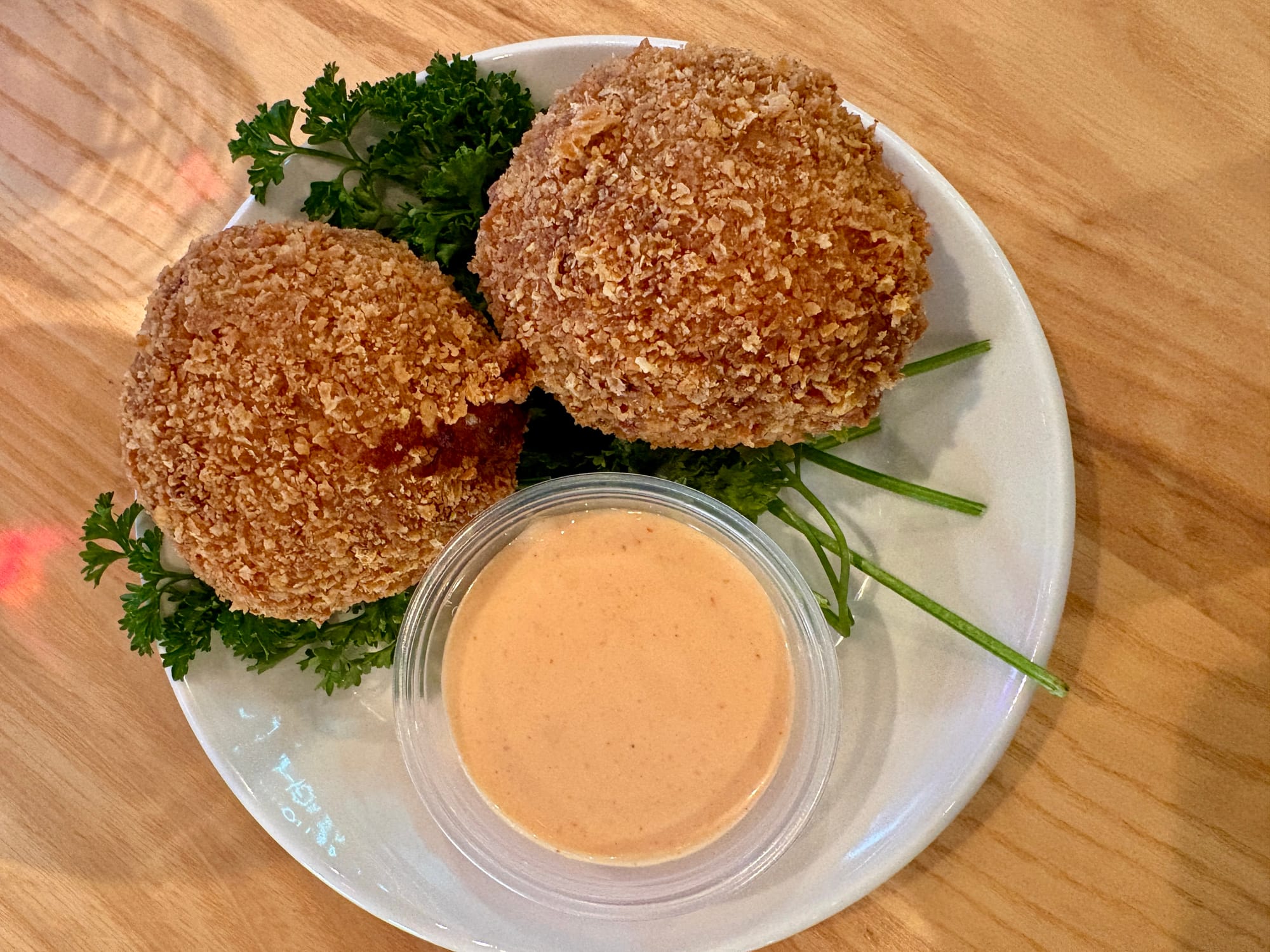
What does the dinner look like on your end once the chefs have decided which dishes to do? At the dinner I attended, you’d obviously researched all the dishes and presented us with stories and a slideshow about them.
I have a large bank of knowledge about the dishes that I put into the slideshow. I know how to tell the story of Cincinnati sauerkraut balls. I never thought those would be any good, but they are the most delightful and popular thing in the entire series, and that’s part of the fun. That’s why it is a secret menu, because if you saw Cincinnati sauerkraut balls on a menu, no one would order it. That’s why I have to force them upon people, and they love it! My role is to amuse people. I come up with five minutes on every dish, although sometimes it’s less about the dish and more about its strange place in our culture. A dinner in St. Louis that I’m doing at the end of August has a couple of real shockers. It took me a day of research, but I found the thing that’s going to surprise people in each dish when I put the slide up. I try to make it entertaining.
At the dinner I attended, you told us that some of your fixation on strange foods started on The Simpsons.
I’ve actually been fixated on this even longer than The Simpsons, practically since high school. The funny side of food has always been something that attracted me. I wrote a lot of food jokes in college and then on The Simpsons; believe me, I wrote a million food jokes. Steamed hams became the most famous one of them. Even back in the day, I was like, I’ve got to be the first one to go try the Arch Deluxe at McDonald’s. When I went to Pittsburgh for the first time, I wanted to know what I could eat there that I couldn’t eat anywhere else. It’s Ohio Valley-style pizza and its Primanti Bros. sandwiches. The whole point of this event is to bring things like that to people. You don’t have to drive to Altoona, Pennsylvania, to try the pizza. You can try a whole nation’s worth of unusual food in one night.
The thing my table kept talking about was how several of the dishes would fit right in at the State Fair of Texas, which is full of the strangest fried foods possible.
I think what you were talking about is the Cheese Frenchee, which is from the 1950s and has become a beloved part of Nebraska food lore. That was one that the chef at Vector Brewing in Dallas came up with; I’d never heard of it before. In general, I try to have dishes with some history behind them and not just novelty. They also have to be served in more than one place. Altoona pizza is served at six or seven spots, not just one nutty restaurant’s publicity stunt.
This is an aside note for our readers: Do not try Altoona pizza. It looks bad.
It’s like a homemade pizza that you or I would make with an English muffin, spaghetti sauce, and American cheese late at night when no one is around.
Yes, it looks like many pizza bagels I made in the toaster oven after school as a latchkey kid. That’s shameful food for nights home alone, not a trip to Pennsylvania. There were so many stories I’d never heard before at our dinner, like the derby pie lawsuits, which were so absurd that it was hilarious.
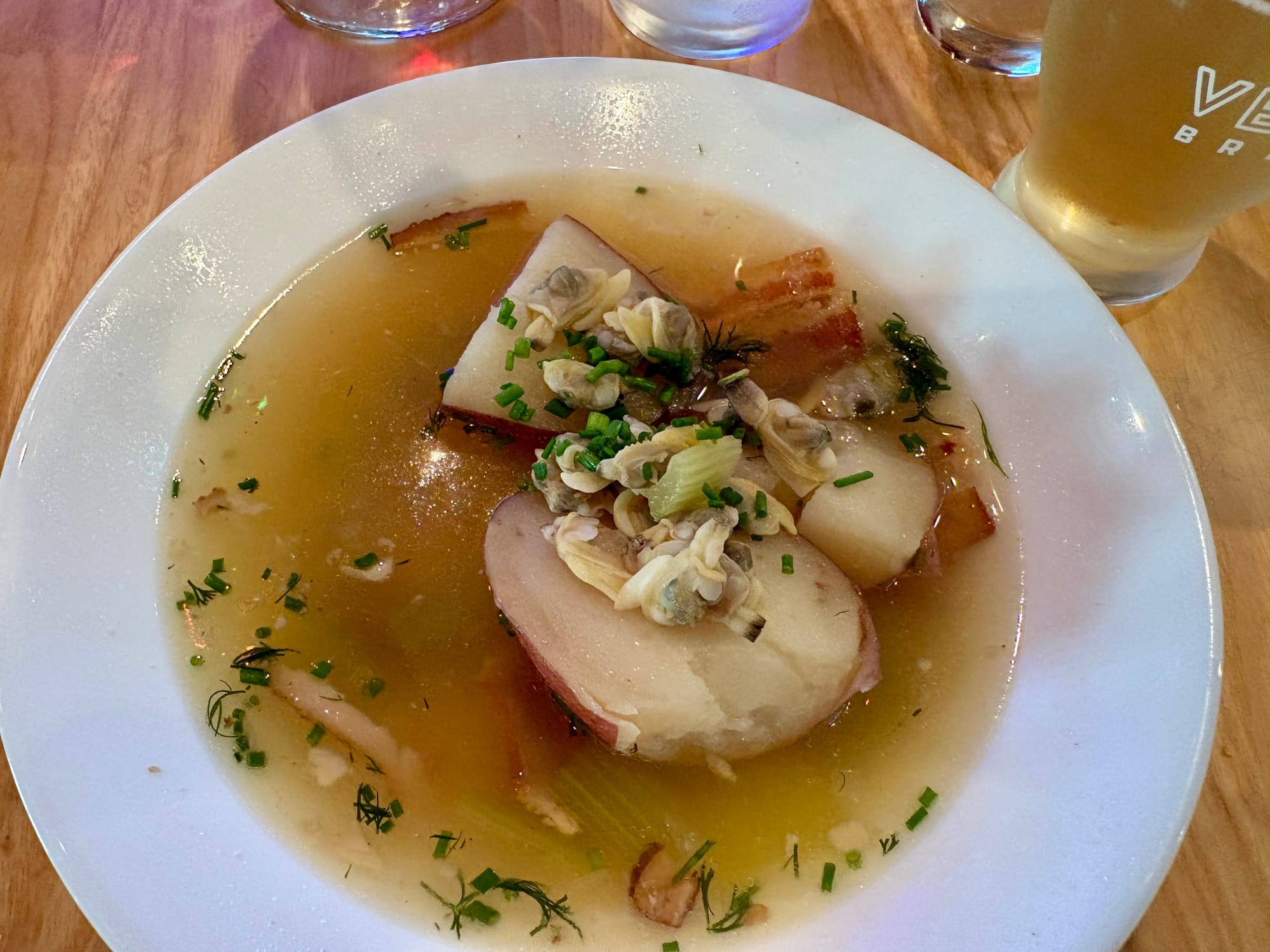
Some of the dishes aren’t funny at all, like Rhode Island-style chowder. I consider myself to be fairly knowledgeable about food, and for 45-years of my life I was like, Okay, we’ve got two kinds of chowder. When I learned there’s a third kind, I wanted to know why we never see it. I made a special effort to go to Providence, Rhode Island, and have it there. It was delicious, and it’s weird that it isn’t more famous. Given how much other stuff has come out of regions of this country, like Chicago-style hot dogs, it’s bizarre to me how much food hasn’t left its own little radius.
One of my closest friends lives in Mystic, Connecticut, and she’s taken me to Rhode Island and shown me Taylor Swift’s house there. Never once did she mention Rhode Island-style chowder. She’s a food writer. Maybe it’s a conspiracy.
Did she take you to have the Olneyville N.Y. System hot dogs?
No!
Those are also a Rhode Island specialty. They’re not all that different from Coney Island or Michigan, but it’s another weird regionalism. There is coffee milk, which they have in Rhode Island too.
What is the biggest challenge in pulling off a Culinary Curiosities dinner?
Most kitchens don’t want to cook seven dishes that aren’t on their regular menu. It’s hard. Places are often too busy, or the mechanics of it don’t work for them. It isn’t easy to line restaurants and chefs up for the Culinary Curiosities dinners, and that’s why I was so astonished that some of these big-name chefs are willing to do it this fall. It takes a place that is ambitious to pull this off. In this environment, when things are so expensive, they have to line up labor for the night and take the chance on selling tickets for the event.
How are you finding restaurants to host Culinary Curiosities?
A combination of connections and cold calling. Aaron Franklin actually came to our first event that I did outside of Portland, Oregon. It was in Austin, and someone invited him. Mason Herford is a friend of a friend. The others are just spots I cold called. Say I want to do Culinary Curiosities in Denver — I will spend a lot of time reading up on restaurants in Denver that feel like they have the right vibe, and then email them. A lot of times, I never hear back. Then sometimes I hear back within the hour. That was Dan Jacobs in Milwaukee at EsterEv; he’s a huge Simpsons fan. It only took him 15 minutes to say he was in.
How do you go about melding together the people who are fans of your comedy career and the people who know you for food into an audience at these dinners?
It’s hard to say. Every city is different. Sometimes I go to a city, and I can tell off the bat the audience is 60 percent Simpsons fans because they’ll laugh at certain jokes or references. My bit about chowder is a litmus test. Sometimes I’ve had dinners where nobody knows that joke, and I’m like, wow, this is going to be an uphill battle because I am explaining from the ground up the chowder joke or what steamed hams are and why they should care. It’s always an interesting mix of people who are fans of the show or fans of the restaurant — or who somehow heard about it and are just looking for a night out.
It has to be fun when chefs take these dishes as a challenge, to do something that’s never been done or turn something that sounds repulsive into a great dish.
The Mount Everest of making people like stuff is Cincinnati chili, which I have now taken off the list. I personally think Cincinnati-style chili is pretty good, if you understand it's supposed to be the topping for hot dogs and stuff. We’ve served it so many times, and I’ve seen so many barely-touched dishes. It’s an acquired taste, even in Cincinnati.
This interview has been edited for length and clarity.


