I am (moderately, not really) scandalized to discover recently that a handful of iconic, high-rotation recipes that I’ve been eating for my entire life are not family standards passed down from generation to generation. Instead, they came from the 1980 edition of the First Presbyterian Church of Conroe cookbook, titled Breaking Bread. That’s the church my Granny, Bettye Wakefield, took me to for several years.
What my mom, Andrea Durrett, remembers about the 1980 edition of this book is that it was partly inspired by a man in the church who was a great baker, and held some cooking classes that Granny and Grand Duke (John, my grandfather) went to. It’s a pretty solid, if of its time, collection of recipes, bound with a binding comb. Granny gave her a copy, and one to her sister and my aunt, Susan Eckis. “When I’m looking for a chicken recipe, I’ll pick up several cookbooks and I always pick up Baking Bread,” my mom says. “It used to be the Joy of Cooking — Mother gave it to me when I was in my 20s, but it’s like an encyclopedia. It’s good for general ideas, but at the time was way too technical for me.”
We were not a mother/daughter duo who cooked together. I was uninterested, and she wasn’t about making me help in the kitchen before meals. I did earn a $5 a week allowance for doing the dishes, and I hated every minute of it. I didn’t get interested in cooking until I bought my own house nearly a decade ago and started hosting my family for holidays. I’ve pushed away from a lot of our traditional dishes, other than cornbread dressing, because that would cause a riot.
Flipping through the hand-typed and bound book, I came across the green bean casserole that my mother made for holidays for decades, and which my granny praised as if it were the second coming. It was exactly what I’d watched her make — all the same ingredients. I thought it was her recipe. I have no idea why I assumed that, other than the fact that I stayed firmly out of the kitchen as a kid meant that what my mom did there was always a bit of a mystery to me. But no, it came from Ruth Decker, a sweet, black-haired elderly woman who wore giant glasses and who always sat near my granny in the back right side of the church on Sundays. My mom’s riff on that recipe was switching from canned to fresh green beans that she cooks for only a moment, to keep them closer to crisp.
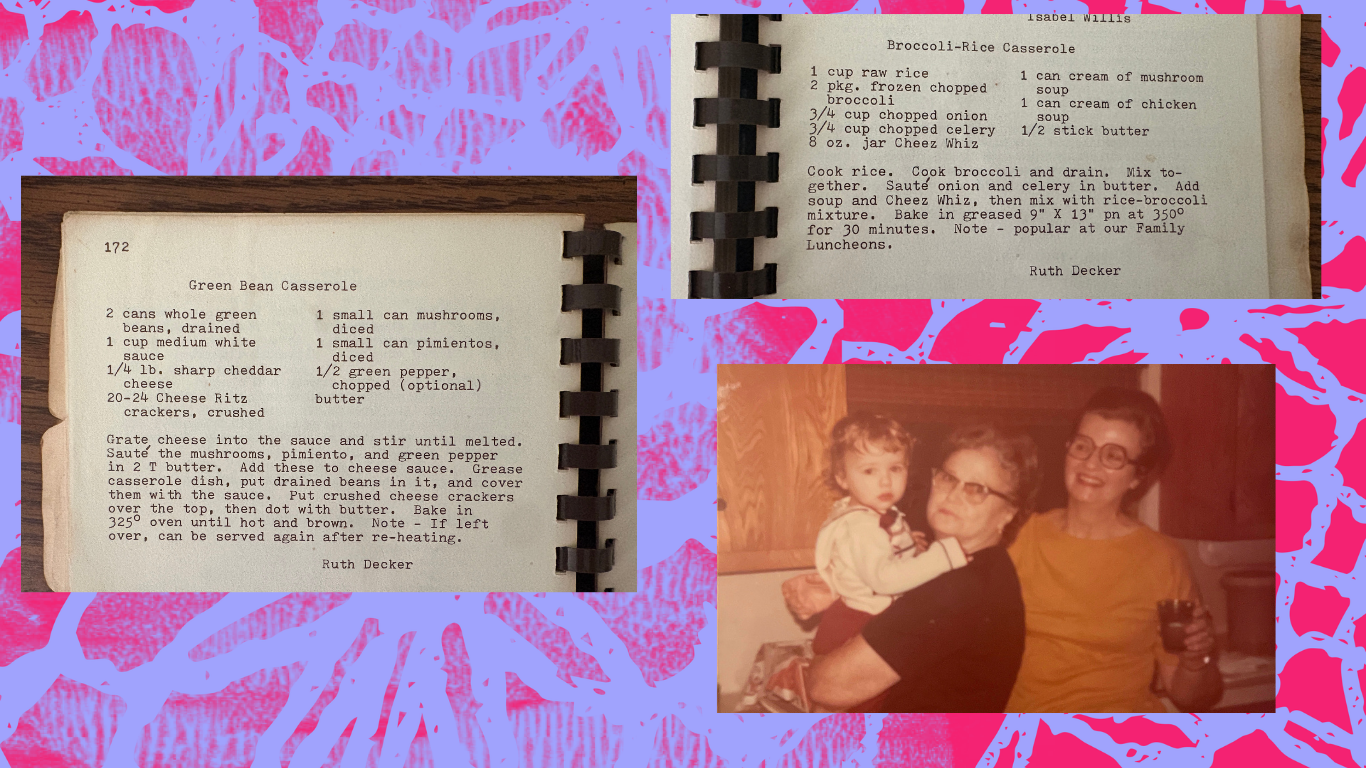
On the next page was the broccoli rice and cheese casserole I’ve had a million times that my stepdad, Gary, loves. It was also a Ms. Decker recipe. My mom made it her own by substituting water chestnuts for celery in the Velveeta and cream of mushroom-and-chicken-fueled dish. “Granny suggested the water chestnuts substitute; maybe she had it somewhere else,” my mom says. “I’m pretty sure I first had it at a church social.” This is also news to me — my mom is not a church person. She used to go to the socials? I don’t blame her; the Conroe Presbyterians loved to eat. So much so that we joked that most people came to church in large part to go to lunch after.
The real shocker was chicken spaghetti, which everyone agrees is the most coveted meal my mom makes, and which she only does now and again to keep us all salivating. Before the cookbook recipe, mom remembers it being a chic dish she ate in a department store. “Sakowitz in downtown Houston had a tea room where they served it, and they called it chicken tetrazzini; it didn’t have so much cream soup. It came in an oval ramekin. We all thought it was ‘the bomb,” my mom says, and I am also shocked to hear her use that phrase for the first time ever. But she also partially credits Breaking Bread. “My adaptation to this recipe came from Susan, who cooks the spaghetti in chicken broth — and I still do — to be not quite al dente, because you still have to bake it.”
I also discovered that my granny submitted a few recipes, most of which I never saw her make. One was a rum raisin ice cream that was right up her alley. I’d forgotten about when she got an ice cream maker in the ‘90s and went wild making fresh ice cream all summer long. Rum raisin was her favorite. We experimented with flavors together — I also remember a peach ice cream and trying to make butter pecan, but never quite nailing it.
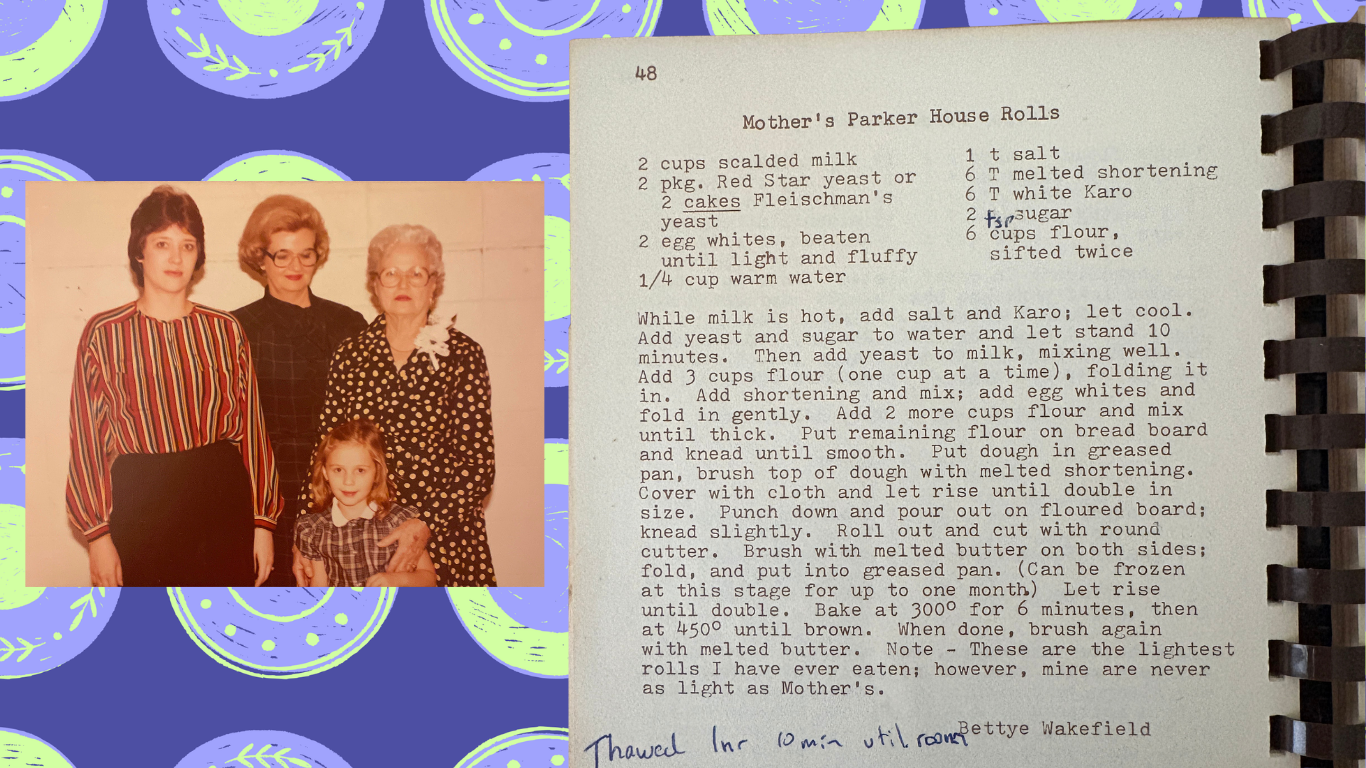
The cookbook was sitting out for me to discover because my mom and aunt Susan (who happens to be a Regular-level subscriber to Ravenous) were attempting to make my great-grandmother’s (known to all of us as Dede, and to the government at Eunice Shelton) Parker House rolls recipe. It is impossible to recreate those rolls from that recipe, they determined, because Dede left some steps out — on purpose. They’d both made the rolls with her while she was still alive, trying to learn the recipe, but swore Dede didn’t tell them all the correct ingredients and measurements. Just the same, my granny submitted a version of the recipe, and while trying to decode it, they burned the cover.
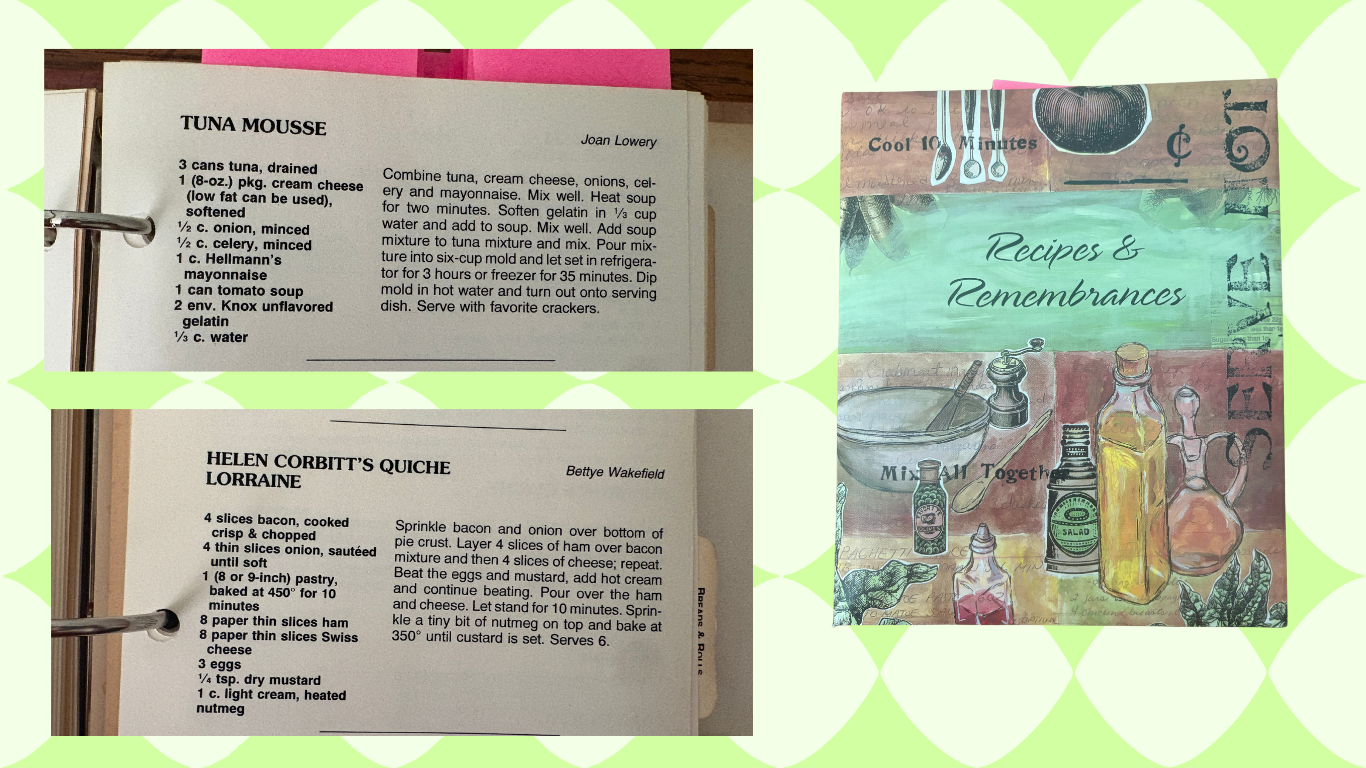
There was a follow-up cookbook published by the church in 2001, called Recipes & Remembrances, and it is full of names of people I know and the truly unhinged recipes they apparently cooked. “There are not very many recipes from the 2001 version I’d try,” my mom says. “I’ll put a sticky note on a page to try it later, but usually don’t.”
Again, all of the entries my granny submitted are things she never really cooked, including a recipe credited to Helen Corbitt, a well-known Texas chef and the director of food services at Neiman Marcus, who developed several recipes still in use at the store’s restaurants. My mom put her recipe for green beans with bacon in, and my aunt shared one for roast chicken with lemon and olives. My granny’s across-the-street neighbor, Joan Lowery, has some of the most unhinged recipes in the book, including a tuna mousse (canned tuna, cream cheese, mayo, and unflavored gelatin, anyone?) and hot olive cheese puffs (you don’t want to know).
Carol VanWassanhova, whose two kids I used to babysit, submitted a holiday wassail recipe that sounds quite a lot like the wassail my youth group poured into the plants at one elderly parishioner’s house — it was overloaded with cloves. And Kathy Haines, the mother of my favorite person in Sunday School, Kaye, has some bangers in it too, including something called Fire & Ice pickles, where sugar, hot sauce, and dried pepper flakes come together for the scare of your life.
Jackie Simpson, the daughter of my granny’s best friend, Eleanor, submitted an onion lasagna recipe that looks good. Really good. Suspiciously good. When I asked my mom, she said it looks good because it’s actually Aunt Susan’s recipe (Susan had a catering business in the ‘90s and taught cooking classes for years). And that kind of sums up the vibe of the First Presbyterian Church cookbook series — everything is shared, and everything is interconnected in these fascinating ways. It’s a cookbook that reminded me of how small the world can be, and how comforting that can feel.
We all have our cooking niche, or reputation, in the family. Susan makes gourmet-level stuff and is always the inspiration for us to push ourselves into unfamiliar cuisines or make dishes just a little better and fancier. My mom is known for mastering standards, like chicken-fried chicken and green beans, then putting her spin on them. Granny was chaotic, getting into food trends and diving into and out of whatever ingredients were of the moment, making her palette seem undefinable. Dede was thrifty, which living through the Great Depression demanded, and didn’t waste anything. Finding Breaking Bread helped me see the community of influences on all of them, and made me realize how many people had a hand in all the food I thought was so specific to my family. The recipes belonged to all of them. Breaking Bread allowed me to see the village, from a dish at a now-defunct department store I never visited to my granny’s lifelong friends, who raised and fed me.