

Last week, one of my family’s favorite places to eat dosa made national headlines. This place has been feeding families for generations in suburban Chicago without notice from food critics or influencers, well before America picked the dosa to represent South India’s culinary culture.
The Sri Venkateswara Swami temple has been a destination for Chicago-area Hindus since the ‘80s. The closest comparable temple was in Pittsburgh, which opened in 1977. My family made its share of road trips to the Steel City before the suburban temple opened. Though the design and architecture of these spaces are spectacular, the food is just as memorable.
On Wednesday, Oct. 14, local police uncovered an alleged white supremacist’s plot to execute a mass shooting at the Aurora, Illinois temple, a terrorist act foiled by a jammed gun. Alexandros Paporakis, a 19-year-old from Chicago’s Northwest Suburbs, was arrested and charged with making a terrorist threat and unlawful possession of a rifle with a barrel shorter than 16 inches.
Taco Bell, a hero to many desi households thanks to its Mexican pizza, plays a part in this horrifying story. According to my former coworkers — who are battling for a union contract — at The Daily Herald, Paporakis, who worked at a Taco Bell, bragged about his plan to a coworker who called the police.
Comfort cuisine can take many forms, mostly shaped by what you grew up eating. That might be a healing bowl of broth or a steaming plate of noodles. The spices will vary; the proteins are optional. And as the Midwest battles seasonal depression as the mercury dips, our moods also determine what foods satisfy.
In our household, equipped with a South Asian pantry stocked with items from the very first Patel Brothers store located on Chicago’s famous Devon Avenue, dosa claimed the role of the original comfort food. Most Americans are now familiar with dosa, and we still cringe when a lazy food writer compares it to a crêpe, but seeing dosa break into America’s mainstream culinary lexicon was impressive. However, my mother wasn’t so sure if I would enjoy the palya (turmeric potatoes) stuffed inside. So she turned to an old friend for support.
Before the culturally sensitive rebranding, Aunt Jemima maple syrup would top the breakfast dosas in the Selvam household, a classic Americanization of a dish that would ensure my sister and I would eat what my mother cooked while fooling us into thinking we were assimilating. As we grew older, the training wheels fell off, and the syrup disappeared from the table.
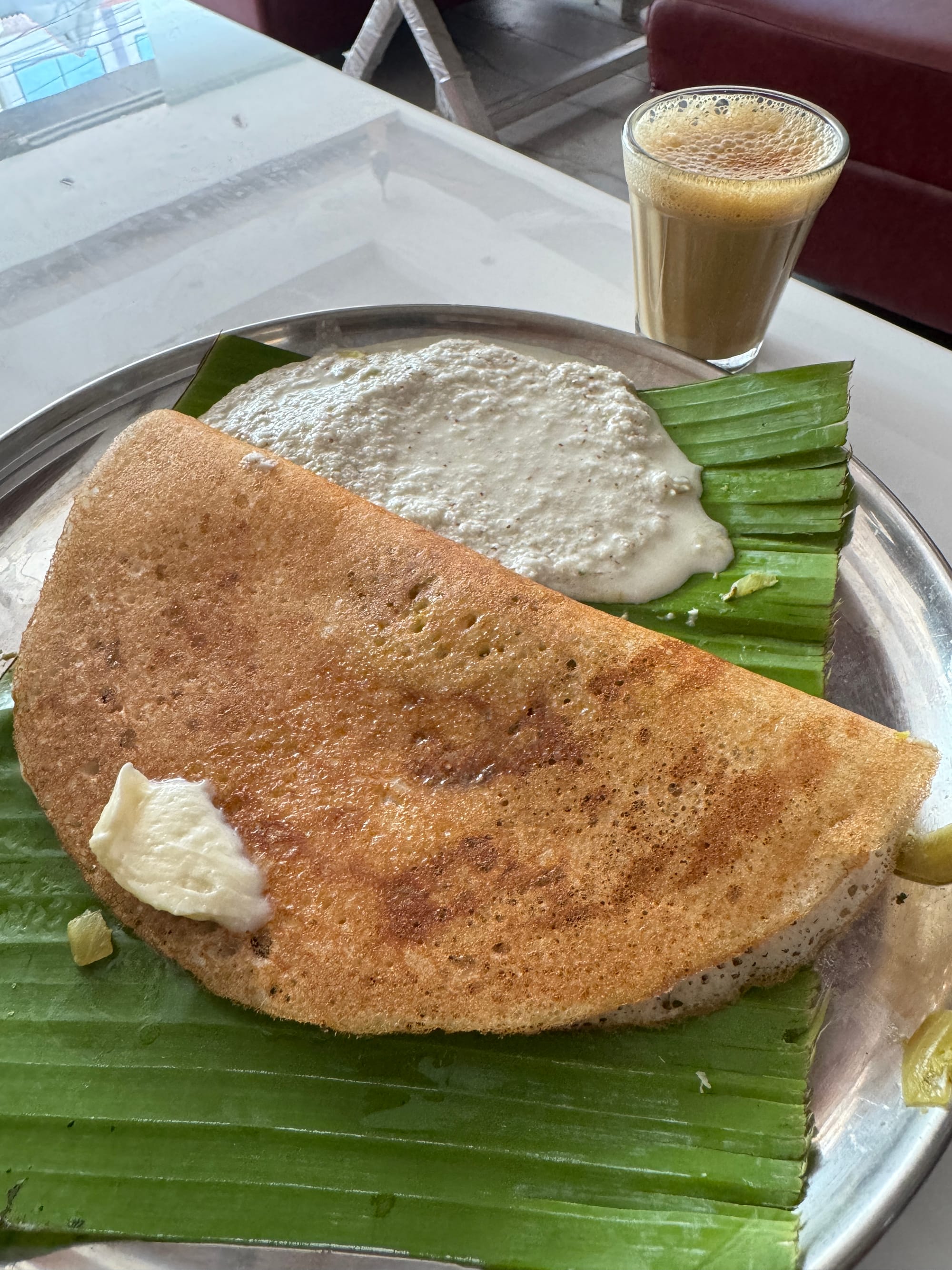
Dosa is a regional food with variations. Some folks live for the crunch of a paper-thin version. At Semma in New York, chef Vijay Kumar folds dosa into a cone and perfectly props it up on a plate. Two years later, and my kid still begs me for “cone dosa.” One of my fondest meals comes from Mysuru, India, at a dimly lit restaurant called Hotel Vinayaka Mylari, where the dosas are thin but fluffy. Staff will come by with metal condiment containers full of flavorful green cilantro and beige coconut chutneys, spooning them on your plate at your request. I can still hear the tapping sound of the spoon dishing out those delicious accompaniments.
But nothing beats the feeling of making your way through a crowded event space, taking extra care that you didn’t step on any auntie’s saris while carrying plastic trays holding oversized dosas served on styrofoam plates at the Sri Venkateswara temple, about 40 miles west of Chicago. (Aurora is probably best known as the home of Wayne’s World.)
The post-temple meal, which came after sitting through the poojas, was the highlight. You had to put in the work. The temple was also one of the few places in America where you could hear languages from Southern India like Kannada and Tamil, way before Never Have I Ever’s Maitreyi Ramakrishnan, who is of Tamil descent, was born. The temple kitchen also pumps out chitranna, or lemon rice. The slightly sour basmati with scant raisins and almond slivers was my mother’s favorite.
Nailing the flavors of Bengaluru in the ‘80s was rare. Nowadays, Eater is naming the city as one of the best cities to eat in the world while touting a restaurant that none of my relatives in the former Bangalore have ever heard of. When film director and noted vegan Kevin Smith was in town in 2020, I delivered a dosa to him before an interview. Last week, my pal, Chicago food writer Titus Ruscitti, posted a dosa photo taken from the temple. It was a delightful sight without the “eat, pray, love” trappings a lot of fools evoke when talking about India.
Expressions of Indian culture, whether its food or the rituals performed at an Indian temple, can be watered down in America. The lamb is bland. The chai is oversweetened. Yoga turns into a scheme to sell athletic clothing. But some things should be sacred. You would think.
The Aurora temple (forgive me) beefed up security about 10 years ago by hiring a security guard and adding more cameras. Community leaders state the obvious: We've been building up to something like this. We’ve got loser would-be politicians in Texas calling a crowd of brown kids at a college football game “a problem.” That’s not the only example. Earlier this year, again in the Lone Star State, a January 6 rioter tried to form South Asian Voltron by spinning a story at a Frisco, Texas city council meeting, claiming Hindus, Muslims, and Jains were teaming up to eradicate the community of Christians.
The Indian and South Asian diasporas are tangled in the model minority myth where many are encouraged to keep their heads down and assimilate. This goes beyond code-switching, a survival tactic, like putting syrup on a dosa. They think if they scrub their hands enough, the melanin will disappear, and that elected officials will acknowledge and support them. Both Vice President JD Vance and FBI Director Kash Patel have yet to issue any public statements on the foiled plot. They didn’t even bother to post AI slop on their socials.
Ten years ago, I insisted on a dosa station at our wedding; it felt like a real opportunity for cultural expression. Reflecting on what happened at the Aurora temple — or what could have — I’m left sad that something so comforting could be corrupted. And I don’t think our elected officials or auntie-chefs are going to save us.

Ravenous is an independent publication owned by the folks writing the stories without investors. We depend on reader subscriptions to bring you stories other publications will ignore. Please consider a paid subscription to ensure we tell more of these stories.


