

There is no perfect place to cry, although I would argue that crying while sitting in a shitty car in the drive-thru of an aging fast-food restaurant comes close to transcendent. There is no science to this, but there is history. I cried in a 1994 Plymouth Acclaim in a Wendy’s drive-thru in 2004 after the girl I had been dating called me to ask me to stop calling her. I can tell you that the woman working the window could see that I was crying and asked if I needed anything, as if she was a first responder, and when I said I was fine she gave me extra fries. Those fries were perfect. There are no fries that feel as good as those. Fries eaten in desperate heartache, drowned out by stereo turned so loud that you can’t hear the anxious rhythm of the heart, playing a mix CD designed to listen to on days that feel like your last day of ever knowing joy. CDs filled with songs of raw emotional intensity that sing to the legacy of heartache, a universal truth that binds us all together.
These emotions are not tied to any one genre, it’s just that emo is a magnet to those feelings thanks to its name. A loosely defined and oft-contested label, emo’s roots stretch to the 1980s Washington, DC hardcore scene, a genre that has taken many forms and redefined as each subsequent wave stretches its boundaries. What was once a melodic and emotionally vulnerable subset of raw and powerful punk rock, one tied to DC hardcore bands like Rites of Spring and Minor Threat, emo was rebuilt with catchy choruses and harmonies by ‘90s pioneers like Jawbreaker and Sunny Day Real Estate. As a new wave of pop-punk bands built larger audiences in the mid-’90s, buoyed by the major label success of Green Day, Blink-182, and the Offspring, emo followed suit. Midwestern bands like the Get Up Kids and Braid were suddenly the voice of a new movement, a less frenetic counterpart to skate punk. As the latter continued to dominate marquees in the 2000s — and bands like Jimmy Eat World found mainstream success — emo shifted once more, all lined-eyes and mascara, as bands like My Chemical Romance, Saves The Day, Taking Back Sunday, and so many more emerged. There is no exhaustive list of emo bands, there is only an eternal argument as to who belongs on one.
Emo became associated with a certain kind of person. Young white men in the suburbs burdened with countless complicated, unknowable feelings. Who drove their parents’ cars to the mall to shop for the perfect outfit in which to be dumped by an unattainable and impossibly perfect girl. Women in these songs were dangerous and delicate objects placed on pedestals, and torn from their platform at the slightest provocation. This is a broad generalization meant to provoke more than it is to inform, because in truth we’re talking about emo not as it was but as it’s perceived, and about a woman who is not a real woman at all, who has been removed from her once lofty podium.
Wendy, what went wrong, oh so wrong?
Fifty-seven years after former army cook Dave Thomas founded the popular fast-food chain, Wendy’s has fallen out of favor. The brand fell into the clutches of private equity in 2008. Popular fast-food podcast “Doughboys,” which in 2016 placed Wendy’s in its platinum plate club – the highest echelon of their personal ranking system. They’ve claimed the brand has fallen off in recent years, noting a shift in quality as a new CEO moved the brand away from the more earnest Thomas era (he died in 2002). Doughboys went so far as to downgrade the chain.
In August, Wendy’s CEO Bob Wright vowed to shift the company’s focus to improving the quality of food instead of prioritizing saving money. The announcement, of course, came only after the brand suffered a substantial loss in stock. While concentrating on cost cutting, Wendy’s slipped behind Burger King to No. 2 in U.S. fast-food sales. To reclaim the glory of its youth Wendy’s announced it will bring back its iconic yellow packaging, and, most recently, released a six-song EP of emo songs about its own restaurants, Songs to Listen to in a Wendy’s Parking Lot.
This EP of melodic, polished emo is a fever dream of vintage corporate synergy. Produced by Matt Squire (Panic! At The Disco, Sum 41, Taking Back Sunday), Matty Mullins (Memphis May Fire, Anberlin), Chloe Kinnon (Winona Fighter), Shane Told (Silverstein), Beau Bokan (Blessthefall), Derek DiScanio (State Champs), and Kat Leon (Holy Wars).
On “She Didn’t Want The Fries,” the album's opener, Mullins sings “she said she didn’t want the fries, she lied she lied she lied” before an expertly polished chorus of whoas completes the performance of pop-dusted emo. Songs like “My Frosty’s Funeral” and “I Miss The Sunroom” take a thousand yellow-tinted memories and turn them into well-branded power ballads that turn heartache into synergistic opportunity, the latter making maudlin poetry of a long standing slogan, “always fresh, never frozen, felt alive, now I’m broken.” It’s an admirable record that sounds exactly as good as it should, as if it always existed, like a lost mix CD found in a long-discarded disc wallet.
It’s a pairing that makes sense. Wendy’s and fast food belong to the same streets and suburbs that emo grew into. Fast food is quick and accessible cuisine for working-class people, busy families, and touring young musicians. It’s a place for wayward teens to cluster and pool resources to share a single order of large fries. It’s a universal language, like heartache. If you are anywhere in the world and you are lost, find a recognizable brand to light your way home. Just as easily as I have cried in a Wendy’s drive-thru I have cried exhaustive tears in a German Burger King. I didn’t know the language, but I knew enough to order a meal, and it was enough to feel safe in knowing sanctuary for even a moment.
That fast food is such an evocative idea, even if you are someone who doesn’t eat fast food, is enough to create lasting memories. Their once unique architecture dots suburban landscapes, sketching out the perimeters of the tapestry that will one day tell the story of our days on this earth. Calling them out by name in songs works to create vivid, instantly recognizable imagery, like MJ Lenderman somberly singing “we sat, under a half-mast McDonald’s flag” on his 2025 song “You Don’t Know The Shape I’m In.”
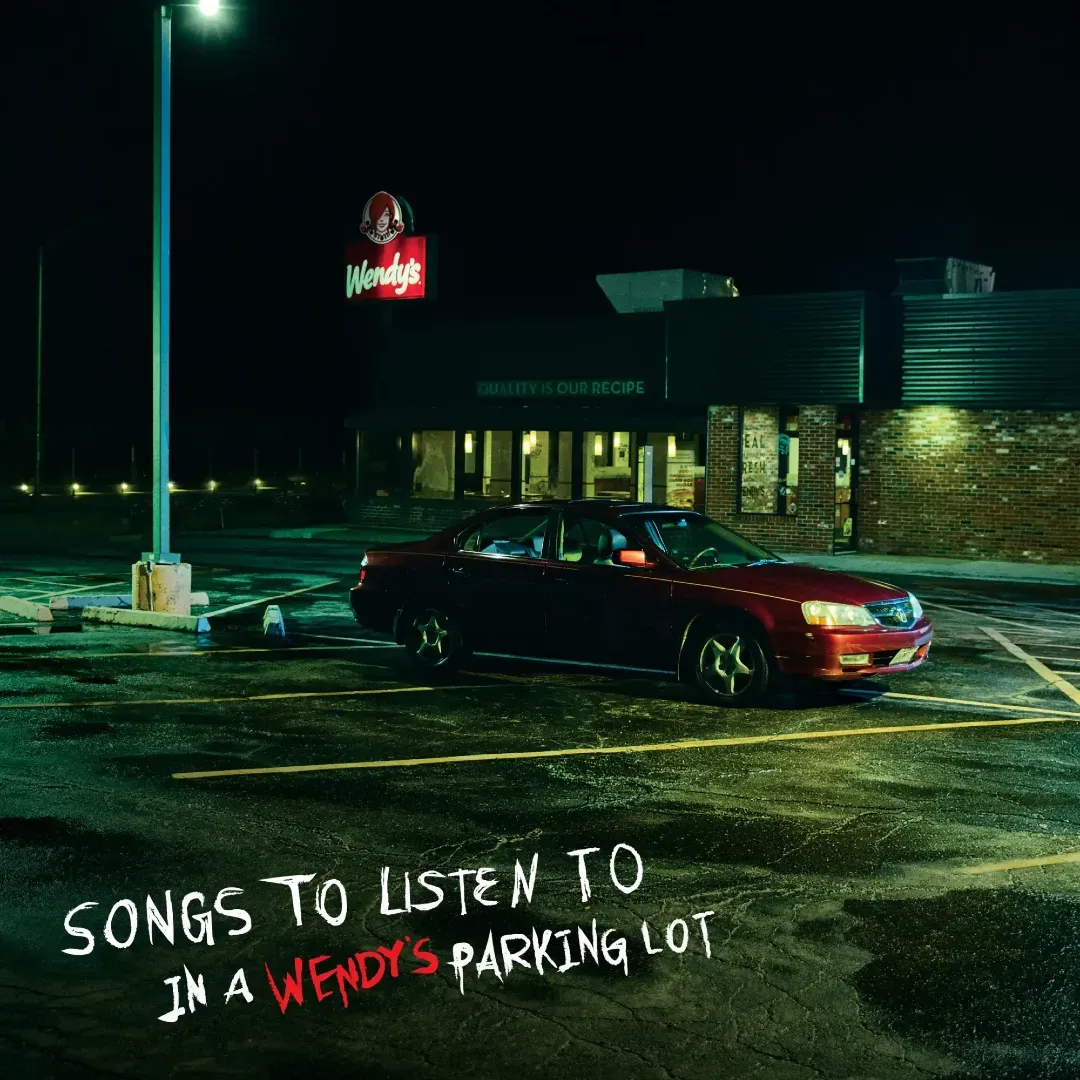
The pairing of music and fast food is a long-standing tradition. Wendy’s has done this itself once before, releasing a hip-hop mix tape in 2018 called We Beefin’ in reference to its famous 1980s slogan “Where’s the Beef?” KFC released a chicken bucket with the lid doubling as a playable flexi-single in 2024. Taco Bell has worked with pop artists as ambassadors for its brand, including Olivia Rodrigo and Doja Cat, both of whom have artistic and aesthetic nostalgia for the decades that came before them. But there is something about an EP of emo songs that feels especially poignant to this moment of desperate CEOs seeking to redeem their standing with a lapsed fanbase. The days of snarky social media managers starting ironic fights between mascots in order to raise awareness of their brands have grown stale. The marketplace now belongs to earnestness as a commodity, and there is no better place to fake it than within the confines of an emo song.
To tease the release of the record, Wendy’s social media subtly changed the iconic red headed girl in their logo — modeled after Thomas’ daughter Melinda, who inspired the brand — to have a hint of heavy eyeliner, all washed out by a moody filter and just the right amount of sparkle and grit. As if the logo is just another impossibly perfect girl at the receiving end of an emo song. The idea of a woman who was once so loved and loving, who isn’t real but doesn’t need to be in order to be the representative of so much misdirected anguish. Below it, the caption read “it was never a phase,” a line that has become a meme in post-emo online culture associated with teens, and the Hot Topic branding of emo in the 2000s.
Wendy’s has gathered the cold bones of nostalgia together, eager to reform them into something that feels like home. All of us who remember how it felt to bask in the glory of the sunroom, who cried in the parking lot of a Wendy’s that has since been renovated or demolished, have grown older. We’re elder millennials who linger at the perimeter of middle age. Nostalgia is a marketing tool that works to recapture the attention of any generation that feels time melting in their hands. This recreation of the music that was once the soundtrack to perfect fries on the days when our hearts were so fresh and new that they were easily broken. It’s not real, but it's not supposed to be. This product manipulates myriad memories into an idealized singular vision of the past. There is also a generation aging into young adulthood that is resistant to the uncertain future we have left for them, and are eager to know how those lost days felt. They’re buying Discmans and CDs without having memories of them. They’re being sold the stories of scars that have yet to bleed or heal.
Emo, and the music that broke and built us, deserves better than this. Recreated here with such intricate, expensive detail in order to be dangled so coldly in front of us, eager to lure us back into the drive-thru. As if we might feel like we used to again. Maybe a minimum-wage-earning worker will take pity on our sad and desperate feelings once more, and give us fries that will come out of their paycheck so that we might feel fleeting, perfect pleasure again.
Ravenous is an independent worker-owned food culture publication committed to publishing the stories you won't find anywhere else. We're also committed to sharing unique voices, to give you more than the run-of-the-mill celebrity churn you'll find elsewhere. But to do that without sponsors, we need reader support. Don't make us cry in the parking lot, subscribe today.


