

The first time I ordered Insomnia Cookies was well over a decade ago, around 2014, when one opened in my neighborhood. I was living in a converted bank in Manhattan’s Financial District. The area was underdeveloped with restaurants and bars, so the options on Seamless were limited. It felt like a novelty to only be able to order cookies from a place and have them delivered into the wee hours of the night. I placed an order (in the afternoon). They arrived in a pizza box with a fair amount of grease in the bottom. The cookies were warm, soft, and absolutely cookies in the most basic sense of the pastry. They tasted… fine.
In 2026, my experience of Insomnia Cookies is exactly the same as it was in 2014. I picked up a box from its location on Dallas’s Greenville Avenue one summer afternoon to find the pizza-style box was less greasy, and the cookies exactly as I remembered them. As they are at its 350 locations across the country. The national chain’s signature sameness is the point; this comfort food can give you a hit of something sweet and nostalgic that is delivered quickly to your door.
Cookies appeal to consumers, but also to private equity investors because they are a limited-ingredient item with reliable margins, the recipes and business model are easily replicable which means the business is easy to scale, and the option to create multiple points of sale with branded dough or items in places like grocery stores offers multiple potential revenue streams. Perhaps most importantly to private equity (PE) firms, customers are willing to pay an ever-increasing price for cookies.
Private equity loves scalability, and the cookie business checks that box. Research and development-driven bakers, alongside food scientists, can elect to limit the offerings in order to control the budget, and lower-cost items can be swapped in if certain ingredients become too expensive. If some of the most successful cookie companies in the country are any indication, consumers don’t always care if an actual baker, let alone family history, is part of the story of the brand. Which seems wild to me — surely a cookie company needs some cookie experts to make the best product, right?
But the founders of the most wildly successful bakeries with the most locations seem to have pulled cookies out of their collective asses. And the PE business model is to buy a company, or a stake in it, and treat that money like a loan. The company pays it back. But the PE firm goes in with the intention of selling the company in a few years, after it has wrung as much cash as possible out of the operation to get the company’s shareholders a return that is higher than the stock market. That’s why PE investments usually mean opening lots of locations, inflating costs of goods, and enshittifying the product.
Seth Berkowitz started Insomnia as a cookie delivery service at the University of Pennsylvania in 2003, where he brought warm cookies to dorm rooms for 89 cents each. He invested $150 in materials to start and made $10,000 in profit after a semester. He was personally baking them in his dorm, and it shows in the final product. The cookies aren’t fancy; its most elevated offerings are on the deluxe menu, and most of them don’t have costly or complex ingredients save for the peanut butter cup chunks. Each deluxe cookie now costs $4.69 in Dallas. Over the years, it has added brownies, ice cream, and vegan cookies to the menu as well.
Today, Insomnia’s price point is closer to $2.54 per cookie in a six-pack for a pickup order in Dallas, at just shy of a 65 percent increase from the original price. As a point of comparison, at the nearest H-E-B, Pillsbury ready-to-eat or bake cookie dough that makes 24 cookies (and, according to me, is extremely close in taste testing to what Insomnia offers) costs $4.05 for a package — or 33 cents a cookie.
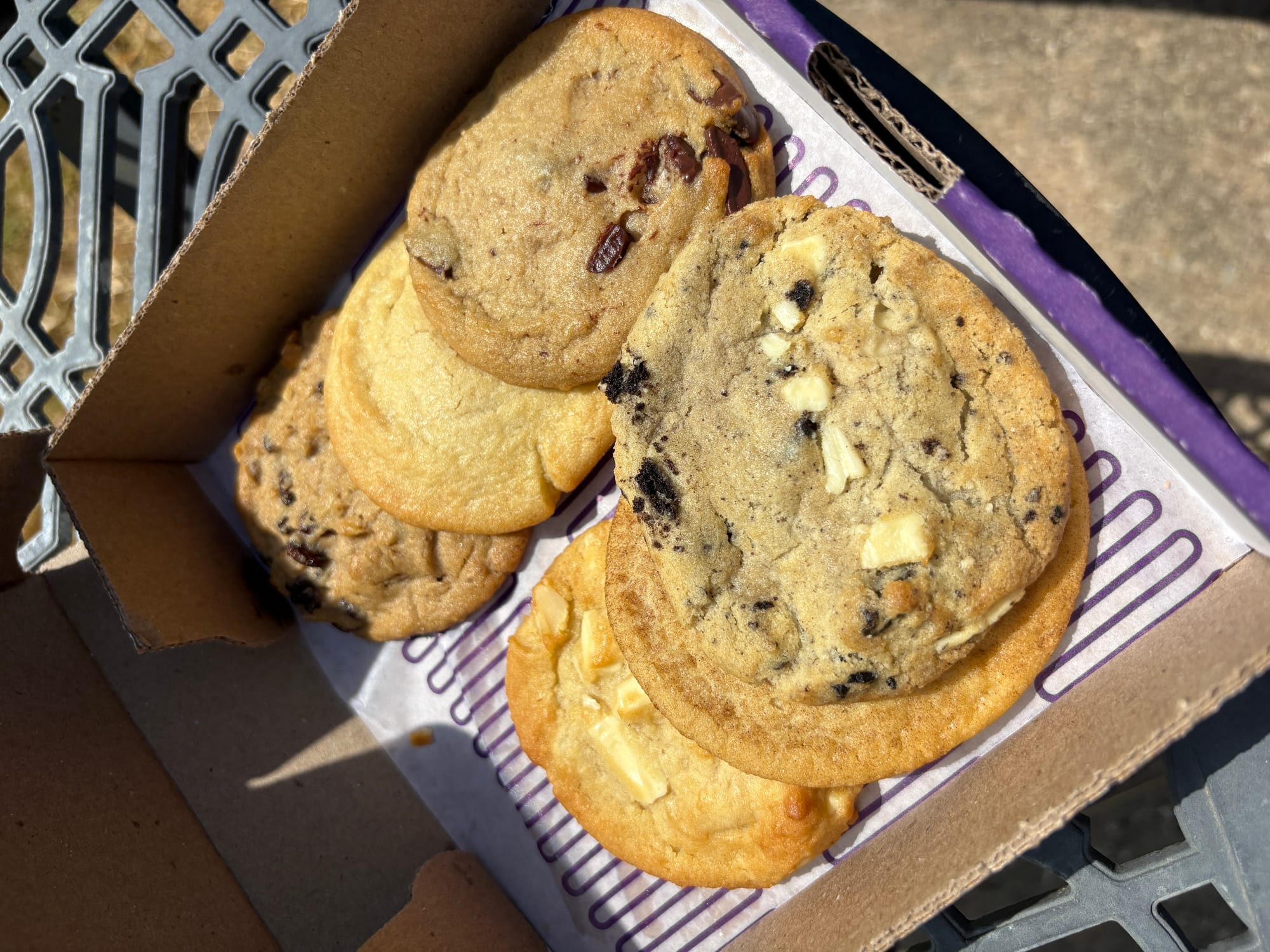
Insomnia has gone through a few owners, including Krispy Kreme’s parent company, JAB Holding Company, which acquired a majority stake for $140 million in 2018. In 2024, after it earned $200 million in profits, that company sold a majority stake to Verlinvest (a family-backed holding company that is private equity with a different corporate structure which also has an interest in Oatly, Vita Coco, and Tony's Chocolonely) and Mistral Equity Partners (a private equity and venture capital firm that mainly invests in high-growth companies). The two firms increased their stake in 2025, buying out Krispy Kreme altogether. The goal, according to a press release, is to grow Insomnia Cookies to 1,800 locations globally in the next decade.
That’s a lot of greasy cookies. And even more profit.
The even bigger cookie company with private equity ties is Crumbl, which has around 1,095 locations in the United States, with more in Canada. It was founded in Logan, Utah, by a pair of Mormon cousins, Sawyer Hemsley and Jason McGowan. Hemsley was a college student at the time, and McGowan describes himself as a tech guy who worked at Ancestry and founded a social media network for Brigham Young University and an unsuccessful competitor to Pinterest.
The goal, allegedly, was to make the world’s greatest chocolate chip cookie. Neither of Crumbl’s founders were bakers or had any experience in hospitality or food. In lieu of a point of view of their own, they A/B tested various ingredients, notably semi-sweet and milk chocolate chips. Crowdsourcing taste buds is certainly one way to do it. They love telling people they asked strangers at gas stations to weigh in on recipe testing, and that is, frankly, weird. It is unclear at what point they consulted a professional baker; that’s not part of the story they want to tell about this cookie empire.
Loving this story? Hating PE cookies? If you've got a little something to drop in our tip jar, it will help us create more stories like this and keep us away from soulless cookies. Every little bit helps.
With a crowd of students from Utah State University to feed, the first store and those A/B tested cookie recipes proved so successful that there were lines out the front door. Without knowing much about the business of hospitality, the founders opted to toss 11 different types of cookies on the menu and created a bottleneck in supplies, manpower, and customer satisfaction. That went badly enough for them that they decided to limit the menu to six cookies each week, with a few on offer and others rotating to keep things interesting. That is also strange; most bakers don’t have a problem managing a menu of 11 cookies.
One thing Crumbl has going for it is social media popularity. The cookies regularly go viral; they have a massive following on social media and are frequent influencer bait for reviews, largely owing to the colorful nature of the cookies and their large size — over four inches on average. As you would expect, popularity on the internet does not have a quantifiable relationship to the quality of the cookies. The founders frequently talk about the fact that they have millions of followers on TikTok, more than some major brands like Starbucks or Dunkin’.
But what does that massive following mean? TikTok’s algorithm serves up a mix of content it thinks an individual user will like, and followers mean close to nothing on that platform. They also brag about the hundreds of millions of TikTok videos about the brand on the platform, but those are not all positive. It has become as popular to talk about how overrated these cookies are as it is to make a haul video, if my For You Page is any indication. I guess if you’re not invested in the end product, all brand awareness is good brand awareness.
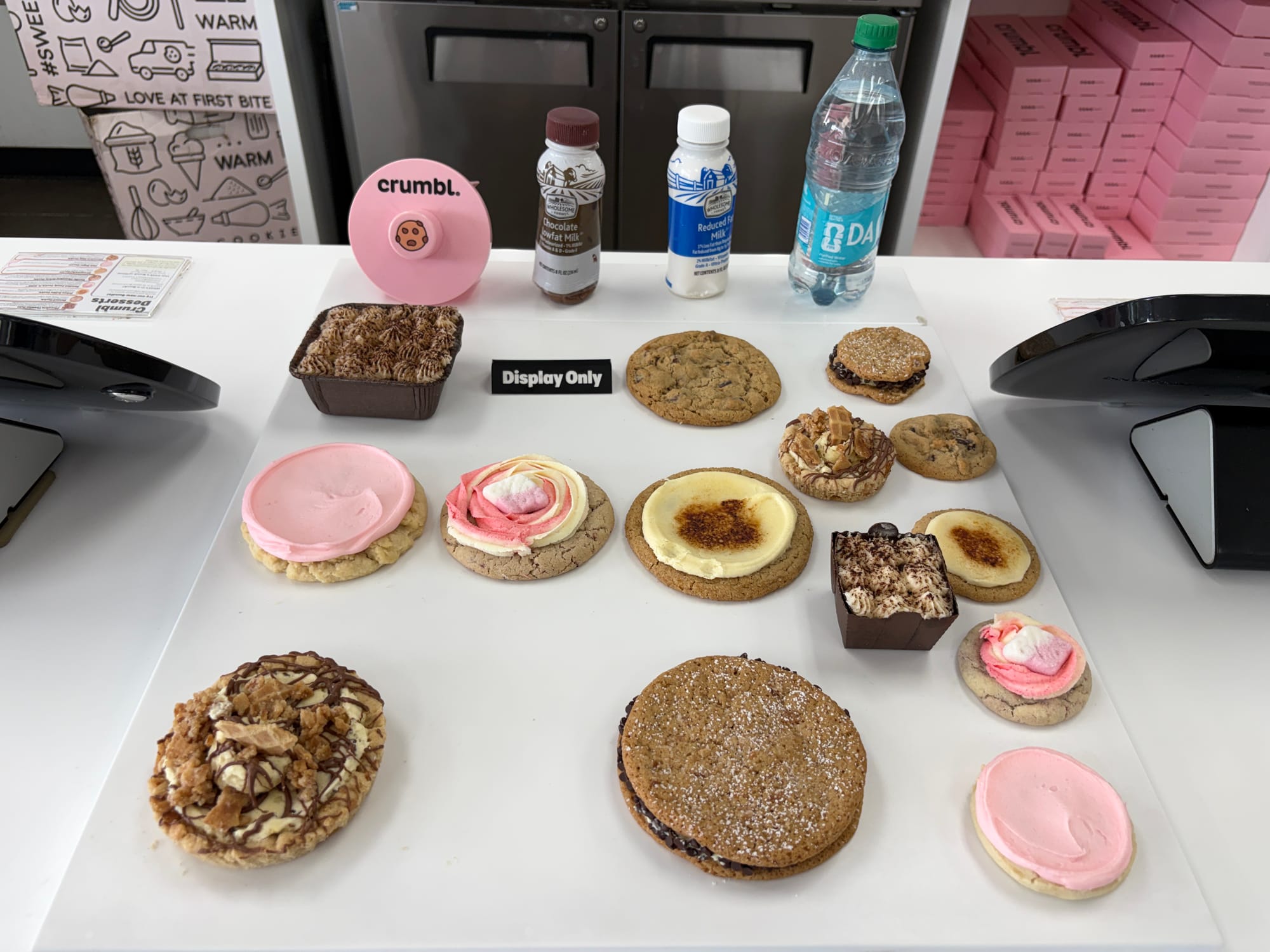
I recently picked up a four-pack at my local Crumbl, which is in a shopping center bookended by an At Home and Sam's Club, two of the most depressing places in the known universe. One on offer was a cookie I’ve seen before, a sugar cookie topped with pink buttercream frosting. The cookie was crumbly and dry as the desert in my mouth, despite being soft. The frosting did not taste of strawberry or raspberry, and not even the almond extract it is supposed to contain. It tasted like sugar — and with roughly 60 grams of sugar in this recipe, it should. That is nearly double the daily recommended allowance for an adult. Sugar is the “secret” ingredient in most of Crumbl’s cookies.
Crumbl likes to tout that it made $1 billion in sales starting in 2022, but that amount is calculated using franchise sales, not profit. That the cookie company chose a franchise model is telling. The franchisees pay a royalty fee to the corporation, along with fees, and are beholden to buying from certain suppliers, which makes the margins on cookies at Crumbl quite slim. Generally, franchisees have more control to grow the profit margin by adjusting one thing they have control over: Employee salaries.
There is rarely health insurance or paid leave in these jobs, and many Crumbl franchises lean on the part-time employee model, hoping to hire students at as close to minimum wage as possible. It affects the quality of the cookies, too. My pink sugar cookie icing was still frozen (the cookie is supposed to be chilled) when it was served to me in a four-pack of cookies, because I didn’t order in advance and the young person behind the counter was rushing to get my order ready. It still didn’t come quickly; the complicated nature of many Crumbl cookie recipes means many need to go through an assembly process, be it warming or icing application, to be ready for consumption.
Crumbl sold a minority stake in its company to TSG Consumer Partners, which also has an interest in Pabst Blue Ribbon, Dutch Bros Coffee, and Arrowhead Mills, in May 2025. The partnership is focused on expanding the business, especially outside of the U.S. There have been reports for over a year that Crumbl’s owners are interested in selling the company for $2 billion. It’s hard to believe that these people care about making great cookies as much as they crave taking your money — while charging $5 for an imperfectly warmed treat.
The cookie business is tempting a lot of PE and VC money. NYC-based Chip City got a Series B investment from Shake Shack founder Danny Meyer’s Enlightened Hospitality Investments in 2024, with an eye on high-growth potential (in June, the chain abandoned the Chicago market, closing all stores). Texas-based Tiff’s Treats has raised millions from four different PE firms and celebrity investors, including Dallas Mavericks great Dirk Nowitzki, jewelry empress Kendra Scott, tennis legend Andy Roddick, and model Brooklyn Decker. NYC-based Levin Bakery was acquired by Stripes, a PE fund with its fingers also in numerous AI products and pricey grocer Erewhon. West Coast bakery Fantasy Baking Co. is still backed by Shore Capital Partners, which also has an investment in Chicago-based Sweetmore Bakeries, which recently acquired Fantasy Baking Co. The snake is eating its own tail with that one, seemingly. And that’s just scratching the surface.
One outlet calls all of this a “global PE feeding frenzy” in the baked goods space. There has clearly been a re-evaluation of consumer desire for these goods and the level of volume it can maintain. As a consumer, however, do you really want to eat soulless cookies?
Is the convenience of going to one of the 800- or 1,000-plus locations better than the value in finding a local baker who is doing it for love of the game? A few weeks back, I went to Walkers, a bar and bistro in Dallas’s Lower Greenville neighborhood, just blocks away from Insomnia. I got a six-inch chocolate chip cookie sprinkled with sea salt to go with my focaccia sandwich and chips for lunch. It cost $6. I had a long conversation with the person behind the counter about her chest tattoos, which she’d given herself.
I don’t know anything about the cookie specifically, but I know Walkers was started by a brother and sister who’ve been working in hospitality in Dallas for awhile, and I ran into a chef I knew at the lunch counter and an editor I write for later as I was leaving, having lunch with someone too. They just hired a pastry chef, Mery, whose career I’ve been following for awhile, and I got to say hi to her. I realized she probably made those cookies.
It was just a chocolate chip cookie. And it was damn good. That was its story. I didn’t regret paying $6 for it at all, especially knowing that all six of those bucks were going to a local restaurant, not a bunch of bank vultures.
 Amy McCarthy
 Courtney E. Smith
Update: Thursday, September 10, 2026, 5 p.m. CT: A note about Levin Bakery's PE backers was added to this story.


