

I recently went to a friends and family night for a new-to-Dallas location of a California restaurant that made me consider breaking out an app that would scan the menu and read it out to me. In fairness, there were lighting issues that an actual electrician was working on during dinner, with lights flashing on and off at one point, so it's hard to say if the low-light, tiny font size that for some reason got lighter for the food descriptions, or my increasingly worsening reading vision was to blame. Is there an app to scan menus and change them into a readable font? For some people, that is where they turn to an AI chatbot, like ChatGPT, Claude, or Google Gemini.
After our server recommended the spicy rigatoni (not what it was called on the menu, but she translated it into Carbone parlance for us), I started to doubt all her recommendations. I did a double take, and she doubled down, telling me she’d worked at some of the many, many, many other restaurants in Dallas that serve the dish, but this one is really good. My best guess as to why is that this place sprung for better tomatoes; there’s only so much that can be done to vodka sauce. But it made me panic a little that she thought I was the type to order this dish. Don’t I look like an adventurous eater? Not the sort to order the best-selling item on the menu, but the one the chef(s) love best? Do I have resting basic bitch face???
I crashed out after a confusing conversation about what on the wine list was and wasn’t available and turned ordering duties over to my companion, whose friends working in the kitchen were the only reason I was there. The service overall was solid, especially for a pre-opening service. But our server was busy with a full house; there was seemingly no sommelier to ask about my wine list questions, and she had no idea about my vendetta to eradicate the cult of spicy rigatoni (it is one of many).
These are two situations that could drive a diner to pop open ChatGPT, or another AI chatbot, to scan the menu. There is a wealth of reviews and data about this restaurant’s two other locations, so it could probably give me some recommendations. Hell, if I Googled the restaurant, Gemini’s AI summary would probably spit out something about the dishes there. And at the very least, AI could make the menu legible in low light without having to resort to the equally annoying habit of turning on your phone flashlight.
At this point, many people are using generative AI (that’s “artificial intelligence” that can create original content like artwork, writing, or code, trained on and drawing from human work) at work, often at the behest of their employer, to do simple tasks like writing emails or doing basic research for stuff they would have previously looked up themselves. It’s summarizing meeting transcripts and emailing action items. According to a Pew Research poll conducted in 2025, the majority of Americans are using it regularly — 27 percent of Americans say they use AI multiple times a day, while another 30 percent use it at least once a day to several times a week. It is becoming more and more pervasive. It was inevitable that it would make its way into restaurants.
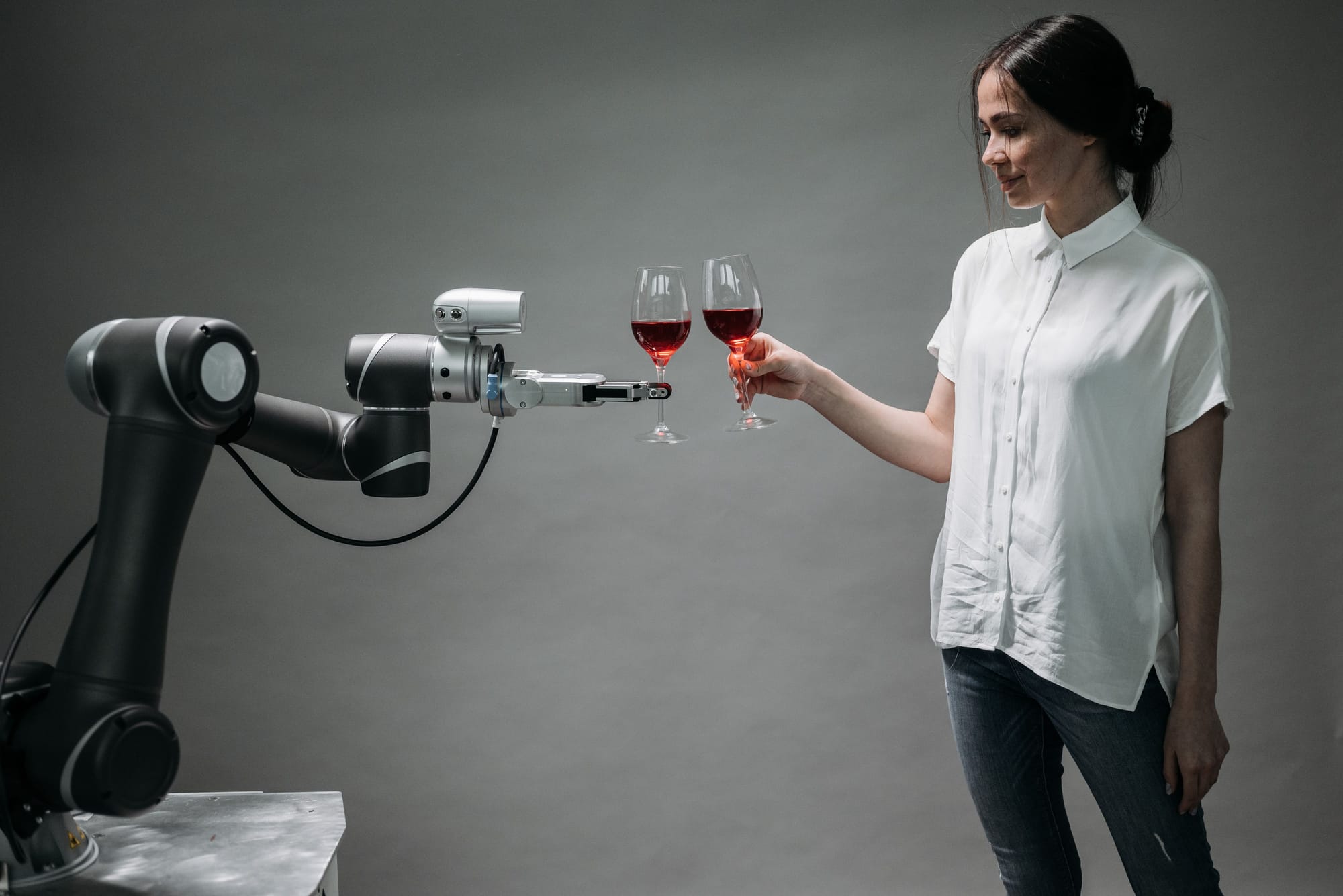
I started asking folks who work in hospitality last year if they were encountering questions from guests about menus, ordering, or costs from guests that referenced AI, and was told by Jacob Fergus, general manager and sommelier at Quarter Acre in Dallas, that he has seen it at the table. He’s seen people use their phone to ask ChatGPT questions in the same way they might turn to a search engine.
“I haven’t seen it for food,” Fergus says. “I think that’s because AI can’t taste and people have a better understanding that lamb is lamb. Whereas with wine, we’ve got regions, grapes, vintages, and prices that are more black and white for an AI to understand.”
Some guests are even trotting it out to test the service. One of the most surprising stories I heard was from Ally Nault, beverage director for Duro Hospitality in Dallas. One of her guests asked if she’d be willing to go toe-to-toe with ChatGPT in picking their wine for the night. They’d already run the wine list through it, requested a certain profile to go with what they planned to eat, and asked it to pick a bottle of wine for under $100 from the list. I was offended on her behalf, but Nault seemed excited to see how it played out. “My guess was that it said Garzon Albarino because it was just ranked a top 100 wine on Wine Spectator. It’s latching on to that fact, and that’s why it's recommending that bottle of wine to you,” Nault recounts.
It is worth noting that Wine Spectator arrives at the scores it assigns to bottles of wine after multiple blind taste tests by humans; AI could not rank a wine in any replicable way. The “knowledge” AI accesses to generate an answer to anyone making this query is built on the work of humans that it scrapes and synthesizes. Nault admits the guest’s chatbot chose a great bottle of wine, ”However, AI didn’t ask you what your palate is like.” And that, Nault notes, is the whole point of a sommelier — to ask what you like to drink, if there is a bottle of wine you’ve had before that wowed you, or a bottle that you especially did not like. With those references in hand, and her deep first-hand knowledge of wines on the list, she made a second recommendation. The customer, she says, bought both. And liked her recommendation more.
While Nault might have enjoyed the game, there is now a note atop a page in the wine menu at Duro’s newest restaurant in Dallas, Scilla, that she says was inspired by our conversation. “Don’t want to read the novel, no worries! Here are a few wines of note, one could say a ‘SparkNotes Wine List,’ no AI needed.”
Not all diners are so egregious in their behavior. Chicago diner Amanda Gaeta Peters says that when she uses AI to search a wine list, it’s usually to narrow down the options before she asks for a recommendation. She likes Claude, which her husband calls “her boyfriend.” “In the moment, when I’m handed a giant book of things, I don’t even know how to describe my own taste in wine well,” Peters says. She’ll refer to a note on the phone of her favorite wines, but barring seeing any of them on the list, she snaps a photo of the wine list and asks Claude what is closest to wines she normally loves. “I at least have a direction to ask a more guided question to the sommelier or server,” Peters says. “I know that’s their whole thing… but I’m also aware that it’s usually very busy in a restaurant. I don’t want to take more of their time.” She says she usually takes the suggestion and can tell by their face when she frames it by saying she’s thinking of ordering one wine because she likes another, whether AI got it wrong or not.

At Quarter Acre, much of the wine list is sourced from New Zealand and Australia, Ferguson says, and while the list isn’t a book, it is full of bottles from vineyards that Texans are less familiar with and might run through an AI assistant. “My understanding is that the technology was mostly looking at the vinho [the regional classification of the wine] or looking at reviews and saying, This wine has the word butter show up in its tasting notes more often than the others, so you should drink this wine. That’s one level deep,” Ferguson says, noting that it can be helpful for diners or guests who feel intimidated or don’t want to have a conversation about price publicly. This could, broadly, make it a helpful tool for people with anxiety or avoidant personality disorder, especially if they feel there are no other options to help them through the interaction.
“Think about those 100-page wine lists,” Ferguson says. “Give that to AI and say, ‘I want to spend $200 on a bottle of wine, and I love full-bodied Italian reds. What should I order?’ That’s a wine 101 question that AI can take care of for guests. All they have to do is say, ‘I want XYZ bottle of Super Tuscan, please,’ and job done.”
Tim Waldron is exactly that kind of guest — sort of. His penchant is for cheap Chardonnay, but not the buttery type. Waldron worked for a Fortune 500 company, leading the business’s use of AI. “Not to toot my own horn, but I’m very good at it,” he says. “I’m not using it like Google. I’m using it to vibe code.” He’s customized his AI agent in ChatGPT, his platform of choice, and developed a library of memories about himself and his preferences. He uses it to streamline his wine orders, but he wants to experiment to see if he can train the app to pick food items he’ll like and should order. “I spend a lot of time with my AI to have it know as much about me as possible, mainly around my way of thinking and my expectations of output,” Waldron says. “I don't know how many hundreds, if not thousands, of hours that I’ve put into that.” Waldron has some specific complaints about Chardonnay, including that it can be over-oaked, and that it is frequently the most expensive thing on a restaurant menu, only available by the bottle, or not available at all because it doesn’t go with the type of cuisine. His AI agent is well apprised of his tastes and, he says, helps him work around Chardonnay missteps.
Waldron is also the husband of a food writer, Erin Perkins, who is a former colleague of mine at Eater, covering the Carolinas for a decade, and later the entire South. She now has a food blog of her own, Cooter Soup, that covers the Charleston food scene. For Waldron, it can be challenging to dine with a partner who has eclectic taste in wine and is also a food writer. “The menu is much more open for folks like her,” Waldron says. “Whereas for me, it’s limiting.” And Waldron frankly doesn’t like asking sommeliers for guidance after they’ve talked to his partner. “The nice thing about AI is that we can ask it the questions that we probably wouldn’t ask our own doctors. I find the degree of privacy quite useful, because I'm kind of embarrassed that I drink Chardonnay,” he says.
Waldron also describes himself as “kind of a nerd,” and a visual learner who has an easier time reading the menu to parse it than listening to a sommelier talk. At the same time, he is dyslexic, so some assistance with reading helps him. AI agents can provide personalized decoding support, adaptive practice, and cognitive load reduction, the University of Michigan found in a report on AI’s capacity to help dyslexic students. It isn’t, as some might suggest, totally evil.

To power these tools, AI companies are building thousands of data centers all over America, the larger of which can require 5 million gallons of water a day, while the smaller ones use roughly the same amount of water in a day as a small town, according to the Lincoln Institute of Land Policy. Their growing demands on the power grid are producing loads of excess urban heat and could cause an increase in greenhouse gas emissions along with air and water pollution, the Yale School of the Environment found. The electricity not only runs the AI, which is constantly training on new material to get better at tasks like recommending wine, but also powers the water needed to cool the computers. And in many places, AI companies building data centers are passing the cost of that electricity use on to consumers. A report from the United Nations predicts that electricity and water use from AI data centers will double in the next four years — and they already have a footprint that is roughly the same size as the entire country of Argentina. The data centers have become massively unpopular and face growing protests and community backlash.
As our use of AI evolves, so does its use in restaurants. “In the last year, I’ve started to see some really in-depth stuff that guests and, really, AI models are able to do,” Ferguson says. Price tracking to understand the mark-ups on wine and search for the best value on a menu are up, he says. AI searches out wholesale costs, retail pricing, and shipping pricing on bottles, and tells guests if one restaurant is marking up the costs more than another.
“But AI can make mistakes,” Ferguson adds; most LLMs are built on scraped text that quickly becomes outdated, or hallucinate answers that just aren’t true. “What wine costs me might be different than a restaurant down the street, based on volume purchasing or corporate deals. What it costs a restaurant in Texas is not what it costs in California or Louisiana or New York.” AI’s reasoning, on a basic level, also finds it hard to factor in when wines are priced differently because they’re sold by the bottle or by the glass, with the latter having a higher markup cost because of the amount of waste built into the price, he notes.
Wine has been growing more expensive year-over-year for myriad reasons, which include various tariffs from the Trump administration and issues with growing due to climate change. That’s where Ferguson sees an opportunity for a sommelier to jump into the conversation and explain the value of wine beyond numbers. “Yes, some glasses of wine at Quarter Acre, our guests can find at Central Market or even H-E-B sometimes,” he says, referring to the upmarket version of the Texas grocery chain and its everyday iteration in this hypothetical. “I’m so happy [about that] because I want you to get it whenever you want an easy-drinking Sauvignon Blanc, and I want you to have it for the same reasons I pour it by the glass: It’s family-owned. It’s sustainably grown. It’s a single, contiguous vineyard of Sauvignon Blanc. And it’s great for all those reasons.” Ferguson says he will happily justify, in a gracious tone, everything about the markup to that glass of wine, including the cost of the glassware, of inventorying it, of storing it, and of serving it — all the human factors that AI struggles to account for.
“I think many of our guests are doing what I am doing, and feeding information to Chat for the first time to see what it can do,” he continues. “If I can just be the other voice in the room and say, ‘Hey, I can probably tell you why Chat is saying that but give you more context.’ I’m okay with that.”
Ravenous is proudly AI-free in our writing, editing, research and visuals. Support independent media by becoming a subscriber today!


