

Ask most people and they’ll tell you HAGS is a tasting-menu restaurant. From Wednesday through Saturday, the plush, soft-toned jewelbox in Manhattan’s East Village serves both its omnivore and a vegan tasting menus, often with some overlap (both currently include a dessert made with rhubarb, “our favorite leggy redhead!” exclamation point included). Add in the optional wine pairing, and the meal will run you over $200 a person. Not the most expensive meal in New York by far, but one for which most people would have to specifically budget for.
But if you ask the restaurant’s co-owner and chef, Telly Justice, a two-time James Beard Award semifinalist, HAGS is a pay-what-you-can restaurant. Since opening in 2022, the restaurant has operated a pay-what-you-can brunch on Sundays, where an a la carte menu might include anything from a cacio e pepe frittata stuffed with spaghetti, or cornbread French toast with miso and smoked maple syrup. Sunday afternoon’s offering is the entire point of HAGS. “Our business model was reverse engineered to pay for the pay-what-you-can service,” Justice says.
“The whole reason HAGS is a tasting menu restaurant, and the whole reason it's expensive, is so that we can have this one day a week that is essentially paid for and we can operate at a loss.”

When Justice talks about pay-what-you-can hospitality, she leans in. Her eyes light up. She sounds clear and sure — like she’s delivering a sermon, like she’s certain she is going to change your life. Perhaps she needs to sound like this, after undoubtedly encountering so many in the restaurant industry who think telling diners they can just pay whatever they want is a ridiculous proposition. But also, she has her pitch down because she is on a mission to spread the gospel of pay what you can.
In March, HAGS launched a traveling pay-what-you-can dinner series with restaurants across the country as Justice and her team visited Madeira Park in Atlanta and Joodooboo in Oakland to help host one-night sliding-scale pop-ups. Even before that, she’s been in the DMs of other chefs, convincing them to have her over to teach them how they too could implement this model — and really, that they should.
Restaurant margins are tight, tariffs and the war on Iran are inflating ingredient costs, and the rent is too damn high no matter where you go. As even the most successful restaurants struggle with how hard it is to keep the doors open, why would you voluntarily operate at a loss for even a day? Haven’t you considered the margins? This isn’t how Justice thinks. “I came to food through the punk community. I really didn't have a relationship with cooking at all until I started to see people doing things like Food Not Bombs,” she says, referring to the decades-old mutual-aid movement that distributes free food across the country, often in concert with protests and other political gatherings. She began volunteering with them as a young adult in Atlanta about 20 years ago. Quickly, she learned how good it felt to serve other people, but also, “how systematically restricted generosity around food is in the country.” Laws around food safety and handling (generally a good thing) were used to shut down distributions, where it became obvious the cops didn’t care about E.coli so much as the idea of anyone getting anything for free.
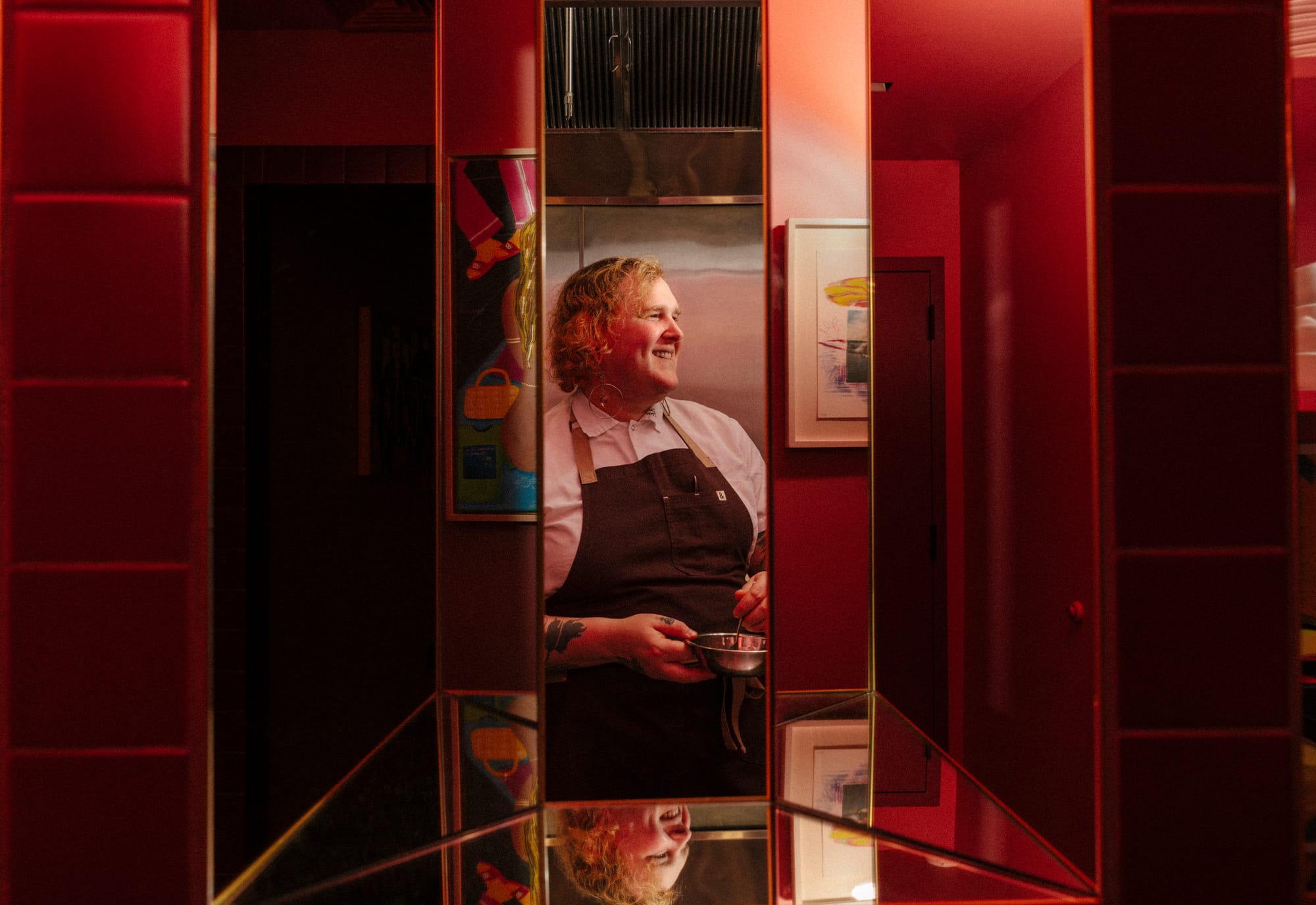
HAGS began as a pop-up while Justice was furloughed from her job at Manhattan’s Contra during early COVID lockdown, hosting sliding-scale dinners or $35 tasting menus with HAGS co-owner and beverage director Camille Lindsley. Justice’s experience with Food Not Bombs informed her approach in “considering the margins” of a restaurant business. Serving an expensive tasting menu four days a week allows not just for HAGS to pay higher-than-average wages (“$25 to $32 an hour, with tips,” says Justice), but also for a day where they can risk not making anything. The entire restaurant menu is designed around minimizing waste, meaning “the food cost for brunch specific inventory is incredibly low,” and instead of hourly workers, HAGS usually relies on salaried managers to staff Sundays, so labor costs are easier to plan.
It’s built to be sustainable, and it has to be, because for those who rely on HAGS for a Sunday meal, “it's really important that people can trust it'll be there from 11 a.m. to 3 p.m. every single Sunday,” she says. “We're not moving around, we're not getting shut down, we're doing it all the time.”
Justice obviously didn’t invent the sliding scale restaurant. The concept has a long history, inspired by everything from punk anarchy to a Christian sense of goodwill toward men. In 1931, Clifford Clinton opened Clifton’s Cafeteria in Los Angeles, which had a “pay what you wish” policy and services to help diners find jobs.Jon Bon Jovi’s nonprofit, which will be honored by the James Beard Foundation in June, operates two suggested-donation restaurants in New Jersey. Last year, Mark Bittman opened the sliding scale Community Kitchen in Manhattan as a pilot project for potential future expansion. And this year, Minneapolis’ Post Modern Times transitioned into being a “free and donation-based restaurant,” in reaction to ICE’s continued occupation of the city.
Those last three examples, however, are nonprofits. Just in reporting this story, I’ve gotten side-eyed questions from family and friends about the concept of a for-profit restaurant willingly risking their bottom line. Do they all just have rich benefactors? Wouldn’t people cheat? Wouldn’t people see this as a way, horror of horrors, to get something for free? Well, yes — that’s the entire point. “I want people to use it and abuse it however they want,” she says. There is no “abusing” a restaurant that actively wants to give you food for free.
This is the thing that tends to break people’s brains, even if they’re not opposed to “charity.” Definitionally, a restaurant exists to make money, and it runs counter to our capitalist programming to believe that can happen if people are allowed to opt out of the check. But mostly what Justice sees is people coming to HAGS “with a lot of earnestness, and they match our generosity.” She estimates about a third of Sunday customers pay less than the ticket price, that 5% don’t pay at all, and there are plenty of regulars to whom servers no longer even deliver a check. And because the restaurant is built around tasting menus and wine pairings the other days it’s open, Sunday would still work even if no one paid. “It's the same ethos we had when we were dumpster diving behind Whole Foods in 2005,” she says. “This idea of let's get this good stuff that's just going to waste, and let's turn it into really yummy food and share it with people.”
Chef Ari Miller wanted to cook with Justice in any way possible. In 2022, his restaurant, Musi, shut down because of the effects of the pandemic, and he spent a stint in New York working in a corporate-run hotel restaurant, only to find himself burned out. Miller landed at Philadelphia’s Post Haste, a celebrated cocktail bar that emphasizes local ingredients and low-waste techniques. The bar had cycled through a few chefs in the kitchen, and Miller brought stability along with a shared ethos, having a “desire to do something more meaningful than just getting some Sysco food with the occasional farm order and calling it a farm to table restaurant.”
On his last night in New York before moving back to Philadelphia, he and his wife visited HAGS. “Going into HAGS felt like you were walking into the womb of patience and understanding,” he says. And while the mission first attracted him, the cooking is what impressed him the most. Miller reached out to see if Justice wanted to come to Philadelphia and do a pop-up.
“He was the first one to really lock in and show not only an interest, but an enthusiasm,” Justice says of Miller. She had been trying to talk to other chefs about pay what you can, but “you call up a chef across the country and you're like, I'm gonna come there and I'm gonna cook some food with you and we're just gonna let them pay whatever they want, to us it sounds normal, but to them it's the craziest shit.” But Miller wanted to hear about how the whole process worked, and could be implemented on a wider scale. The two collaborated on a Saturday night sliding scale dinner in November, featuring dishes like guava katsu tempeh and shiso garganelli. And since December, Post Haste has been offering a pay-what-you-can dinner menu every Sunday.
It's really important that people can trust it'll be there from 11 a.m. to 3 p.m. every single Sunday. We're not moving around, we're not getting shut down, we're doing it all the time.
There are two arguments to be made for pay-what-you-can service. The first is that it’s a good and kind thing to do. Sam Hart, chef at Counter in Charlotte, North Carolina, says they first encountered the idea of paying what you can through HAGS, and that mission-driven hospitality struck a connection. They started talking with Justice over Instagram “about the way that we operate with food culture, and what we're trying to do in the community,” Hart says. “We were like, OK we’re gonna be best friends.”
From the start, Hart wanted to build Counter to be an equitable space. It’s “owned and operated as a collective effort amongst employees,” its website states, and Hart says it has a mission to support the local community. There is perhaps an over-romanticization of the third space happening these days, but restaurants, if they work at it, have the ability to be not just businesses but places that meet the needs of a community.
And hang out with any chef long enough and you realize they often just want to feed you. The pay-what-you-can format scratches the itch that every chef has on some level, to get people to try what you make because you think it’s cool and you want to share it with as many people as possible. Which is continually at odds with the realities of pricing; typically, meals at Counter run at $225 a person. In February, Counter and HAGS hosted two pay-what-you-can events to raise money for the Ali Forney Center and the Bulb, Counter’s non-profit partner which distributes local produce for free to about 100 families a week across Charlotte.
Hart was surprised at how many people paid more than the perceived value of the menu. But also, “a few people mentioned the first time that they were able to come into the restaurant was because it was a pay what you can event,” they say. The pay-what-you-can model allows for an expanded idea of hospitality, the plain good of welcoming in more people because an experience like that is now available to them. “It's definitely something that we want to do more of in the future. I want to make sure we can feed everyone, not just a select few,” they say.
Aside from the ideological reasons, pay-what-you-can service can be a smart business decision, not in spite of but because of its anti-capitalistic ambitions; It encourages a certain kind of diner to, ironically, “vote with their dollars.” Justice says pay-what-you-can brunch itself will never be a profit driver (“We can range anywhere from less than $1K in sales on a Sunday to upwards of $3K,” Justice says, as opposed to the sales that come from multiple seatings of a $100+ tasting menu), but it is the restaurant’s “No. 1 growth driver,” with new brunch customers often returning to try tasting menu. “We’ve built trust with the community, [and] people are offering to pay more — which is not the goal but it is what they're doing democratically.” Justice says. Often, HAGS will end a Sunday earning exactly as much as if everyone had paid the ticket price.
And it’s a party. At a recent brunch, HAGS was pouring South African wines made by women vintners. The tables were filled with young queers and old East Village stalwarts, ripping at their black sesame sticky buns to a soundtrack of post-punk bops. Strangers spin around from the bar to chime in on what they overheard at a nearby table. And whatever morbidly curious instinct one might have to guess who was paying what for their food is immediately dashed by the understanding that everyone is an equal guest.
“I think a lot of us end up in the restaurant industry because we're pinko leftists or we're misfits,” says Miller. Still, he emphasizes, for the most part, that restaurants are for-profit businesses. Sundays were slow at Post Haste, and when he reached out to Justice, he and his team were trying to figure out something that would garner attention and get more people in the door. Miller thought “we can do something gimmicky, or we can do something that's meaningful.” What sold Miller on the idea of paying what you can, he says, was Justice’s argument that this could boost business in general: “She was like, people might not be able to come on a Sunday, but they dig your mission so they're going to come on a Friday.” When we spoke in March, Miller said earnings are up overall, there’s been a good community response, and that most people have been paying the ticket price for their meals on Sundays. But there are also customers who don’t pay, “and that's part of the success of this model, right? Because if that doesn't happen, then it's just manufactured.”
Pay what you can is not a one-size-fits-all salve for community building and capitalism. When I first spoke to Atlanta chef Steven Satterfield, he was a week out from Justice and HAGS hosting a pop-up at his wine bar, Madeira Park. “I love that it does open the door for some people that might want to have a more elevated experience but feel like they can't afford it,” he says. But part of why he agreed is that HAGS is assuming most of the night’s expenses: Madeira Park is covering the food costs, but HAGS is covering the labor and any potential losses. Satterfield, like many chefs, has loans to pay back, and the idea of trusting guests to pay enough to pay the bills, even just for one night, feels more daunting. HAGS is frankly a smaller restaurant, featuring a few booths and maybe four bar seats, while Madeira Park seats nearly 120. “If you take a little bit of a loss on 30 seats in one night, then you did something great for the community. But if you do that times four, then it could be a little bit more challenging.”
You can’t put generosity on a budget spreadsheet. Even if pay what you can brings new diners in the door, or all evens out at the end of the night, you build a variable like “maybe losing money” into a restaurant business because you want to, because you believe profits are secondary to a greater point about how we should be living our lives. Really, that they are second to hospitality; Money should not keep one from experiencing joy and care.
HAGS is a queer restaurant, and it is easy to assume an ethos of mutual aid comes out of that identity-driven mission. For Justice, it’s the other way around. “I don't think [pay what you can] is inherently queer, because food sharing and food accessibility and food justice is inherently human,” she says. People naturally want to make sure others are fed, “and capitalism is the new thing that has really disrupted our relationship to that.”
If it is a queer idea, she says, it is because “queer people are inherently anti-capitalistic” (though maybe tell that to Peter Thiel). It is because queer people, and people of many other marginalized identities, have largely had to build and maintain communities in the face of discrimination that we are perhaps more likely to embrace an idea like this. “It's very, very hard to find someone in the queer community who has not gone through some level of strife,” says Hart. Queer people, immigrants, people of color, are more immediately attuned to the problems systems like capitalism create, and are the first to ask “how can we lift the struggle off of everyone else? ...I think it's it that's why you see [that generosity] so much more frequently within these communities. We've experienced it and we want to make sure others see the light at the end of the tunnel.”
Later, Satterfield said even though sales that night were about 33% lower than overall cost of food, the night was clearly a hit, especially within the local queer community. “We heard from one of our servers that a guest was thanking us for doing this because they got laid off two months ago and have not been able to dine out, so it was a very special night for that guest in particular,” he says. And while he still has no plans to implement it regularly, he says pay-what-you-can “adds great value to the community at large.”
The movement is growing. In March, Justice visited celebrated Mexico City restaurant Masala y Maíz, a restaurant with a mission statement that centers environmental and social justice, and better labor conditions in the restaurant industry. Masala y Maíz recently announced “A Global Day of Hospitality” on August 26, where dozens of restaurants around the world like Kabawa and Vato in New York, Cicatriz in Mexico City, and Foxy Nişantaşı in Istanbul and — yes — HAGS, will offer pay-what-you-can service. “Paga Lo Que Puedas, Pay What You Can was rooted in why we cook in the first place,” said Masala y Maíz co-founders Saqib Keval and Norma Listman in a press release. “To open our doors fully to our community and offer the complete experience of our food and hospitality — without money being a barrier, demonstrates how a benevolent restaurant business model can also be a successful model.” Organizers continue to look for restaurants interested in participating.
Justice hopes her efforts lead more people in the industry to see a future beyond scarcity. However impossible it seems to run a restaurant, to pay your bills, to stay alive under these conditions, one day of food being more accessible to the community is better than none. “If you're already struggling, try it out. Try it once, try it for a week, try it for a season,” Justice says, “see if it does something.” How could it not?


