

In November 1982, theater critic John Simon wrote a review of a “genuinely peppy, and often genuinely droll” production of the play Hooters for New York magazine. The play concerns two younger men in a sexual entanglement with two older women, the plot moving from “predictable unpredictability to predictable predictability,” though apparently the actors are charming enough. At the end, Simon notes the play’s title is “a synonym, I learn, for knockers — you always learn something in the theater.”
This will be the last time anyone learns this information from a play. In April 1983, six men who came to be known as the “Hooters Six” (though it’s unclear if anyone but themselves bestowed them the title) founded Hooters, the bar and restaurant, in Clearwater, Florida, which found popularity due to the guarantee that it was staffed with conventionally attractive women in revealing outfits. “What else brings a gleam to men’s eyes everywhere besides beer and chicken wings and an occasional winning football season?” the restaurant’s current website recalls of the chain’s origin. “Hence, the name: Hooters. It is supposed they were into owls. Strange group.”
The restaurant, which met immediate success, relied on double entendre, insisting on a look-but-don’t-touch atmosphere that kept things at least nominally family-friendly. Though that was never really true. Almost from the restaurant’s conception, both workers and diners protested that the restaurant encouraged the blurring of boundaries. In 1993, a Minnesota server named Whitney Miller told the Associated Press that she had a regular who refused to pay for his food unless she took off her shirt. Miller, along with other employees, filed harassment lawsuits against Hooters and alleged the chain created a “corporate culture of misogyny.” In 1997, the chain paid out $3.75 million to settle a lawsuit filed by a trio of men in suburban Chicago who claimed they were denied jobs at Hooters because they were men. In 2001, a man was arrested for murdering a Hooters waitress; she allegedly met him while working. And the restaurant has faced lawsuits over hiring biases, racial discrimination, and harassment of a trans customer.
For a moment in the 2010s, it seemed like compounding forces would mean the end of Hooters. Chains like Buffalo Wild Wings and Wingstop have been ascendant, ensuring abundant, cheap options when it comes to chicken wings. In 2017, Hooters unsuccessfully attempted to compete with other wing chains by opening Hoots, an even more “family-friendly” fast-casual chain that focused on carryout orders and employed both men and women in decidedly less revealing outfits.
But Hooters also faced every business’s death knell: private equity. The chain was sold in 2011 to a group including HIG Capital and Chanticleer Holdings. After that, the chain rode the private equity merry-go-round with different owners for decades, landing with Nord Bay Capital and TriArtisan Capital Advisers in 2021. They summoned the private equity trifecta: cutting costs, raising prices, and loading Hooters with debt.
Aside from that, it seemed like a “breastaurant” was just not what the general public wanted anymore. The “hot girl serves you dinner and flirts with you” business plan seemed more and more to just be for creeps. In March 2025, the chain’s majority operator, Hooters of America, filed for bankruptcy, and two months later, Hooters abruptly closed nearly 40 restaurants. But we live in reactionary times, and the #MeToo movement revealed that some men believe their greatest threat is not being able to openly ogle women.
This past November, Hooters Inc. — the original corporation formed by the Hooters Six (which still had control of some restaurants in Florida and Illinois) re-acquired Hooters of America, and 140 of the current 198 restaurants, while promising an upgraded menu and better kitchen equipment. The original corporation, Hooters Inc., is also emphasizing — you guessed it — a family-friendly atmosphere, offering free meals for kids on Mother’s Day, and pledging that “all server uniforms will return the original look,” meaning the return of those bright orange shorts instead of the tighter and skimpier bikini bottoms rolled out in recent years.
Neil Kiefer, CEO of Hooters Inc., isn’t a member of the Hooters Six. He began with the chain in 1983 as its attorney, rising to CEO in 1992. But the 74-year-old tells People that he envisions a “re-Hooterizing” of the brand, ensuring a return to the basics like making sure his restaurants use the right sauce. And he once again insists that Hooters exists all in good fun, and that, in fact, it was private equity that was making the restaurant feel overly sexualized. “I think they went too far down the road of making it more like a little boys club hangout, and they therefore alienated the women and the families we have,” he told Fortune.
But the plausible deniability of just-some-wings-and-beer has always butted up against what much the public understands Hooters to be. Which is a place to engage in the business of sex without the taboos, the nuisance of heavy security, and the pesky safeguards that tend to exist at strip clubs. No wonder so many men in power are excited about its return.
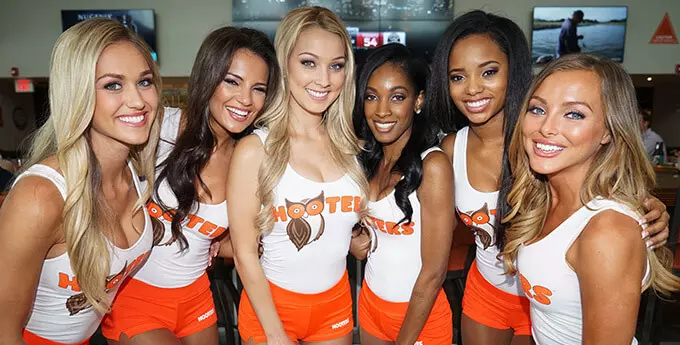
Last year’s news of Hooters’ bankruptcy sent conservatives into a panic. The neoconservative site the Washington Free Beacon argued that Trump should bail out the restaurant, saying its downturn “coincided with the Democratic Party's malicious efforts to shame men for liking boobs.” A Fox News panel similarly argued that “Bidenomics is Destroying Hooters.” Hulk Hogan’s Real American Beer even declared it would bid on the company to save it from closure, because "Hooters is 200% American.”
And in March, President Trump appointed MAGA influencer Nick Adams to a new diplomatic role, the Special Presidential Envoy for American Tourism, Exceptionalism, and Values (whatever that means). Like a middle schooler, Adams is obsessed with Hooters. After the midterm elections in 2022, he posted that “if more members of Gen Z had been brought to Hooters as children, I can GUARANTEE we would have had a red wave last night.” When Hooters declared bankruptcy, he wrote “Bidenflation, combined with the woke un-Americanism of the Democrats has caused terrible harm to one our [sic] country’s great institutions. I personally volunteer myself to lead a Presidential Taskforce For The Preservation of Hooters.”
What does he want to preserve? Not necessarily Hooters, but what Hooters represents to him and so many. Which is not the “family-friendly” space for people from all walks to enjoy wings and fries, but a safe space to observe (cis, white, skinny) women with their prominently highlighted breasts, and to flirt with them (or harass them) freely without being told no.
It’s not wrong to sell sex, nor to pair it with chicken wings. But one historic issue with sex work is when and how (mostly) women are compelled to engage with it rather than freely choose it. It is the issue of all labor — that the workers aren’t in charge of the conditions or means of production. Hooters relies on male customers being told they can act with impunity. “It was impossible to be friends with customers because a palpable power imbalance undercut our interactions,” wrote Ashley Jordan of her time as a Hooters waitress. “The mere fact that they were there seemed to make them feel superior, as if Hooters was a misogynistic safe haven where they no longer had to feign respect for women.” And creating that imbalance was no accident; Hooters argued in a lawsuit that being a woman is a bonafide occupational qualification for being a server at the restaurant.
Hooters can even be family-friendly, as long as you’re emphasizing a specific kind of family, one in which boys are to learn nearly from birth that women exist for their pleasure. When Adams says Gen Z would be more conservative if they had gone to Hooters as children, it’s because the lifestyle conservatism promotes hinges on gender hierarchy and sexual objectification, and children must be taught early.
Peter Rothpletz wrote as much for the New York Times, about just how many dads and grandpas seem to take their gay sons to Hooters, prodding the waitresses to flirt with them in the hopes it’d act as diluted conversion therapy, that they’d snap out of whatever was happening and grow up differently. The joke was on them, though, as the Hooters waitresses appear to be unilaterally kind and supportive to these sons, making them feel welcome; one Hooters employee told Rothpletz “she finds it ‘heartbreaking’ when she watches fathers and grandfathers routinely drag in boys who didn’t fit their idea of masculinity, either because they were gay or simply not quite macho enough.” But regardless of the actions of Hooters employees, the fathers’ intentions aligned with the Hooters brand.

In his new HBO special Color Theories, comedian Julio Torres jokes that “orange was the color the United States was heavily exporting in the ‘90s. Orange was an aspirational color. What do I mean by orange? Sun, surf and rock ‘n’ roll.” This is what America saw itself as — sexy, fun, and unburdened. The pursuit of a good time, all the time, no matter what stands in your way.
Conservatism runs on nostalgia, and nostalgia promises a return to the way things were, just recalibrated toward the time most adult men would currently find enticing. Scientifically, that’s during the Reminiscence Bump of adolescence and young adulthood, when everything seemed bright and new and hopeful. If you’re in your 40s or 50s now (Nick Adams, for instance, is 41), the bump crests right around the late ‘90s and early 2000s, when Hooters was at its cultural peak. He, and so many other men, are seeing their youth through orange-tinted glasses.
The timing also makes perfect sense that, as our government forces businesses to roll back DEI initiatives, threatens the bodily autonomy of women and queer people, and as Trump weaponizes the EEOC to file anti-white discrimination lawsuits, Hooters reemerges. Nostalgia is always half-imagined, not things as they were but as some believe they should have been.
Hooters has always emphasized a certain look for its girls. Their hiring forms emphasize they want women who have an “athletic look and the all-American, cheerleader, surfer, girl next door image: beautiful and sexy yet wholesome, vivacious, and friendly.” The euphemisms do some heavy lifting. Who gets to be all-American? The girl next door to what house, in what neighborhood? In 2024, Hooters of America LLC paid $250,000 to settle an Equal Employment Opportunity Commission lawsuit, back when it would sue over this type of thing, over racial discrimination, after a location hired back mostly white and light-skinned Hooters girls after COVID layoffs. The conservatives rushing to “save” Hooters do so because Hooters has long sold a particular idea of what America means: White, young, and patriarchal.
Hooters continues to emphasize its returning to its more innocent roots. “It’s a beach-theme restaurant, not a sexualized one,” Kiefer told Fortune. Like if he says it enough, it’ll become true. And maybe that’s what he wants it to be. But plenty of men have already decided they want it to be, to remain, something else. A place where children can grow up to be conservatives. A place to be insulated from “woke.” All-American.


