

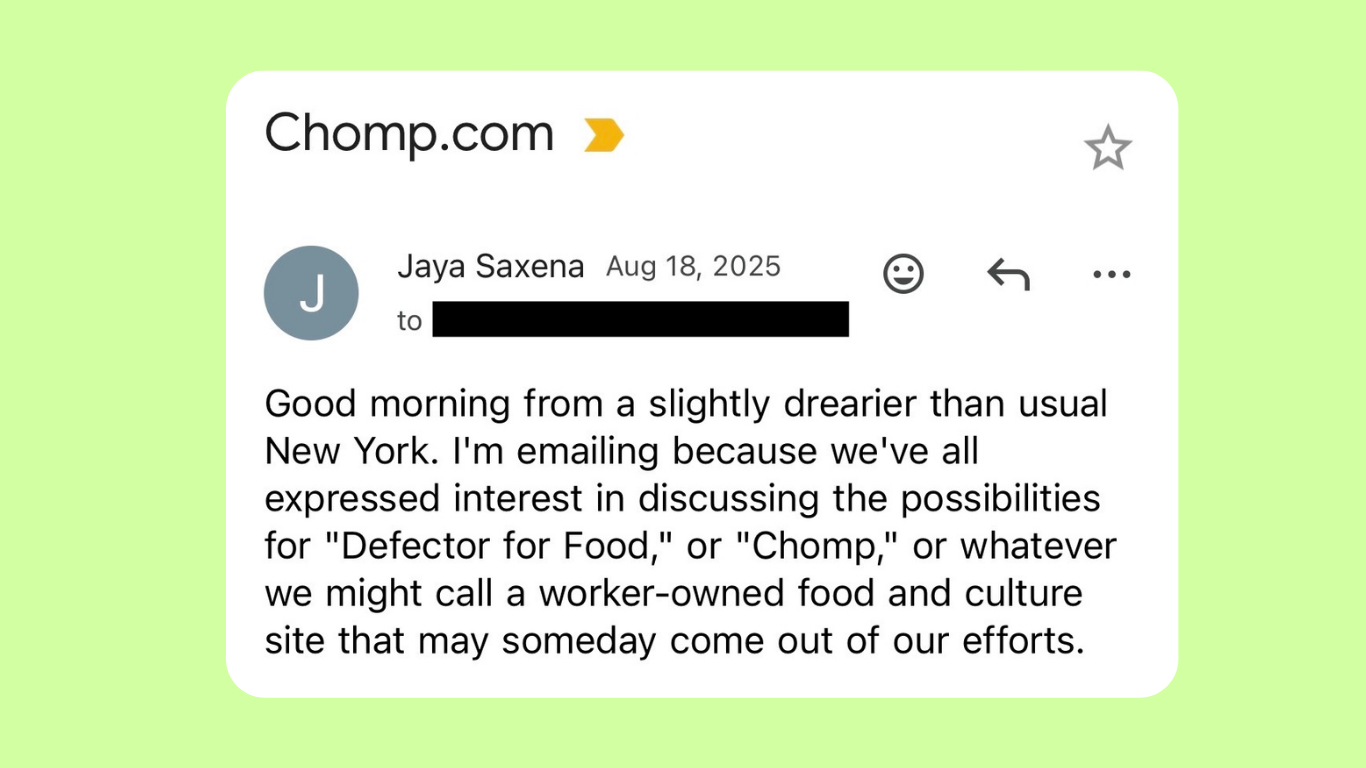
In August 2025, I received an email from Jaya Saxena with the subject line, “Chomp.com,” referring to the fictional food and dining website that appears in the TV show The Bear. In the email, she wrote that several people have discussed starting a worker-owned food and culture site and that we should set up some time to discuss. “Hopefully this is the start of something good,” she ended her message.
Eight months later, here we are, founder-owners of Ravenous. When I first started this journey, I honestly did not know what “worker-owner” meant. Over the months, Jaya introduced me to this almost utopian dream of a media company that gave all workers an equal stake in the company and decision-making power. She pointed to Defector, Hell Gate, Coyote, and many more who’ve been navigating this new path. I thought I was done with working in media. I was burnt out and felt that I had hit a ceiling. But somehow, I was drawn in with this last hope.
Before Ravenous, I worked with Jaya sporadically on a few projects, but I didn’t really *know* her. I knew her as one of the biggest names in food media, nominated for a James Beard Media Award and series editor of “The Best American Food and Travel Writing.” But I’ve gotten to know Jaya over these past few months as more than a writer and editor, but a visionary of what food media can be. For her, building Ravenous was inevitable.
Ravenous is a worker-owned food culture publication founded by five journalists who are tired of toothless food journalism. With more than 30 years of combined experience in the industry, we're all keenly aware of why a place like Ravenous is so needed in this moment: corporate food media is broken, and worker-owned publications are the future. We believe that readers want incisive, well-reported stories — not just AI generated lists and influencer bullshit. To make that work happen, we need our support. Subscribe today to help put the bite back in food media, and we'll give you a little discount for joining us during our subscriber drive.
Frances Dumlao: So what is your favorite story you've ever written?
Jaya: I really do love “The Food That Makes You Gay.” (Editor’s note: She received a James Beard Award nomination for this piece *and* a Writers Guild Award nod — no big deal.) That was such a weird one, and I was so appreciative that my editors trusted me to run with that, because it still feels like an impossible story to explain. Even though I wrote it, people ask me, "What's it about?" And I'm like, "I have no idea." You have to read the whole thing to know what it's about. I felt so grateful to be able to take the time to really explore these weird ideas I had and see if they added up to anything. I also really loved when I got to write this piece about Margaritaville.
I remember that one.
It was fun, obviously, to have an excuse to be paid [by the publication] to go to Margaritaville, and spend my whole day in this really bizarre place. That was another story where I was like, "Send me to Margaritaville, because I'm really interested in this," and I feel there's something here, and I'll figure it out when I get there.
And then once I realized that I could write this story about American work ethic and the idea of leisure and all these intersecting things, I got really excited when I started feeling all this stuff connecting. I love when I write a story, when I start getting that feeling where suddenly it's like, "Wait, wait, everything's starting to make sense. Everything's coming together."
I feel like you're going to incorporate a lot of that work when you're working at Ravenous. So why are you doing Ravenous?
My whole career has been either being employed by traditional media corporations — I've worked for some pretty large ones — or being a freelancer seeking work from these big media corporations. I've been able to do a lot of cool work, but I also definitely see how these other business and money concerns interrupt that work and keep people from being able to do things that connect with readers or being able to tell important stories, because you're so concerned with page views and ad dollars and paying back investors that that takes precedence over doing good journalistic and literary work. We all live in a capitalist society, and on some level, there's no escaping that.
I have been, over the past few years, really excited about watching this worker-owned movement grow in media and seeing what problems it has been able to solve, and things it's been able to improve about the industry. I've just had it in the back of my head that at some point I wanted to try this, and then when I got laid off, it felt really obvious, like "Okay, we have to try. If it doesn't work, we can all get jobs later, but we have to try."
I feel like getting laid off from our previous employer that it was a sign from the universe that this needed to happen. Do you feel that way?
It was a sign from the universe, a real kick in the pants. I fully admit that I was probably too much of a coward — not even a coward, but I had a steady job, a good salary, and I had good benefits. My wife is also a freelancer. I was like, it would be really irresponsible for me to voluntarily separate myself from good health insurance in order to pursue something else. I did not feel that was a choice I could reasonably make. But when the choice was made for me, I remember feeling a lot of relief. I remember feeling like, "Okay, now I don't feel this guilt or like I'm trapped in this place. I can make these decisions that I want to make without anything holding me back." It was really this idea of "I think we have a good idea here, and we should pursue it as far as it'll go."
So, what do you think the future of food media will look like in five years?
We're not the only ones doing this. In food media specifically, there are all these independent and also worker-owned sites and zines popping up. And I think that's so exciting. And I hope that becomes the new guard. Because that makes the industry better and more equitable as a whole. So I think that is really fantastic.
What is one thing you want to see in the food world die?
One thing I would hope dies is, or I guess maybe it's more, makes a reappearance: I want journalistic ethics to be more of a thing in food media. I keep thinking of just how much of food media is driven by undisclosed comp meals or influencers, basically asking for money from restaurants or asking for free meals in direct exchange for coverage. Many food writers’ first relationship is with PR people instead of chefs and workers and the actual restaurants. This has been a problem in food media for a long time. Influencers didn't invent people trying to get meals for free. But I hope that that is something that can continue to come back into food media.
I hope that we could definitely be more transparent.
We've talked about it in our ethics statement. One of the reasons why this happens is because going out to restaurants is expensive. Especially with independent media companies, we do not have the money to pay for all of our meals in an entire month. So I understand why people accept those meals. But, it needs to be disclosed. It should not be the basis of a review or criticism. People need to talk about that, rather than just being, "Wow, I love this place so much." And then you found out it's because they were treated to a $500 dinner.
If you had $20 for a meal in your city, what would you get?
I think the King of Falafel in my neighborhood in Astoria serves the best falafel that I have certainly ever had. But then any friend that I have brought there who is from or been to a country that makes falafel tends to agree. So I feel pretty confident in the strength of the falafel sandwich there. The sandwich or the falafel platter, a side of their hummus or lentil soup, and a soda would probably run about 20 bucks, and that would be money really well spent.
You need to take me there. I want to go, because that sounds wonderful. I also used to live in Astoria like 10 years ago. I'm definitely not in the know of what's cool in New York anymore.
I'll take you to all my places in Astoria and also all of Zohran Mamdani's favorite places to eat. It's so funny with him specifically being the mayor and being from this neighborhood, he has blown up a couple of spots here in a good way. But there's this one cafe called Little Flower, which is one of my favorite places. And when he was campaigning he had this big scavenger hunt that ended at Little Flower. And he's recorded some videos there, and I was just watching this whole campaign, being like, "Good for Little Flower, but I swear to God, if I go there and there's an hour line, I'm going to be so mad. I need to be able to get my cardamom cappuccino and a pastry easily. Please don't ruin this for me." But the last time I was there, it was chill.


