

Last week, I was invited to a press lunch at New York's Santo Taco, a counter service taco spot, for the unveiling of their new tuna tostada, which seemed such an obvious addition that it stopped me in my tracks. I immediately messaged my colleagues: Is it just me, or is the tuna tostada having a moment? I get that it's a silly question, as the fish tostada qua tostada has existed along the coasts of California and Latin America for generations (centuries? eons?). But what I was seeing wasn't just any tuna tostada, but the descendant of a very specific iteration.
Santiago Perez, owner of Santo Taco and a Mexico City native, confirmed that the tostada I am thinking of (slices of raw, sushi-evoking tuna adorned with a spicy aioli and avocado) began at Contramar, a restaurant that mixes "home cooking and coastal cuisine," he says, in Mexico City. It first opened in 1998 and would become a vanguard for the now-trendy Roma Norte neighborhood. In her 2019 book My Mexico City Kitchen, Contramar chef Gabriela Cámara wrote that "no other Mexican restaurants were serving raw tuna back then." It became a hit in Mexico, and a little over a decade ago, Mexico City began a massive tourism push specifically emphasizing the country's culinary offerings as a must-see. Suddenly, it seemed like every American who paid attention to “Best Places to Travel” lists had eaten at Contramar and was eager to find that experience back home. A new generation of Mexico City-inspired restaurants is taking up the challenge.
Santo Taco's version swaps sliced tuna for fat, poke-esque cubes. Denver's Mezcaleria Alma, which calls itself a "love letter to Mexico City," uses fatty toro on a bed of smashed avocado, while New Orleans' Acamaya leans into the Asian fusion by adding peanuts and nori. "It’s hard to believe, given that the tuna tostada has now been copied in restaurants around the world and is sometimes even listed as 'Contramar’s tuna tostada' on other menus!" wrote Cámara. "I’m not complaining. In restaurants, imitation is flattery; I’m glad people like ours enough to want to make their own." Though now Americans don't even have to leave the country for the real thing: Contramar itself just opened a location in Las Vegas, with its signature tostada front and center. —Jaya Saxena

Ravenous is a worker-owned food culture publication founded by five journalists who are tired of toothless food journalism. With more than 30 years of combined experience in the industry, we're all keenly aware of why a place like Ravenous is so needed in this moment: corporate food media is broken, and worker-owned publications are the future. We believe that readers want incisive, well-reported stories — not just AI-generated lists and influencer bullshit. To make that work happen, we need your support. Subscribe today to help put the bite back in food media, and we'll give you a little discount for joining us during our subscriber drive. Plus, you'll have access to exclusive newsletter content.
A Texas Mainstay
The second I saw Jaya’s Slack message about tuna tostadas having a moment, I thought, “But they never went away,” just as Amy McCarthy actually wrote it. That’s true in Texas, where there is inevitably a menu you will find them on. My favorite non-special occasion, eat-it-on-a–random-Tuesday-night tuna tostada can be found at Taco Y Vino, a casual wine bar and Mexico City-inspired taqueria that happily opened a second outpost at the end of last year, about 10 minutes away from me in the little city of Garland, just outside Dallas.
But Jaya is right, this dish came screaming into food culture and onto menus in a big way at the end of the ‘90s, with Mexico City restaurants playing a big role in popularizing the dish. Jimmy Contreras, who owns Taco Y Vino, says he was inspired by a visit to Restaurante Danubio in 2019. In the summer of 2020, he created his own version. “I was sitting by myself in my restaurant, eating all my food, and I wanted a refreshing bite because it was so hot,” he says. Contreras waxes poetic about the tostada’s creamy, fresh Hass avocado, the salty Maggi seasoning that touched every bite, and the crave-worthy aioli that finished it.
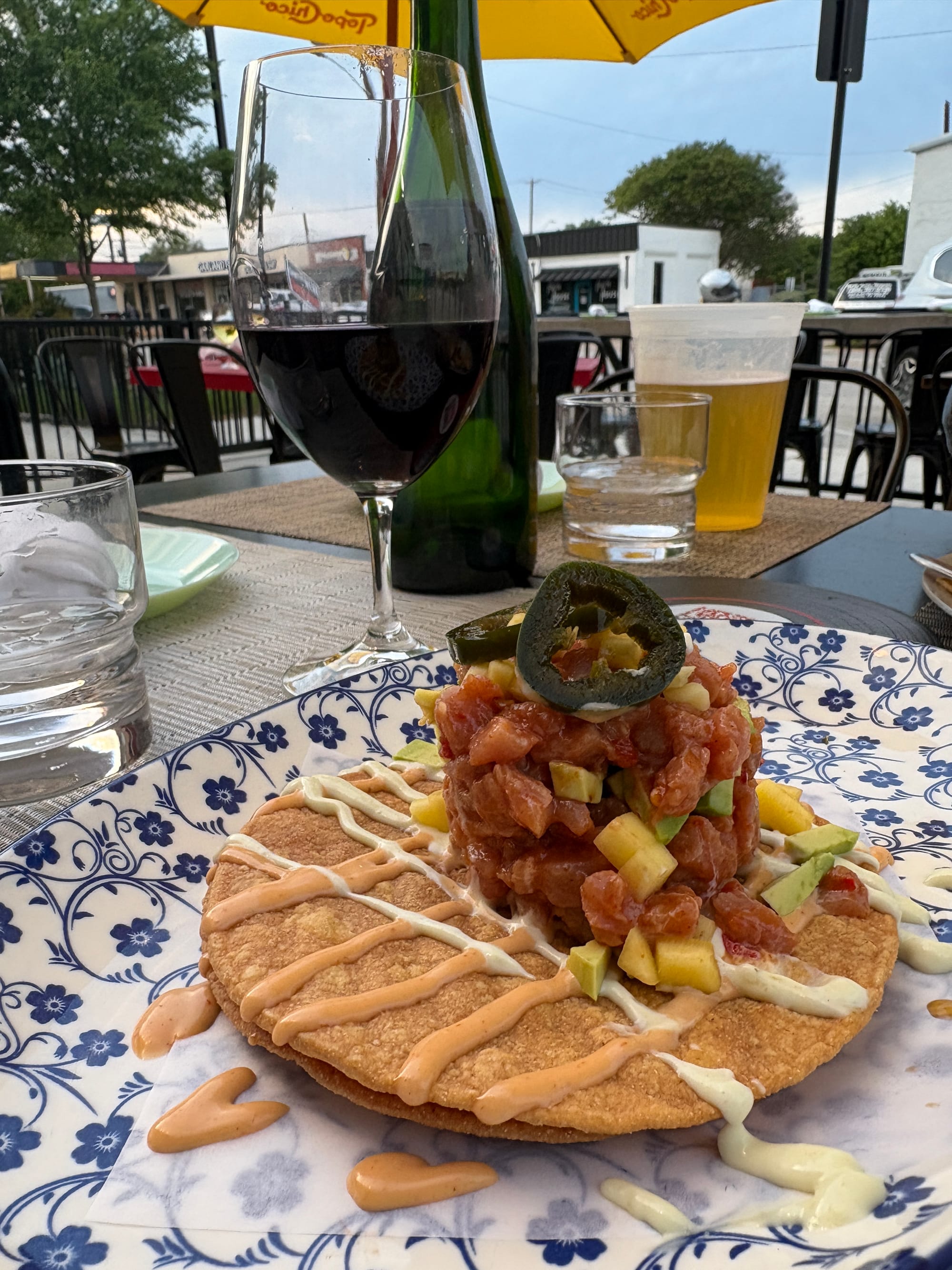
Right now, the biggest challenge to keeping his tuna tostada on the menu is the price of tuna, Contreras says, which may be part of the reason it is returning to fine dining caliber menus and why diners might see it fall off at neighborhood joints or counter service taquerias like the one Jaya mentioned. In Houston, the tuna tostada has become more of a work of art at spots like Mayahuel, which uses pricey bluefin tuna, and Michelin-starred Tatemó, where it is topped with caviar.
For Contreras, keeping his take on the tuna tostada in rotation is a matter of consistency. “I always joke, if we’re going to have something shitty on the menu it has to be shitty every time,” Contreras says. To be clear, this is a top-notch tuna tostada.
Before he debuted the dish on his own menu, Contreras remembers decades back, loving and being inspired by the tuna nachos on the menu at the long-closed Dallas restaurant Victor Tangos, which opened in 2008. James Beard-recognized chef Anastacia Quiñones Pittman was working in the kitchen and had to double-check to confirm she created the dish. She remembers making “at least a million of them” nearly 20 years ago. “I don’t remember them being popular on menus [then],” she says. “They were definitely popular at VT’s.”
“There is an ebb and flow to seafood in Mexican food,” Contreras says. “Texas is very land-oriented, so it’s not always thought of.” Which is true. There will never be a day when I am unable to find an asada or barbacoa-loaded tostada, taco, quesadilla — whatever I want. Tuna tostadas are not exactly in short supply, but also not always everywhere. —Courtney E. Smith
Evolved Takes in Chicago
Respectfully, tuna tostadas have long found a niche in Chicago, which, through the years, has welcomed an abundance of mariscos restaurants — favorites include El Barco Mariscos and Mariscos La Costa. The Midwest loves its cured meats and pickled veggies: Why wouldn’t that philosophy extend to seafood? Nevertheless, a turning point may have arrived in 2022 when the owners of Chicago’s venerable Publican opened a seafood-centric spinoff of their popular taqueria. The restaurant struggled, and Big Star Mariscos closed two years later. However, in 2023, Diego — a dive bar with great food — opened a few blocks away, and its tuna tostada quickly became an Instagram favorite, serving up an antidote to Chicago’s winters with a refreshing balance of acidity, sweetness, and quality yellowfin.
The dish was so successful that chef Stephen Sandoval brought a tostada with him to his upscale steakhouse, Triño, where a fried tortilla is topped with dollops of crab turned green thanks to pistachio. Ever eyeful of trends, the owners of Mariscos San Pedro — the flagship restaurant inside the Thalia Hall concert venue — opened their restaurant in 2024 with a black garlic-laced tuna tostada, designed as something concertgoers could quickly chomp on before a show. The stampede continued later that year with Mirra, which combines Indian and Mexican flavors. Its chefs plate their tostadas over crunchy papadum, the fried Indian wafer often made with rice flour.
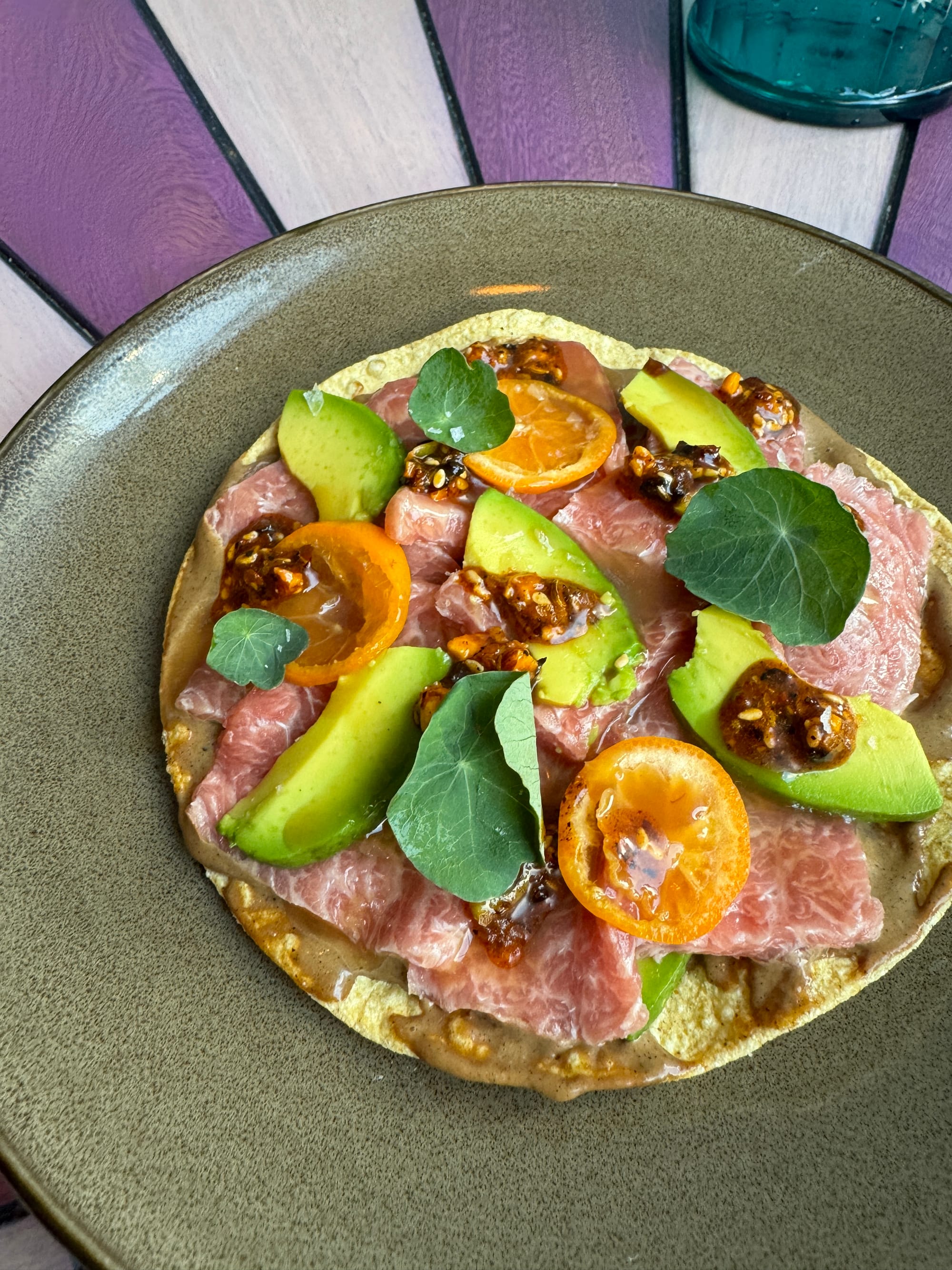
For Chicagoans, a tuna tostada is an escape, much like the intention of the original tiki bars, which opened in the 1930s. Paired with a cold lager, locals can imagine crashing ocean waves that insulate urban dwellers from polar vortices and other frosty maladies. Esteemed chef Rick Bayless tells me that he doesn’t think tuna tostadas ever go out of style. At his Bar Sótano, they serve a tostada sibling, a tlayudita with truffle-seasoned Hawaiian bigeye tuna: “Tuna tostadas will never go out of style — it’s so great — but it will evolve!” says Bayless. — Ashok Selvam
Monday, April 27, 2026: The spelling of Jimmy Contreras's name has been corrected.


