

When I saw that Evan LeRoy, one half of the famed LeRoy and Lewis Barbecue in Austin, Texas, and Paula Forbes, the noted cookbook author and restaurant critic for Texas Monthly, were dropping a cookbook about the new school of Texas barbecue, I couldn’t wait to get my hands on New School Barbecue: Recipes for Next-Level Smoking and Grilling. LeRoy’s establishment was among the first barbecue places to earn a star during Michelin’s inaugural Texas ceremony in 2024. Frankly, the entire state is still trying to figure out what that means.
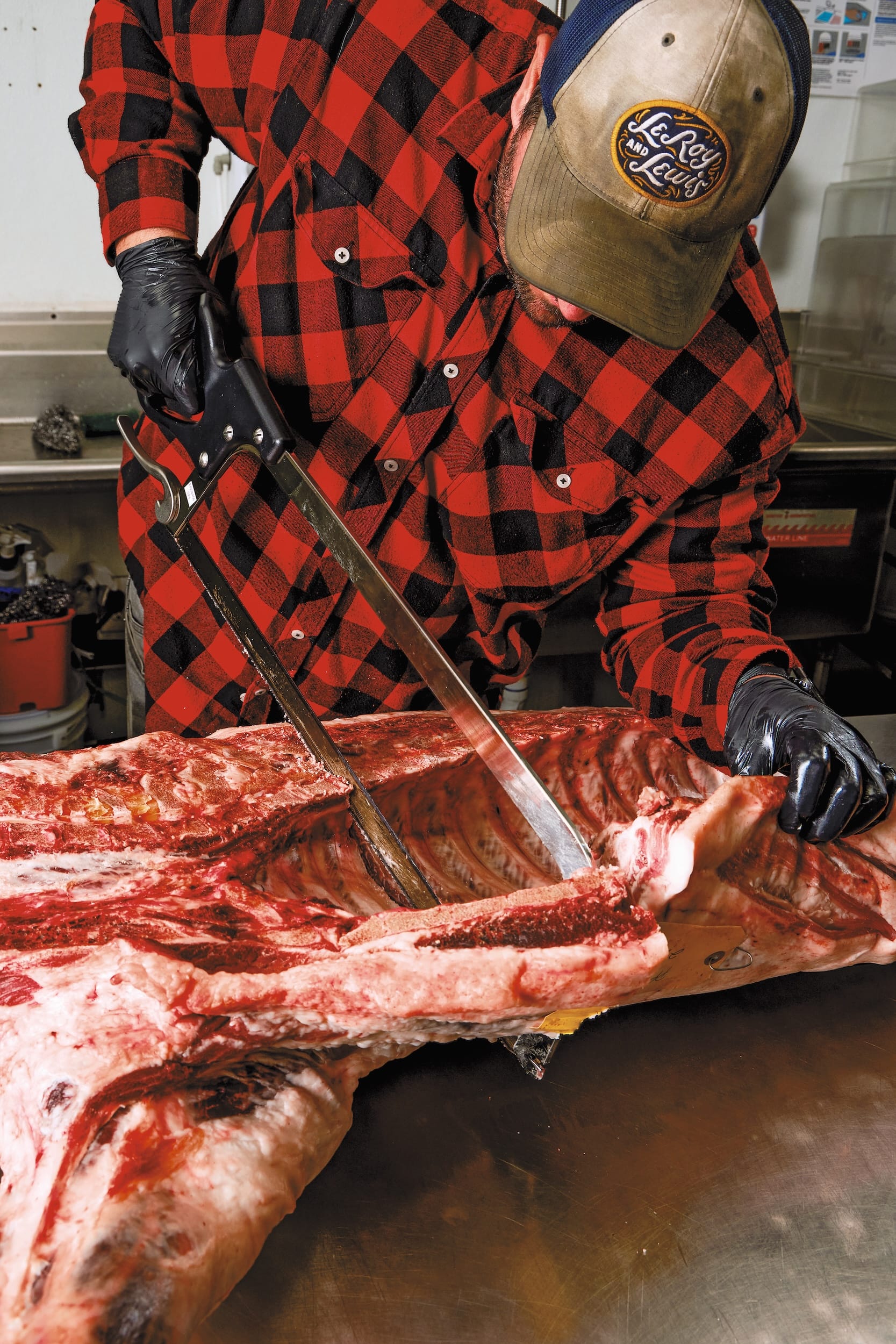
There are a few things that are unlike the rest in this cookbook, and its commitment to featuring the farmers and ranchers who raise the food used in it is at the top of the heap. LeRoy and Lewis sources its products locally, and, on opening, part of the mission was to figure out how to run a barbecue joint doing that. That mission led to learning how to butcher a whole animal, and the cookbook includes guides to do that, too. It sounds daunting, and it is (you don’t have to do it), but it’s also a way to showcase what the work of making a plate of barbecue really looks like.
I spoke to both about LeRoy's decade-plus career pushing the limits of barbecue, what Forbes had to do to test so many barbecue recipes, and why there are so many delectable beets in this book.
Ravenous: What is new-school Texas barbecue?
Evan LeRoy: New-school barbecue, as we define it at LeRoy and Lewis, is rooted in sourcing. We make sure we get all the meats we serve in Texas. We also try to keep one foot firmly planted in the traditional cooking methods of Texas barbecue, but mix it up with a global influence of flavors and cooking techniques. We are taking that framework of barbecue using native Texas wood, offset, and direct-heat pits, with scoopable picnic sides — those are the rules. We can smoke any type of meat or vegetable, and serve different types of sides that aren’t traditional.
It feels like there was a moment when we entered a modern barbecue era. Many people attribute that to Aaron Franklin and his methods. Others think it was when pitmasters started integrating influences from around the world. What do you think?
EL: The opening of Franklin Barbecue [in December 2009] was probably a tipping of the scales moment. There was a lot of interest in barbecue before that, and barbecue food TV shows. We’ve seen leaps and bounds in the cuisine since then.
Paula Forbes: I agree that Aaron Franklin was a turning point, but I also think he went so hard on the return to tradition — his barbecue is very traditional, using the “old ways.” Since then, people have started letting themselves not be so beholden to the old-school classic style of Texas barbecue. We’ve seen a lot of international influences. Evan is taking that to the next level at LeRoy and Lewis, and in this cookbook, in terms of technique and evolving what types of barbecue there are.
Do you think some of the interest comes from Texas barbecue leaving Texas? I was living in New York City when Evan was at Hill Country Barbecue Market in the 2010s, and I went because it was the only actual Texas barbecue available (Editor’s note: Were you aware that Courtney is from Texas?). And the only place to get Shiner beer at the time.
EL: Yes, absolutely. Texas barbecue is the primary style that has gained influence throughout the entire country and the world. It means a lot to me as a Texan. At that time, when I was working at Hill Country, and it was gaining popularity, we were introducing New York diners to what Texas barbecue was, and it was exciting. I was explaining what a brisket was, what a pound of it was, and that they didn’t have to order a whole pound to have barbecue. I felt like a barbecue ambassador at the time, and I still feel that way, especially when we’re traveling. That’s what the cookbook and my idea of trying to teach people about new-school barbecue and get them on our side is about. Showing people how good it can be, how different it can be, and how interesting it is.
I saw some fun learning curves happening in real time as people ordered there. [laughs] You are also one of the first barbecue spots to earn a Michelin star. I’ve been trying to figure out what a Michelin star for barbecue means. Do you have any idea?
EL: If I were to say that it’s mostly for chef-driven, out-there places, that is contradicted by the inclusion of a place like Corkscrew BBQ [in Spring, Texas, outside of Houston]. I’m not exactly sure what the criteria are. We are just trying to be the best barbecue restaurant we can every day, and I think that’s what it comes down to. I guess we got lucky?
I don’t think you got lucky. I’m just wondering if other people who really know about this see a through-line that I’m missing in the selections.
PF: If we all knew what Michelin was looking for, we’d be making a lot more money. [everyone laughs] My question about this is, I’m curious how much they trained the inspectors about barbecue. Or did they just build the plane while flying it by eating around? Your average person just thinks that barbecue is good. It is very difficult to be as knowledgeable as you can be about it and say definitively that this is a good barbecue place and this is a great barbecue place. But I like their picks.
This cookbook has a lot of history, a glossary, and a lot of context added. It feels like you want to bring people in at a lot of levels for barbecue: ground-up, interested in it as hobbyists, and professionals. Tell me about the decision to go in that direction?
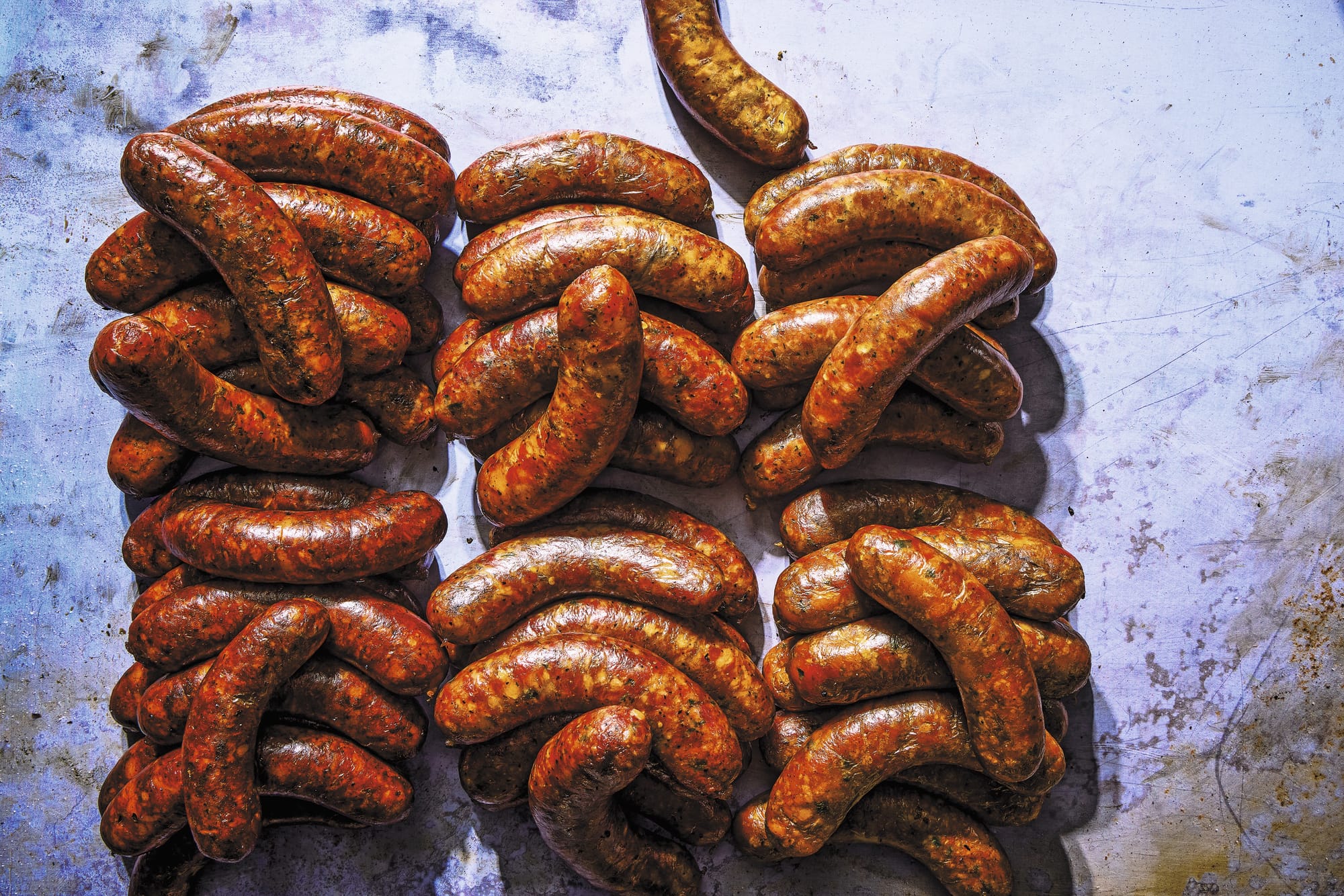
PF: Just because you know how to barbecue, that doesn’t mean you’re familiar with Texas barbecue (Editor’s note: Forbes is from Madison, Wisconsin, and based in Austin). We wanted to make sure the context was there. There are some very difficult recipes in this book. There’s a whole sausage-making chapter that might be intimidating. We wanted to give them footholds and bring them along. From a cookbook perspective, that is one of the most complicated parts of the book. We really worked hard on it, because it is how Evan cooks at the restaurant. He calls it a formula, but it is percentages of ingredients based on the weight of the meat you have, and with that, you can make any flavor of sausage that you want. The goal was to unlock that door for people so they can make seasonal sausages and have fun with the flavors.
People may be surprised to see that brisket gets just a normal amount of attention in this book, and doesn’t dominate the meat conversation. Where does brisket stand in the conversation about the new school of barbecue?
EL: We did want to devote the appropriate amount of attention to brisket because we have a unique method of wrapping and preparing it, and seasoning it. Almost everybody in Texas, when you’re thinking of backyard barbecues, is putting multiple layers of seasonings and using complicated rubs. Our recipe is the antithesis of that; it’s just salt and paper, and oak wood smoke. We wrap it in a way that highlights the textures. We keep the fat cap uncovered so it gets crispy, and keep the lean part sitting in just enough of its own juices to stay moist, and that gives us a different, layered texture. As far as all the other meats go, when I was starting in barbecue and developing this new-school idea, I asked myself the same question. I was reading a lot of rhetoric, discussion, and writing around barbecue. And I wondered, “Can we stop talking about brisket? Can we stop talking about the ribs?” Every single article I read was the same. “The brisket had a sturdy bark. The ribs were hammy and chewy. The potato salad was cool, and the pickles were tangy.” I was like, but what else can they do, besides cook brisket and ribs? That was why we wanted to devote so much time to the other cuts in the book and the new-school barbecue.
Cooking some barbecue is hard to do at home and requires special equipment. When you were testing this, Paula, how prepared were you?
PF: I’ve written several cookbooks, and I think all of them have had barbecue in them, but this was the first one with this much barbecue. [laughs] When Evan and I started this book, I was wrapping one up with Steve McHugh, who is a chef in San Antonio. He asked how I was going to test the recipes, and I said I didn’t know because it was going to be summer and I’d be out in the heat, managing all these lots. He suggested I get a pellet smoker. I said, “I can’t do that, it’s cheating.” And he insisted I should, because the recipes need consistency. That’s how I did it, on a Traeger pellet smoker. I truly think the recipes are better for it. Test to test, I could guarantee it would be the same. There are all these factors on barbecue when you use an offset, like the type of wood you can get a hold of, or the weather. This evened the playing field so that I could make sure I was getting the same results.
Was it more demanding than the average cookbook because of the long cook times on meat?
PF: Some of the recipes. Brisket, obviously, was a big one, and the beef cheeks. The sausages, too. But I could control my pellet smoker from my phone. So I’d be at my desk, typing away, and be able to check in on the brisket.
There’s also a smoked duck recipe, and I have noticed it popping up more and more in Texas barbecue. Where is that coming from?
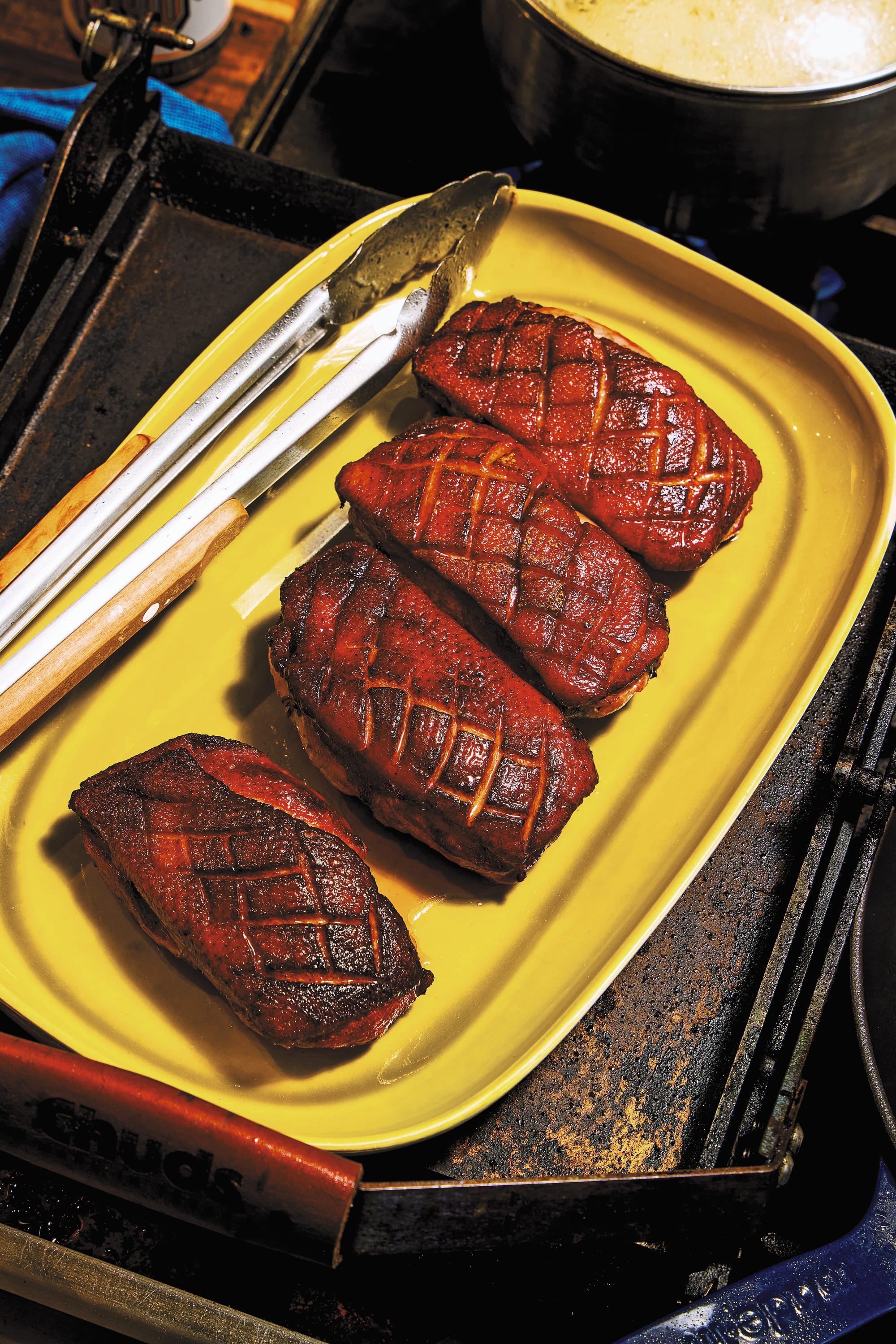
EL: Those duck recipes were inspired by a rancher named Sebastian, who gave us enormous ducks when we were still in the food truck. We felt like the luckiest people in the world to be able to get our hands on them. We had a big party called Duck Wild, where we served the smoked duck breast, duck confit, foie gras on brisket, and the duck rice recipe in the book. We wanted to celebrate how good his meat was. I’ve started to see it on a lot more menus. Parish Barbecue in Austin has one here with some orange flavors and crispy skin. I just like seeing different meats on menus and when people mix it up. You’re also seeing lamb on more menus, not just at places like Austin’s KG BBQ; Interstellar BBQ is also serving it.
PF: With both duck and lamb, those were meats people defaulted to disliking for a long time, whether or not they had actually had them prepared properly. With my restaurant critic hat on, I’m seeing more of both at restaurants in general. It does not surprise me that it is popping up more in barbecue, too.
Vegetables as mains make up a whole section of the book, and I understand that was inspired by a conversation between the two of you?
EL: Yeah, years ago, when Twitter was still Twitter, I saw a Tweet from Paula that asked, “Why don’t any barbecue places specialize in smoking vegetables?” And I thought, you know what — our food truck was brand new at that point, and I decided we were going to do it. The whole roasted cauliflower was really popular at that point. People were doing cauliflower steaks and whole heads; that was a no-brainer for us. We smoked it, and smoked it again like you do burnt ends, and got it all roasted and charred. We put a nice sauce on it. It came together super quickly, and I can’t replicate how easily it happened again. So Paula was the inspiration for our cauliflower burnt ends, which are one of our most popular dishes.
PF: I didn’t know that until we were working on this book. [both laugh] We were working on the proposal, and Evan sent me five recipes. I read that and was like, “Wait, is this true?” That recipe is amazing. People love it, meat-eaters love it. It’s really cheap, because cauliflower is not expensive.
EL: Just cauliflower and barbecue sauce.
Speaking of barbecue sauce, let’s talk about the big role that beets play in the book — way more than any other I’ve ever seen. How did it become an ingredient you use in barbecue sauce?
EL: Beet barbecue sauce is our main sauce at LeRoy and Lewis. We had a few different sauces, but all of them were missing something. There was a sweet one, a tangy one, and a spicy one. I ended up putting them all together, and it was more balanced but still missing something — a bit of earthiness and bright color. I wanted to bring over a smoked beet with goat cheese dish from the restaurant I was at previously, Freedmen’s, that was really good. We decided to juice some beets and add them to the barbecue sauce. It added exactly the taste and color we were thinking about. Now, we use a beet powder that still gives us all of that.
The beet red velvet brownie was part of a promotion we did weeks ago called “Sweet Week.” We do “Heat Week” in the summertime, where we serve five spicy dishes, one each day, and if you come and eat all five each day, you get something free. We did it in the wintertime with desserts, and that forced us to think outside the box and do some different desserts. When I learned that red velvet was just red food coloring, I felt kind of robbed. This recipe tries to put some purpose behind the color. It’s a fun recipe that makes a beautiful little brownie.
Then we also have pastrami beets, which is another smoked vegetable dish in the book. It’s kind of like the foil treatment for beef cheeks, because they’re close to the same size. They’re roasted and then put in a brine with all the flavors of pastrami but no pig. They’re pickled, then we put a rub on them and smoke them. They have that nice pastrami color in them. I just love beets. They’re super versatile.
Lately, in the last year or so, what have you seen in barbecue that you’re excited about?
EL: I’m most excited about seeing even more international takes on barbecue. In Texas, you expect to see a Mexican take on barbecue, and even a Cajun take. But with something like KG [in Austin], which has an Egyptian take on it — I’d never even seen a person from Egypt, growing up in Austin, Texas. It’s awesome to have that culture and influence here. You’ve got Kafi BBQ in Dallas, where he’s doing incredible stuff, and there is so much wagyu beef. And there’s Blood Brothers in Houston, with a ton of Asian influence. Seeing these combinations you don’t think of every day in Texas has me excited.
Evan didn’t mention Smoke & Ash in Arlington, which does Ethiopian and barbecue, so Paula, you can talk about them.
PF: I do love Smoke & Ash. I’m starting to see barbecue influence pop up in fine dining, too, with people using more smoke flavors. One of my best new restaurants in Texas Monthly this past year is a place called BonFire in Paris, Texas. They do French food, but all with fire, so it has that smoky barbecue flavor to bring Texas to French food. I think it’s a two-way street; it’s not just barbecue taking inspiration from other cuisines but also other cuisines taking inspiration from barbecue.
This interview has been edited and condensed for length and clarity.


